
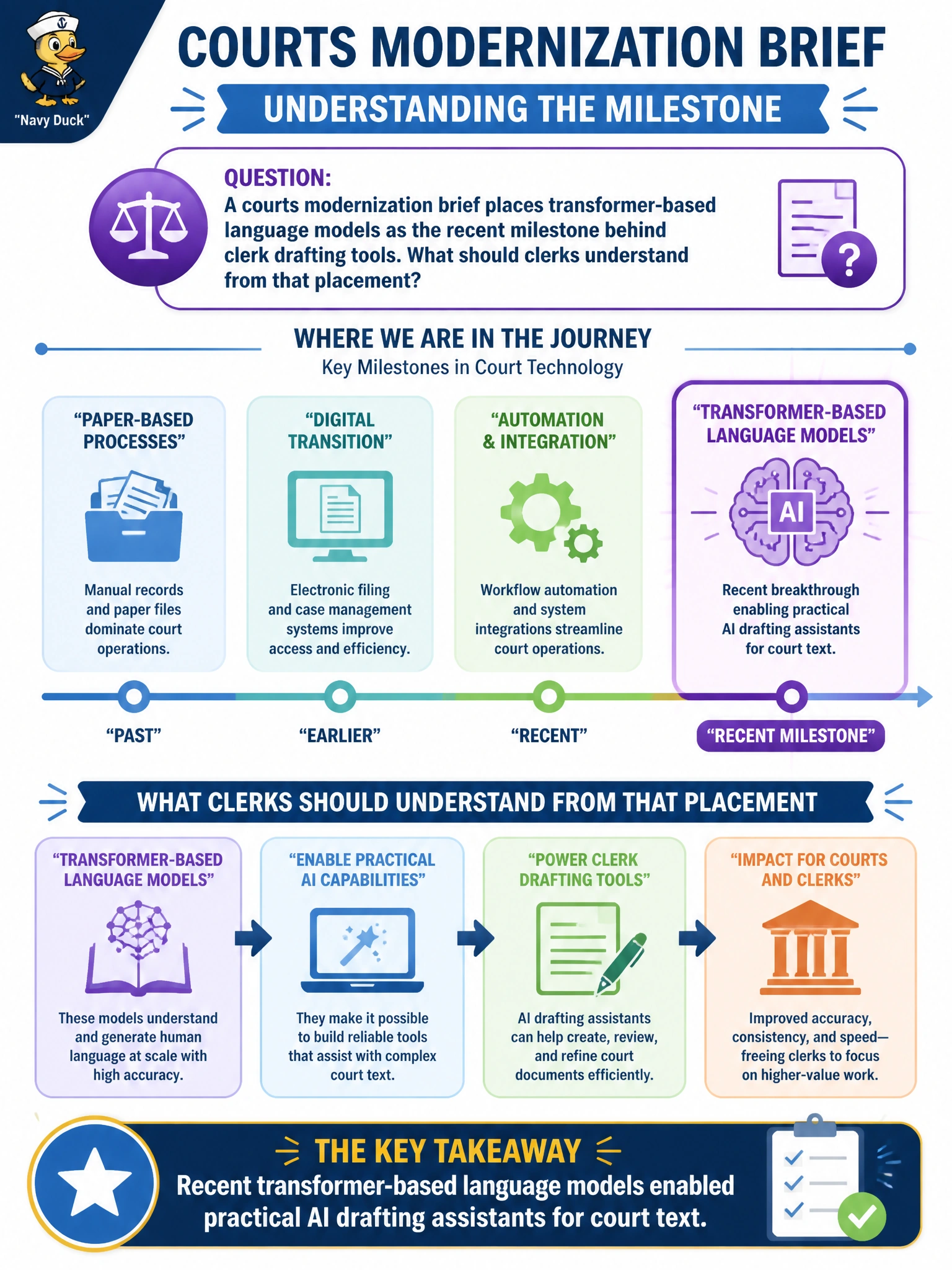
A courts modernization brief places transformer-based language models as the recent milestone behind clerk drafting tools. What should clerks understand from that placement?
Select an answer to reveal the explanation.
Short Explanation
Those clerk drafting helpers didn’t appear out of thin air—they rode in on transformer language models that can draft and rewrite text. The modernization brief is pinning the tool to that recent milestone. Know the milestone, and the new assistant makes a lot more sense.
Full Explanation
Placing transformer-based language models as the recent milestone behind clerk drafting tools correctly teaches courts modernization staff that practical AI writing assistants for dockets, notices, and routine correspondence became viable after transformers improved contextual language generation and summarization. Clerks should understand that today’s drafting helpers are enabled by that model class—not by typewriters or inventory systems—and that the milestone explains why text assistants appear in court modernization briefs now rather than decades earlier. Saying recent transformer-based language models enabled practical autonomous opinion drafting for court text overstates the milestone, since transformers enabled assistive draft generation for routine text, not autonomous judicial reasoning and issuance of opinions without a judge's review, while transformers matter because they enabled fluent draft generation for drafting assistants. Claiming recent transformer-based language models enabled practical verified citation drafting for court text confuses fluency with verification, since transformers can generate citation-looking text but frequently hallucinate sources that still require human checking against approved authorities, while transformers matter because they enabled contextual drafting assistance. Asserting recent transformer-based language models enabled practical tamper-evident archiving for court text misplaces the milestone in the wrong workflow, since tamper-evident archiving depends on hashing, access controls, and audit logging rather than language generation, while transformers matter because they enabled adaptive probabilistic paragraph drafting. Exam caveat: milestone questions usually ask which technology made a civic workflow assistant practical; choose the link between transformers and drafting help, not absurdist denials or furniture metaphors. Operational check: when clerks adopt drafting assistants, require human review of pleadings and notices, ground outputs on approved templates where possible, log model use for audit, and brief leadership that ‘transformer-enabled’ means capability readiness—not unsupervised filing of AI-written court documents.
Prefer to study offline? Printable PDF study book + test engine ($7.50, unofficial). These questions stay free here.