
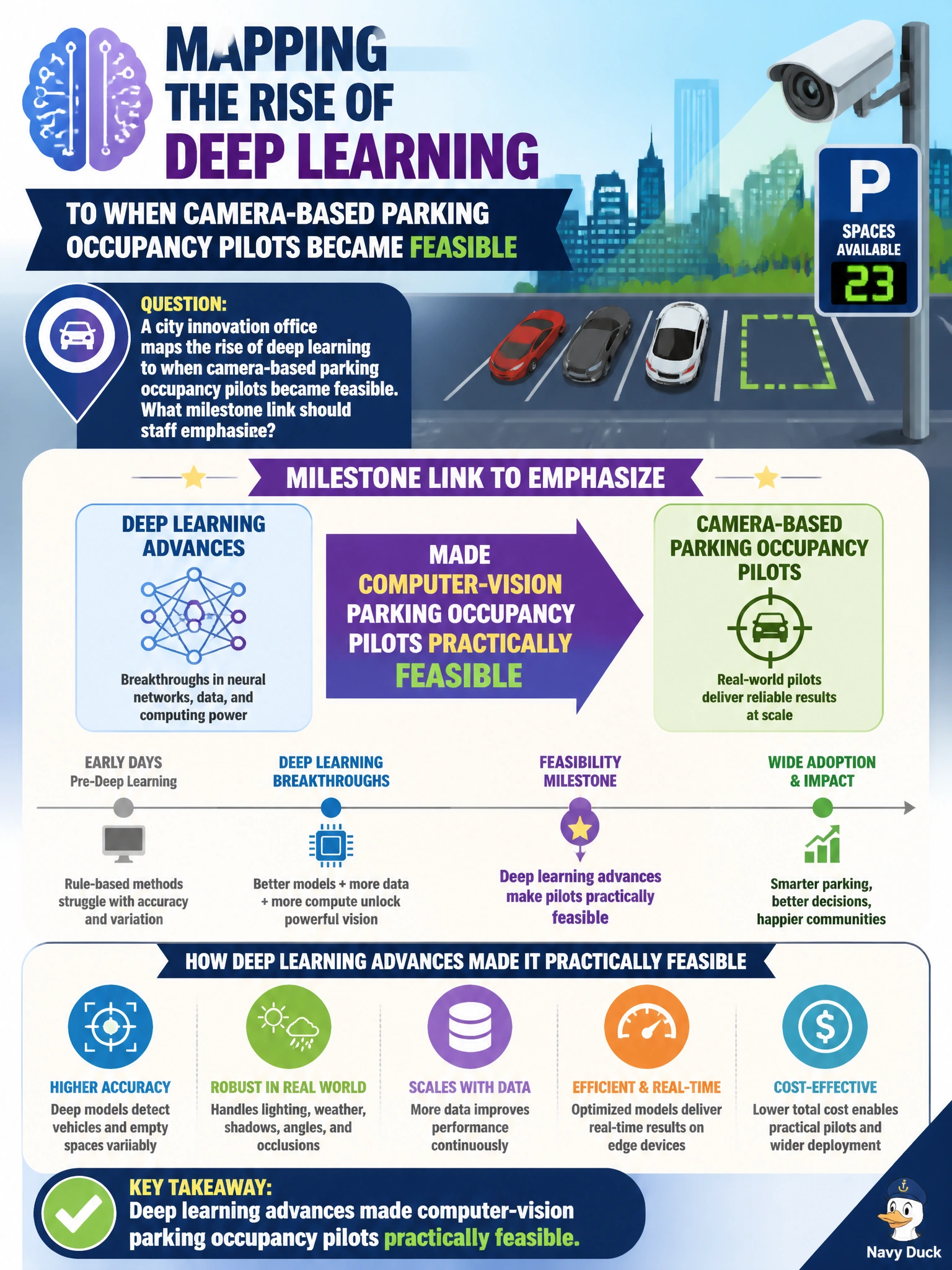
A city innovation office maps the rise of deep learning to when camera-based parking occupancy pilots became feasible. What milestone link should staff emphasize?
Select an answer to reveal the explanation.
Short Explanation
Think of old cameras that mostly recorded blobs versus today’s models that can tell “spot empty” from “spot taken.” Deep learning is what made those parking pilots stop being science fair and start being city trials. That’s the milestone the innovation office is drawing.
Full Explanation
Deep learning’s breakthroughs in hierarchical feature learning are what made camera-based parking occupancy pilots operationally realistic for a city innovation office. Modern convolutional and related vision models can distinguish occupied versus empty stalls under variable lighting, angles, and weather far better than earlier rule-based blob detectors, so municipalities can pilot curb and lot utilization without staffing every camera feed with a human counter. Emphasizing that milestone link keeps strategy conversations honest: the feasibility of civic computer-vision parking work rose with the broad maturity of deep learning, not specifically with transfer learning advances. Claiming transfer learning advances made computer-vision parking occupancy pilots practically feasible confuses reusing pretrained features for data efficiency with the underlying supervised vision capability that made occupancy estimation reliable enough to pilot. Claiming federated learning advances made computer-vision parking occupancy pilots practically feasible confuses decentralized privacy-preserving training with capability readiness—federated learning keeps data local while training a shared model but did not create the hierarchical feature learning that lets cameras distinguish occupied versus empty stalls under glare, shadows, and rain. Treating few-shot learning advances as having made computer-vision parking occupancy pilots practically feasible mistakes a specialized data-efficiency technique for the core breakthrough—pilot feasibility came from vision models that classify stall images, while few-shot advances aimed at learning from a handful of examples and not the specific capability that made occupancy pilots operationally realistic. Exam caveat: exam items often pair a technology milestone with a municipal use case; the correct answer connects capability readiness to a practical civic pilot rather than inventing bans, transfer-learning feasibility myths, federated-learning feasibility claims, or few-shot-learning feasibility claims. Operational check: when briefing leadership, cite the vision capability that made occupancy estimation reliable enough for a governed pilot, note privacy and retention controls on curb cameras, and separate ‘pilot feasibility’ from ‘citywide deployment readiness’ so staff do not overclaim what deep learning currently delivers on municipal parking assets.
Prefer to study offline? Printable PDF study book + test engine ($7.50, unofficial). These questions stay free here.