
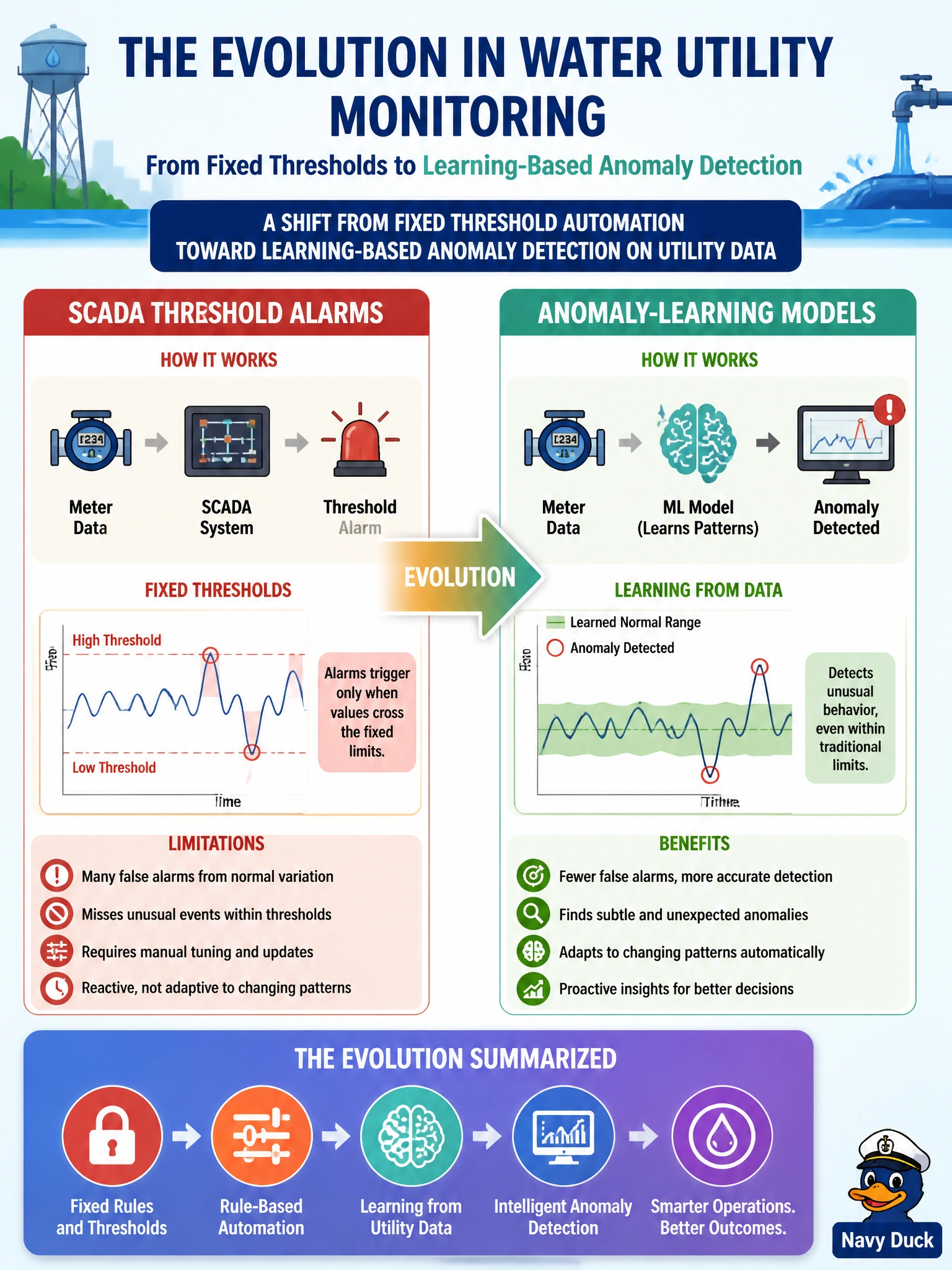
A water utility contrasts SCADA threshold alarms with later anomaly-learning models on meter streams. What evolution is being illustrated?
Select an answer to reveal the explanation.
Short Explanation
Old-school SCADA yelled when a number crossed a hard line you set by hand. Newer models learn what “weird” looks like in the meter stream. That jump from fixed thresholds to learning-based detection is the evolution the utility is teaching.
Full Explanation
Contrasting SCADA threshold alarms with later anomaly-learning models on meter streams illustrates a clear evolution in water-utility automation: from fixed, engineer-set limits that fire when a tag crosses a hardcoded band toward models that learn normal multivariate patterns in meter and sensor streams and flag deviations that thresholds alone would miss. That literacy point helps operators understand why utilities layer learning-based detection atop (not instead of) foundational SCADA monitoring for leak, demand, and quality anomalies. Treating this contrast as a shift from dynamic threshold adaptation toward learning-based anomaly detection on utility data is wrong because the earlier stage is fixed threshold automation with SCADA alarms on meter streams, not thresholds that already adapt dynamically, even though the anomaly-detection endpoint is correct. Treating this contrast as a shift from predictive threshold modeling toward learning-based anomaly detection on utility data is wrong because the comparison starts from automated fixed thresholds firing on telemetry, not from predictive modeling of thresholds, even though the learning-based anomaly detection endpoint is correct. Treating this contrast as a shift from multivariate threshold logic toward learning-based anomaly detection on utility data is wrong because the starting point is static single-tag engineer-set threshold alarms, not multivariate threshold logic, even though the later anomaly-detection stage is correct. Exam caveat: evolution items reward recognizing a shift from static rule/threshold automation toward learning-based anomaly detection on utility telemetry, not mistaking the starting point for dynamic threshold adaptation or predictive threshold modeling, nor for multivariate threshold logic. Operational check: keep calibrated SCADA thresholds for hard safety bounds, pilot anomaly models on meter streams with operator feedback loops, investigate false positives against known maintenance events, and document that learning detection supplements—not replaces—operator judgment and regulatory sampling requirements.
Prefer to study offline? Printable PDF study book + test engine ($7.50, unofficial). These questions stay free here.