
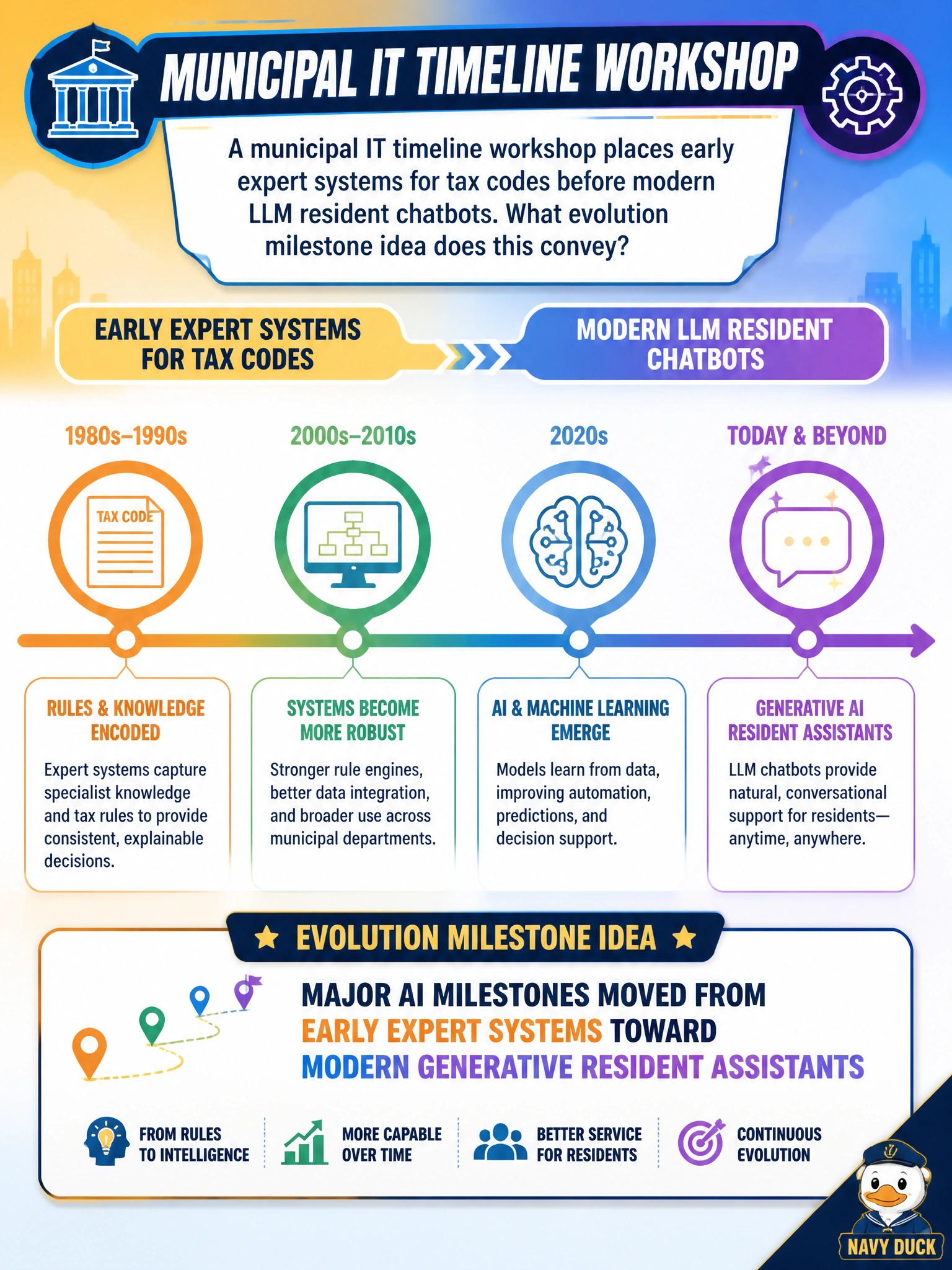
A municipal IT timeline workshop places early expert systems for tax codes before modern LLM resident chatbots. What evolution milestone idea does this convey?
Select an answer to reveal the explanation.
Short Explanation
First came the stiff rule engines that knew the tax code like a flowchart; later came the chatty generative bots residents poke for hours. You’ll see expert systems first, then LLMs—not rule-based, template-based, or symbolic bots at the modern end. History keeps the hype honest.
Full Explanation
Placing early expert systems for tax codes before modern LLM resident chatbots conveys that major AI milestones moved from early expert systems toward modern generative resident assistants. Expert systems encoded specialist rules—if income schedule X and exemption Y, then compute Z—and were among the first widely discussed AI deployments in administrative domains. Generative LLM chatbots that answer resident questions in natural language are a later milestone, dependent on large-scale learning and different technical paradigms. The municipal timeline workshop uses familiar city-hall examples so staff internalize chronology: rules-heavy expert systems precede today’s generative assistants.
Claiming major AI milestones moved from early expert systems toward modern rule-based resident assistants mislabels the modern endpoint, which is generative LLM assistants, not rule-based systems. Saying major AI milestones moved from early expert systems toward modern template-based resident assistants mislabels the modern endpoint, because today’s resident chatbots are generative LLMs, not fixed template scripts. Saying major AI milestones moved from early expert systems toward modern symbolic reasoning resident assistants mislabels the modern endpoint, because symbolic reasoning is rules-and-logic based like the early expert systems, while the later milestone is generative assistants.
Exam caveat: chronology questions reward ‘expert systems → modern generative/LLM assistants,’ not detailed dates. Distractors keep the expert-systems start but mislabel the modern endpoint as rule-based, template-based, or symbolic rather than generative.
Operational check: when briefing non-technical leaders, use a simple milestone slide from rule-based expert systems to statistical ML to generative assistants, map current city tools onto that timeline, and avoid implying that adopting an LLM replaces the need for encoded policy rules in tax and benefits engines.
Prefer to study offline? Printable PDF study book + test engine ($7.50, unofficial). These questions stay free here.