
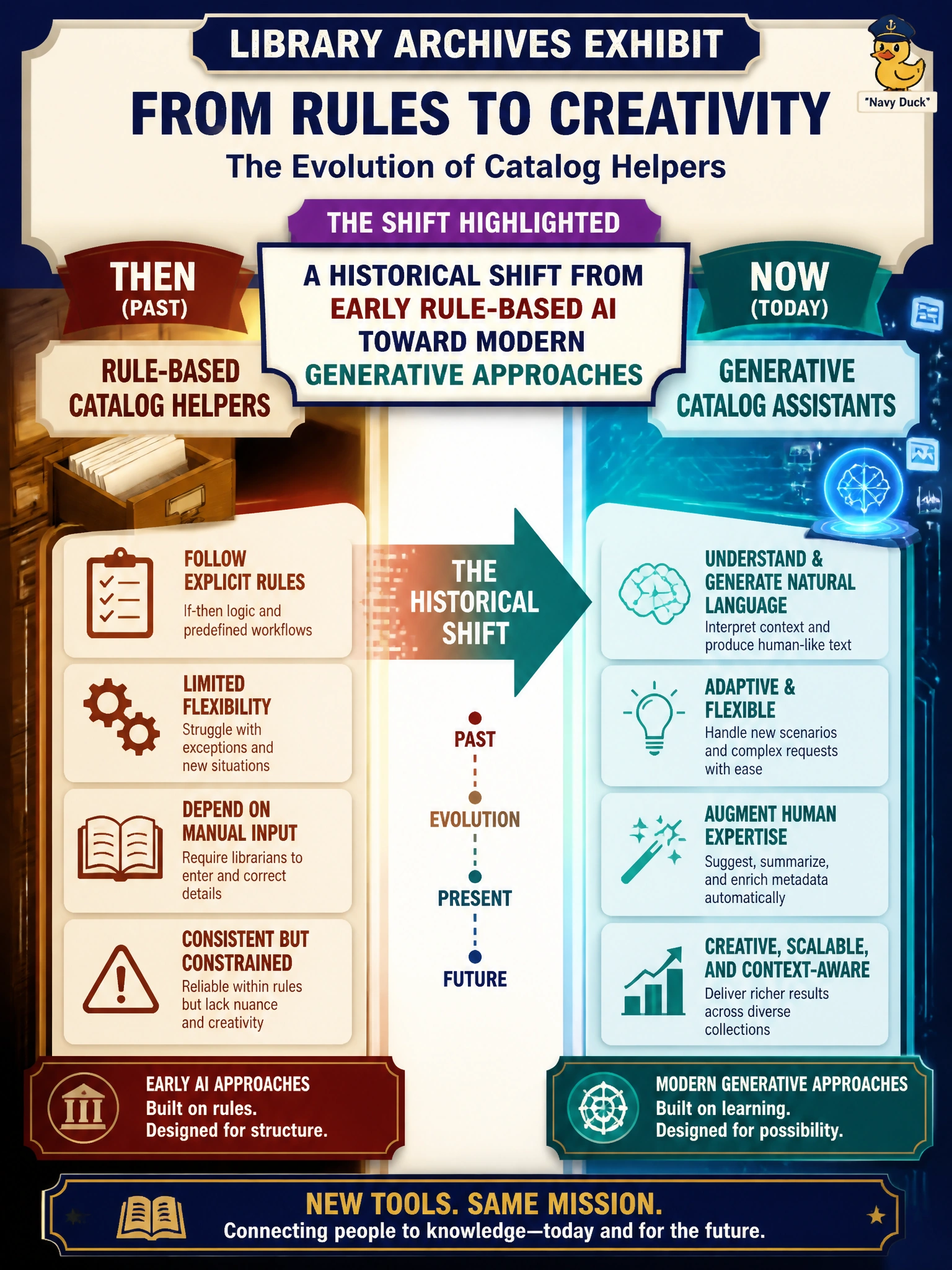
A library archives exhibit contrasts rule-based catalog helpers of the past with today’s generative catalog assistants. What shift is the exhibit highlighting?
Select an answer to reveal the explanation.
Short Explanation
Old helpers followed hard-coded “if subject equals X, suggest Y” rails; new ones draft natural-language answers from patterns. The exhibit is the baton pass from rules to generation. Libraries lived through that shift.
Full Explanation
The archives exhibit highlights a historical shift from early rule-based AI toward modern generative approaches. Earlier catalog helpers typically followed explicit rules: if subject heading equals a value, suggest a narrow set of titles or cross-references. Modern generative catalog assistants draft natural-language answers, summaries, or reading guidance from learned patterns over large corpora. Both can coexist in a library stack, but the exhibit’s pedagogical point is the directional shift in how ‘AI help’ has been built—from brittle, transparent rules toward generative systems that produce fluent novel text. Public institutions lived through that evolution in discovery tools just as industry did. A historical shift from early rule-based AI toward modern generative ontologies mislabels the modern endpoint, because ontologies are structured vocabularies and formal concept relationships for organizing knowledge, not generative assistants that draft fluent novel text, so it misses the exhibit’s contrast between rule-based logic and generative output. A historical shift from early rule-based AI toward modern generative classifiers mislabels the modern endpoint, because classifiers assign predefined labels or categories to inputs, not generative assistants that draft fluent novel text, so it does not capture what the exhibit is highlighting. A historical shift from early rule-based AI toward modern generative embeddings confuses representation infrastructure with generation, because embeddings are vector representations used for similarity and retrieval, not generative models that produce novel answers, so it does not capture what the exhibit is highlighting.
Exam caveat: focus on the shift rule-based → generative. Coexistence is allowed; the exhibit still teaches historical directionality. A historical shift from early rule-based AI toward modern generative ontologies misnames structured knowledge schemas as the generative shift itself, not the rule-based-to-generative shift the exhibit traces.
Operational check: label which catalog features are rules versus generative for staff training, keep rule-based authority control where consistency is mandatory, apply extra review to generative answers that cite holdings or policies, and preserve examples of older helpers in archives education so staff understand why governance needs differ by paradigm.
Prefer to study offline? Printable PDF study book + test engine ($7.50, unofficial). These questions stay free here.