
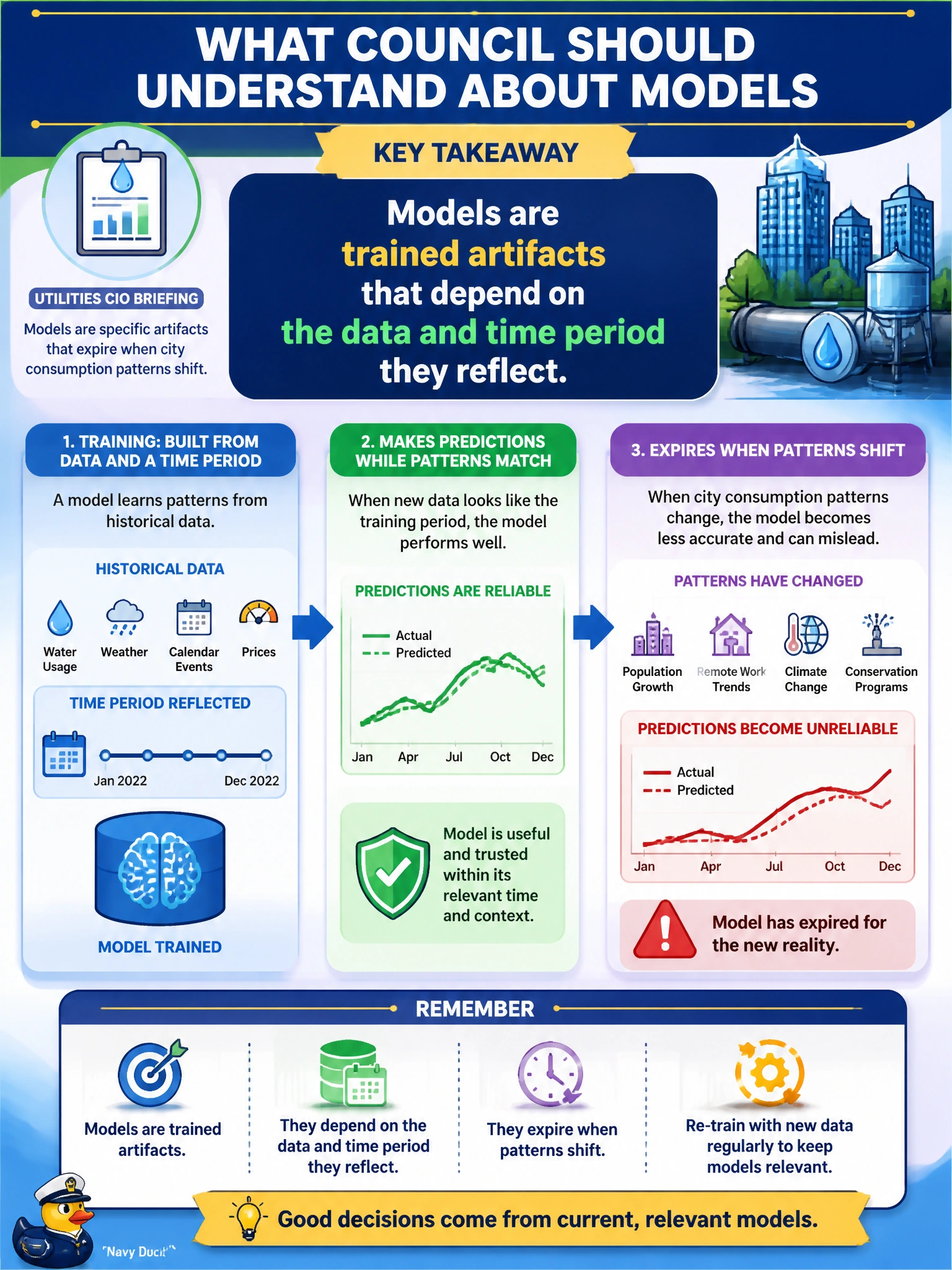
A utilities CIO briefs council that models are specific artifacts that expire when city consumption patterns shift. What should council understand about models?
Select an answer to reveal the explanation.
Short Explanation
Think of a demand model like last year’s snowplow map—great until the city grows a new subdivision. When consumption patterns shift, you can’t count on it to still be right. Models are time-stamped products of their training data, not eternal truths.
Full Explanation
Council should understand that models are trained artifacts that depend on the data and time period they reflect. A utilities demand, leakage, or consumption model is not an eternal truth; it is a snapshot of relationships learned from a particular historical window. When the city adds neighborhoods, electrifies heating, changes pricing, or alters industrial loads, the artifact can drift and degrade. Briefing council this way sets expectations for refresh cycles, budget for retraining, and skepticism toward vendors who imply a one-time model purchase never needs maintenance.
Saying models are trained artifacts that degrade when the underlying data schemas they map change mistakes a schema break for time-based expiry; a renamed field or changed format can break a pipeline, but it does not explain why the artifact expires when city consumption patterns shift. Describing models as trained artifacts that decay predictably based on the loss functions they apply confuses training objective with drift; the loss function guides optimization during training and does not set a predictable decay timetable once consumption behavior changes. Treating models as trained artifacts that expire based on the hyperparameter bounds they establish mistakes settings for foundation; hyperparameter bounds constrain the search during training and do not cause expiry or keep the artifact valid once patterns shift.
Exam caveat: models are time-bound artifacts. Link ‘expire when patterns shift’ to dependency on training data and period—not to degrade when the underlying data schemas they map change, to decaying predictably based on the loss functions they apply, or to expiring based on the hyperparameter bounds they establish.
Operational check: record training date ranges on every production model card, monitor prediction error against current consumption, define drift thresholds that trigger retraining, and report model age and performance to governance forums alongside uptime metrics.
Prefer to study offline? Printable PDF study book + test engine ($7.50, unofficial). These questions stay free here.