
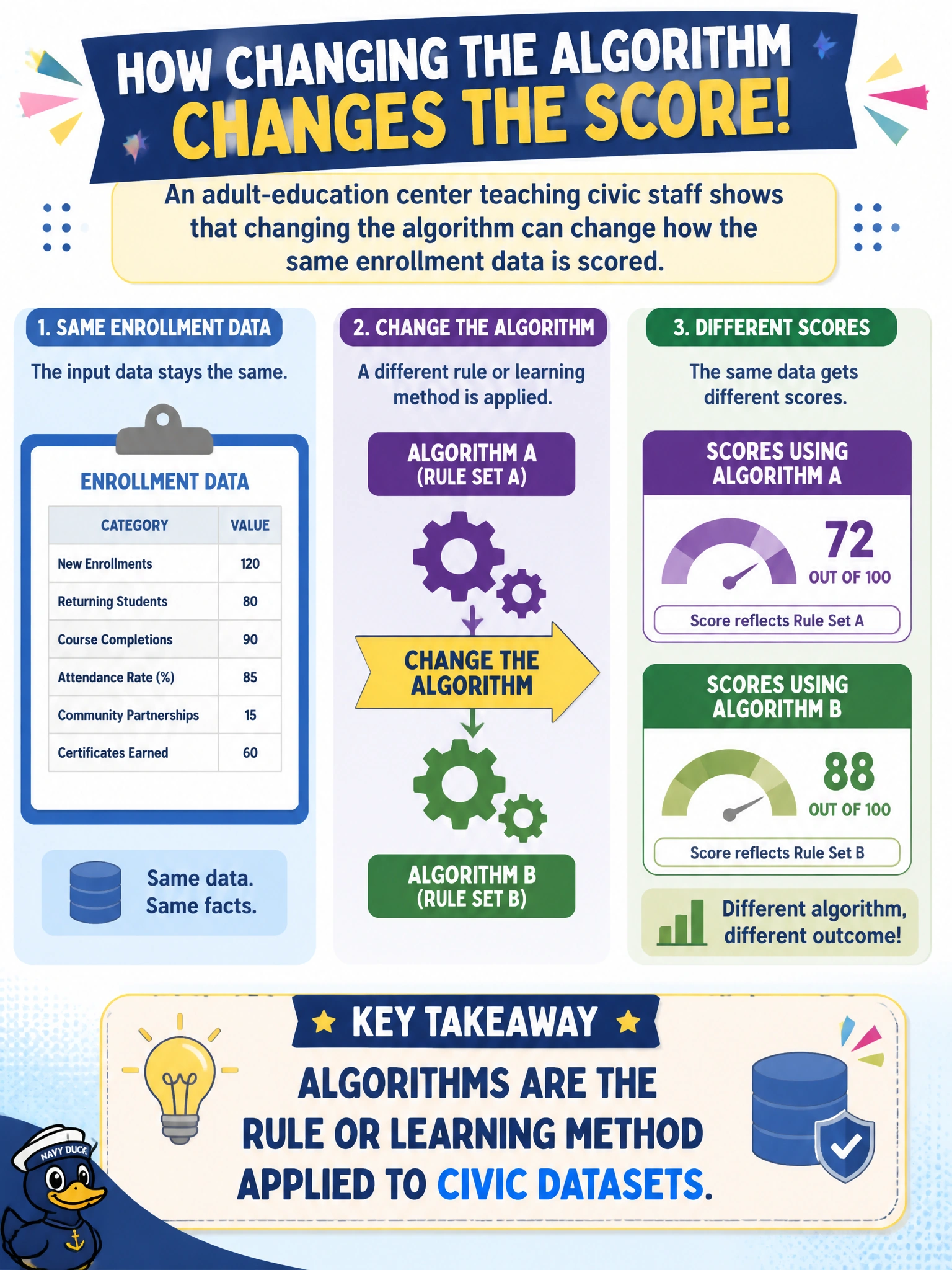
An adult-education center teaching civic staff shows that changing the algorithm can change how the same enrollment data is scored. What role of algorithms does this demonstrate?
Select an answer to reveal the explanation.
Short Explanation
Same stack of enrollment sheets, different recipe—different scores. The algorithm is the method you pour over the data. Swap the method and the results can shift even when the spreadsheet looks unchanged.
Full Explanation
Showing that changing the algorithm changes how the same enrollment data is scored demonstrates that algorithms are the rule or learning method applied to civic datasets. Holding data fixed while swapping the method isolates the algorithm’s role: different rules, distance metrics, model families, or training objectives can reorder scores, alter who appears ‘high priority,’ and shift operational decisions even though the underlying enrollment rows did not change. Adult-education and staff training use this demonstration so civic employees stop treating algorithms as the learned weight values stored from civic datasets and start treating them as consequential scoring methods that require justification and testing.
Treating algorithms as the learned weight values stored from civic datasets fails the demonstration’s result, because weights are the tuned parameters produced by training, not the rule or learning method that was swapped to score the same dataset differently. Treating algorithms as the accuracy metrics calculated over civic datasets mistakes an evaluation of performance for the scoring method itself, since the demonstration changed the method while keeping the data the same and metrics only summarize how well that method scored. Claiming algorithms are the final enrollment decisions issued from civic datasets confuses the output with the algorithmic foundation, because decisions are the results issued after scoring, not the rule or learning method that produced the different scores.
Exam caveat: algorithm = method applied to data. When stems say ‘same data, different algorithm, different outcome,’ choose the option that names algorithms as the decision/learning method—not final enrollment decisions issued from civic datasets.
Operational check: before changing scoring algorithms on enrollment or benefits-adjacent tools, run shadow comparisons on historical cohorts, document why the new method was chosen, assess disparate impact across demographic and geographic groups, and version both algorithm and configuration so council or auditors can reconstruct past scores.
Prefer to study offline? Printable PDF study book + test engine ($7.50, unofficial). These questions stay free here.