
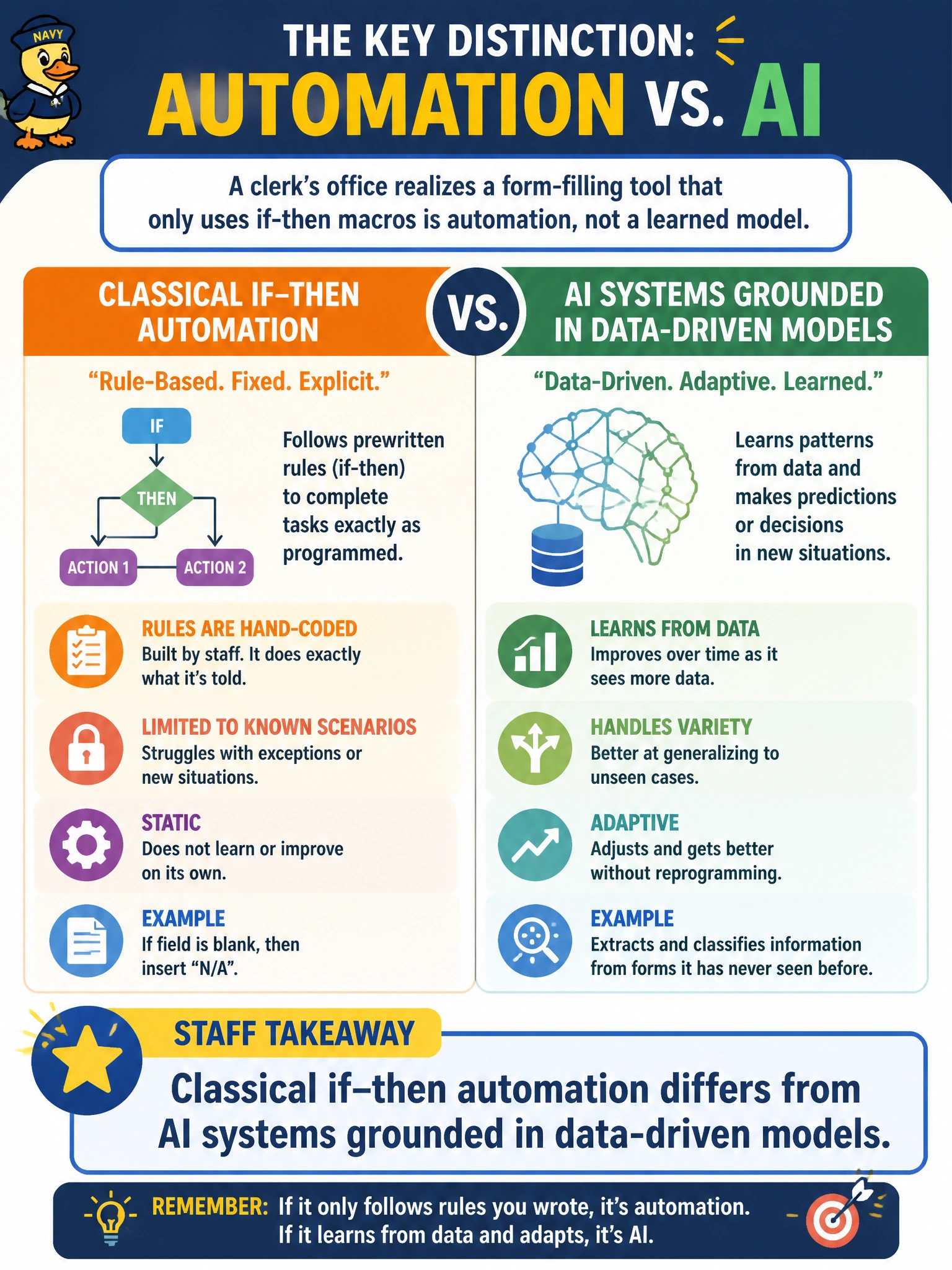
A clerk’s office realizes a form-filling tool that only uses if-then macros is automation, not a learned model. What distinction should staff take away?
Select an answer to reveal the explanation.
Short Explanation
If the tool only follows sticky-note rules—“if box X, then copy Y”—that is classic automation. AI that learned from piles of past forms is a different animal. Macros are handy; they are not the same as a data-driven model.
Full Explanation
Clerk’s office staff should take away that classical if-then automation differs from AI systems grounded in data-driven models. Macros that fill forms when field A equals a value and then set field B are deterministic automation: every branch was explicitly authored by a human. They do not learn new mappings from piles of historical forms unless someone rewrites the rules. AI systems in the essentials sense typically involve models whose behavior is induced from data—statistical patterns, classifiers, or learned predictors—rather than only hard-coded branches. Recognizing the difference prevents offices from labeling every script ‘AI’ and clarifies when model governance (training data, drift, evaluation) applies versus ordinary change control on macros.
Saying classical if-then automation differs from AI systems grounded in deterministic models misses the distinction; deterministic behavior is what the macros already exhibit—same input always yields same output because every branch was authored—not behavior induced from data as in learned models. Saying it differs from AI systems grounded in symbolic logic models puts rules on both sides; symbolic logic models are explicitly authored symbols and inference rules, not predictors learned from piles of historical forms. Saying it differs from AI systems grounded in predefined rule models draws no line at all; predefined rule models are the if-then macros themselves, so this contrasts rules with rules rather than contrasting rules with data-driven models.
Exam caveat: automation can be valuable without being AI. The exam distinction is classical rules versus data-driven models—not ‘macros bad, AI good.’ Some hybrid systems exist; classify by whether behavior is primarily learned from data.
Operational check: inventory form tools and tag each as rules-only automation versus model-assisted, apply ML governance only where models exist, still test macros for logic errors, and avoid procurement language that calls pure if-then RPA ‘machine learning’ when no learning artifact is present.
Prefer to study offline? Printable PDF study book + test engine ($7.50, unofficial). These questions stay free here.