
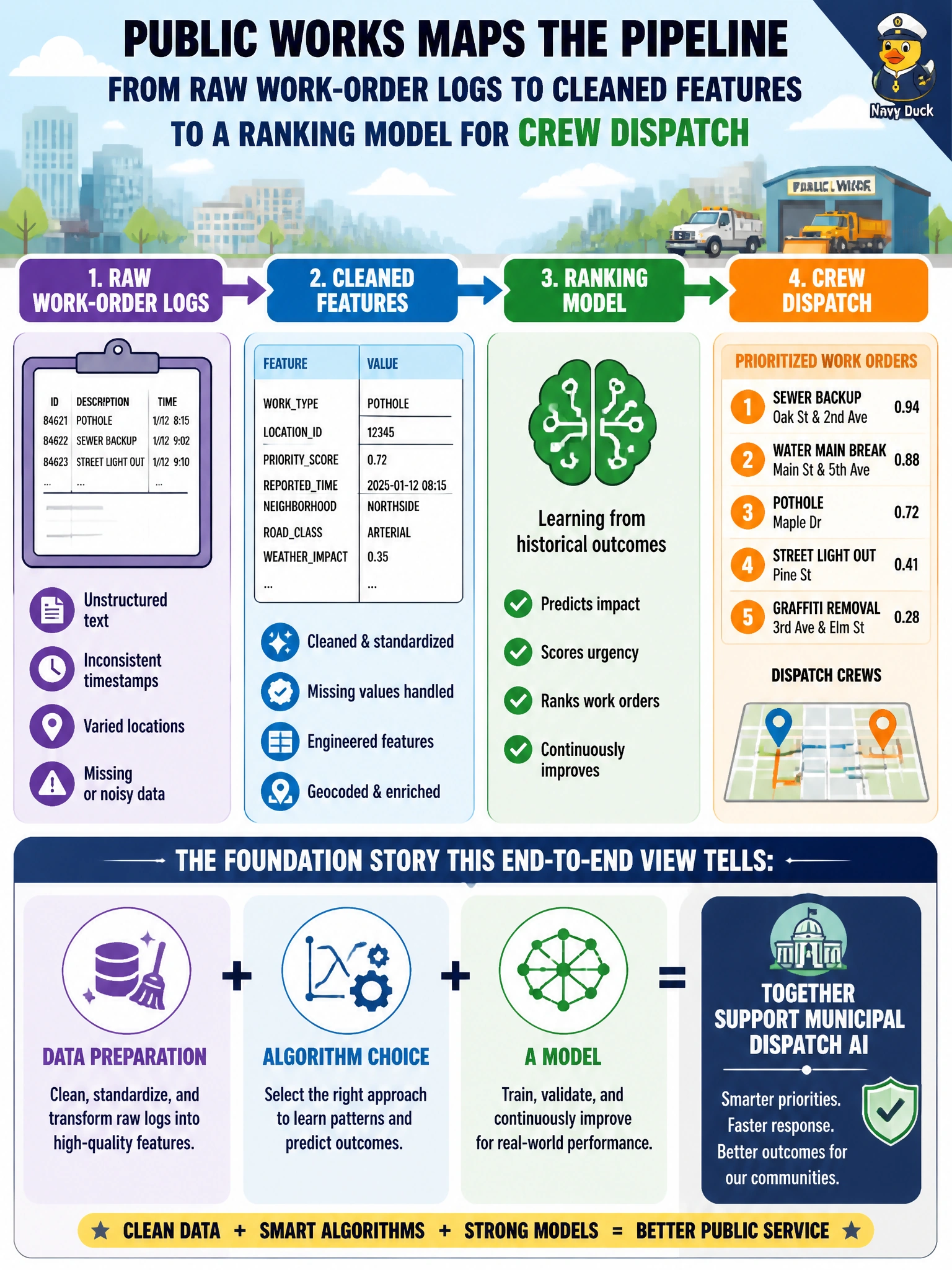
Public works maps the pipeline from raw work-order logs to cleaned features to a ranking model for crew dispatch. Which foundation story does this end-to-end view tell?
Select an answer to reveal the explanation.
Short Explanation
Raw work orders are muddy boots; cleaned features are wiped boots; the ranking model is who gets sent first. You need the whole hallway from mess to model. That is the end-to-end foundation story for dispatch AI.
Full Explanation
Public works’ end-to-end map—from raw work-order logs to cleaned features to a ranking model for crew dispatch—tells the foundation story that data preparation, algorithm choice, and a model together support municipal dispatch AI. Raw logs are messy: duplicate requests, inconsistent problem codes, missing locations. Cleaning and feature engineering turn those logs into usable inputs. An algorithm defines how ranking or prioritization is learned or computed. The resulting model produces ordered dispatch suggestions. Seeing the pipeline teaches that civic AI is a chain of foundations, not a single magic ranking screen.
Saying data ingestion, feature extraction, and a deployment API together support municipal dispatch AI describes intake and serving plumbing, when the end-to-end story requires algorithm choice to turn cleaned features into a ranking model that produces ordered dispatch suggestions, not an API serving them. Claiming data orchestration, model tuning, and a heuristic engine together support municipal dispatch AI replaces cleaning with workflow management and a learned ranking model with tuning plus fixed rules, ignoring that the foundation story starts with turning messy raw logs into usable features and ends with ranking logic that learns prioritization. Saying data validation, batch processing, and a regression model together support municipal dispatch AI narrows preparation to checks, swaps algorithm choice for a processing mode, and narrows the model to regression, skipping the broader cleaning and ranking logic that turns cleaned features into a prioritized model.
Exam caveat: pipeline questions test whether you can name data prep + algorithm + model working together. Distractors usually swap those foundations for plumbing like ingestion, orchestration, or a deployment API or narrow them to one check or one technique like validation, heuristics, or regression.
Operational check: document each pipeline stage with owners and quality metrics, keep raw and cleaned datasets lineage-linked, evaluate ranking models against fairness across neighborhoods and trade types, and require human dispatch supervisors to override rankings when field conditions the features omit become material.
Prefer to study offline? Printable PDF study book + test engine ($7.50, unofficial). These questions stay free here.