
Transit planners treat bus GPS traces as the data layer feeding a delay-prediction model. What relationship does this highlight?
Select an answer to reveal the explanation.
Short Explanation
Those bouncing GPS dots you're tracking are the raw ingredients for the delay crystal ball, not crowdsourced pings or synthetic trips. The model only sees what the buses actually did on the road. You'll find operational data goes in and predictions come out, while static schedules can't show where delays actually happened.
Full Explanation
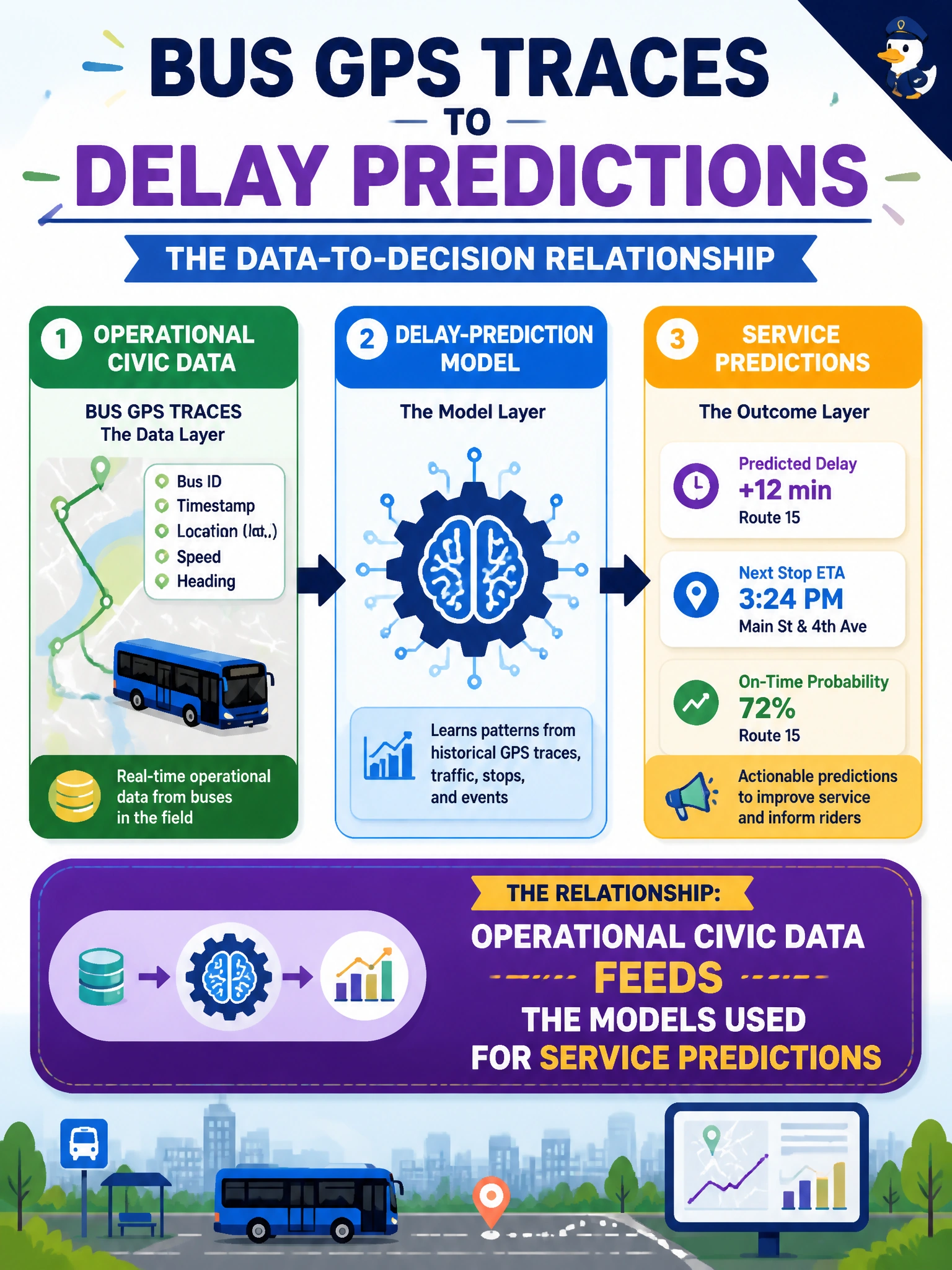
Transit planners treating bus GPS traces as the data layer feeding a delay-prediction model highlight that operational civic data feeds the models used for service predictions. GPS traces, stop arrival events, and related telemetry are the empirical substrate from which delay patterns are learned. The model does not invent traffic reality; it estimates from recorded operations. That relationship keeps planners grounded: improve prediction quality by improving data coverage, sampling frequency, and linkage to schedules—not by swapping in crowdsourced reports, synthetic simulations, or static schedules. Crowdsourced mobility data feeds the models used for service predictions fails: it names the wrong data layer for this stem. Crowdsourced phone pings and volunteer reports are uneven opt-in observations, while bus GPS traces are the systematic operational telemetry that records actual delays the model must learn. Synthetic simulation data feeds the models used for service predictions fails because it names the wrong data layer; synthetic trips are computer-generated scenarios, not bus movements, so they cannot supply the GPS-observed delay patterns the model learns from. Static schedule data feeds the models used for service predictions fails because it names the wrong feed for delay prediction; timetables record planned departures, not vehicle positions and arrival times, so GPS traces remain the feeding data layer here. Exam caveat: operational GPS traces feed delay models—keep the data layer straight. Crowdsourced mobility, synthetic simulations, and static schedules answer different questions and cannot substitute for observed bus movements. Mixing up which dataset records operations is the trap these items test. Operational check: validate GPS coverage by route, monitor feed latency into the prediction pipeline, version datasets used for each release, and compare predicted versus actual delays so drift is caught early.
Prefer to study offline? Printable PDF study book + test engine ($7.50, unofficial). These questions stay free here.