
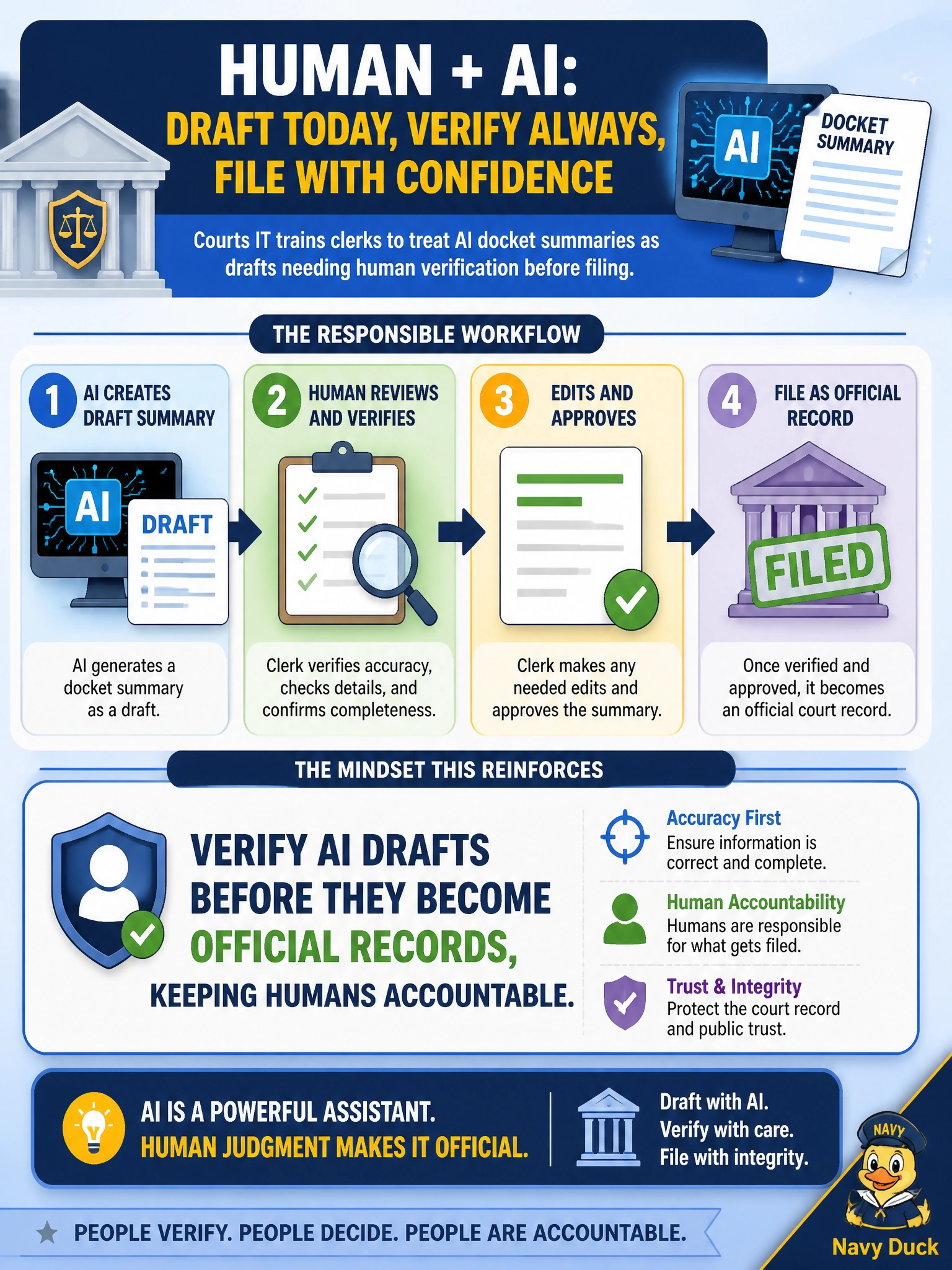
Courts IT trains clerks to treat AI docket summaries as drafts needing human verification before filing. Which mindset for human–AI collaboration does this reinforce?
Select an answer to reveal the explanation.
Short Explanation
Treat the AI like a first-draft intern: helpful, fast, but you’re still accountable for the record, you can’t shift liability to developers. You can’t treat it as a peer since it can’t answer for party names or dates, and you’ll need more than loose on-the-loop monitoring. You’ll still check every draft before it becomes official.
Full Explanation
Courts IT reinforces a verify-then-trust mindset: verify AI drafts before they become official records, keeping humans accountable. Docket summaries that feed filings, notices, or case management systems become part of the justice system’s authoritative trail. Treating generative or extractive summaries as drafts forces clerks to check party names, hearing dates, case numbers, and dispositions against source documents before anything is filed. That preserves chain-of-responsibility: a named human stands behind the official record, which is essential for due process, public trust, and correction when the model hallucinates or truncates critical facts.
Verifying AI drafts before they become official records while shifting liability to developers still misplaces responsibility because developers cannot attest to each filing's party names, hearing dates, and dispositions — only the named clerk can for due process, public trust, and correction. Verifying AI drafts before they become official records while treating the AI as a peer still misplaces responsibility because a peer implies shared accountability, but models cannot attest to party names, hearing dates, and dispositions for due process, public trust, and correction — only the named clerk can for the current official record. Verifying AI drafts before they become official records while utilizing human-on-the-loop workflows still understates responsibility because on-the-loop implies loose supervisory monitoring rather than mandatory pre-filing verification, and even sampled review can miss the same hallucination or truncation and still require a clerk to confirm critical fields before filing. Exam caveat: ‘verify AI drafts’ is the collaboration principle under test, not treating the AI as a peer. The wrong answers either shift liability to developers, treat the AI as a peer, or utilize human-on-the-loop workflows instead of keeping humans accountable. The balanced civic answer keeps both capability and accountability.
Operational check: watermark AI-produced docket text as draft until clerk attestation, require source-document side-by-side review for critical fields before filing, log named clerk attestation to keep humans accountable rather than utilizing human-on-the-loop workflows, and use post-filing sampling only as secondary quality audit for omission and hallucination rates.
Prefer to study offline? Printable PDF study book + test engine ($7.50, unofficial). These questions stay free here.