
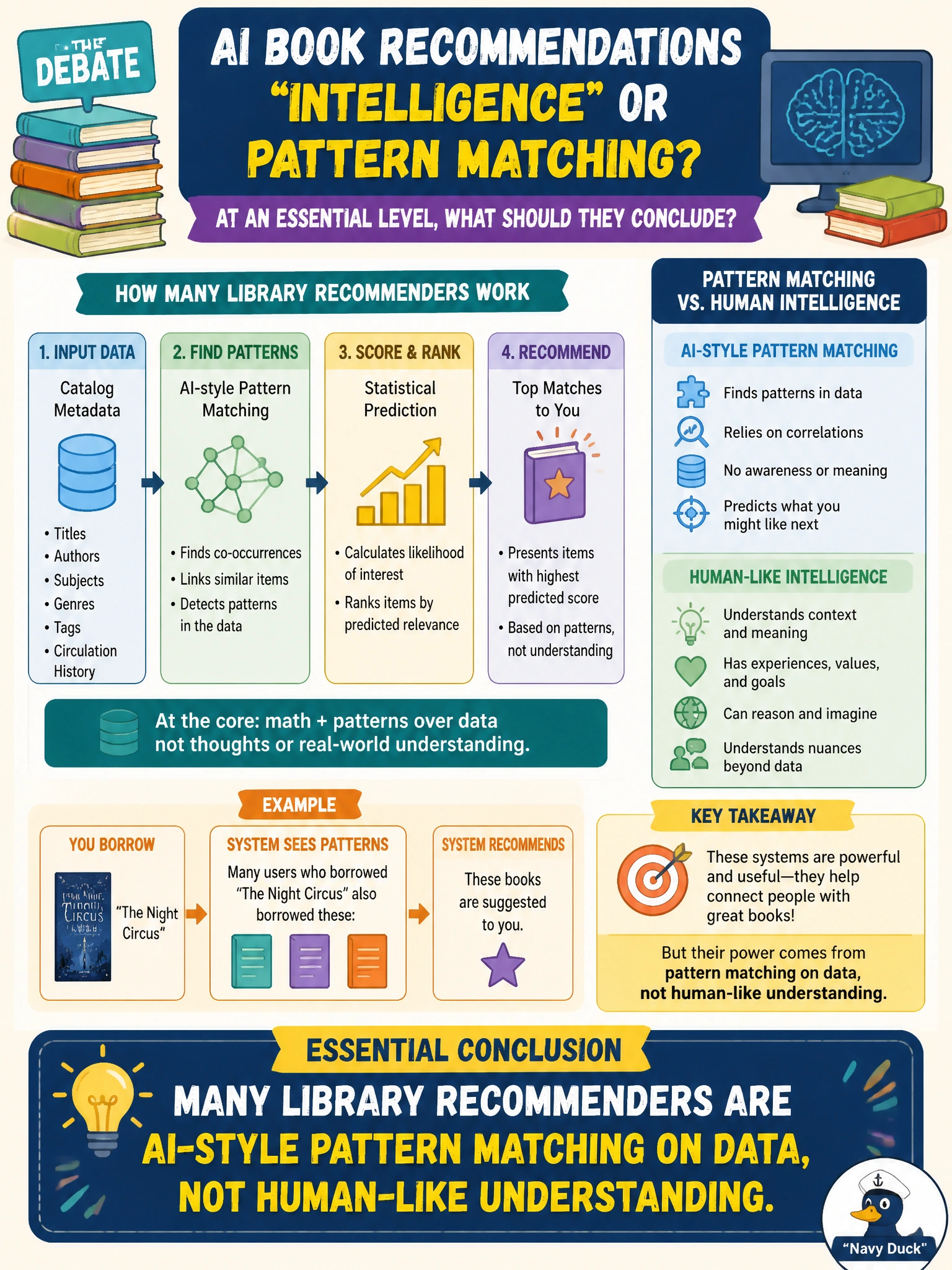
Library staff debate whether recommending books with AI is “intelligence” or pattern matching over catalog metadata. At an essentials level, what should they conclude?
Select an answer to reveal the explanation.
Short Explanation
The catalog recommender is more like a clever sorting hat for metadata than a bookworm with feelings. It matches patterns in what people borrowed—not consciousness. You'll go wrong if you call it semantic reasoning, cognitive processing, or symbolic logic — it's statistical pattern matching on borrowing data, not human-like understanding.
Full Explanation
At an AI essentials level, library staff should conclude that many library recommenders are AI-style pattern matching on data, not human-like understanding. Recommenders typically learn from circulation histories, subject headings, co-borrow patterns, and metadata similarity. That is powerful pattern recognition over catalog and usage data, and it can improve discovery for residents. It is not consciousness, comprehension of theme, or lived appreciation of a novel’s meaning. Teaching this distinction prevents staff and patrons from over-attributing mind-like understanding to systems that are correlating features. Essentials curricula stress that ‘AI’ in this setting usually means statistical or learned pattern matching, not artificial general intelligence. Saying many library recommenders are AI-style semantic reasoning on catalogs, not pattern matching gets the mechanism backward; they do statistical pattern matching over circulation histories and metadata similarity, not human-like semantic understanding of books. Saying many library recommenders are AI-style cognitive processing on records, not statistical data misidentifies the method; they learn statistical correlations from borrower preferences and co-borrow patterns, not mind-like cognition. Saying many library recommenders are AI-style symbolic logic on metadata, not probabilistic models misstates the technique; they typically use learned probabilistic models over subject headings and usage data, not hand-coded symbolic logic rules. Exam caveat: calling recommenders ‘pattern matching’ is not an insult or a claim they lack value; it is the accurate essentials framing. Do not equate ‘not human understanding’ with ‘not useful for civic service.’ Operational check: label recommender features clearly for staff and patrons, monitor for popularity bias and collection equity gaps in suggestions, allow librarians to override or curate lists for local programming, and avoid marketing language that implies the system ‘knows’ or ‘loves’ books.
Prefer to study offline? Printable PDF study book + test engine ($7.50, unofficial). These questions stay free here.