
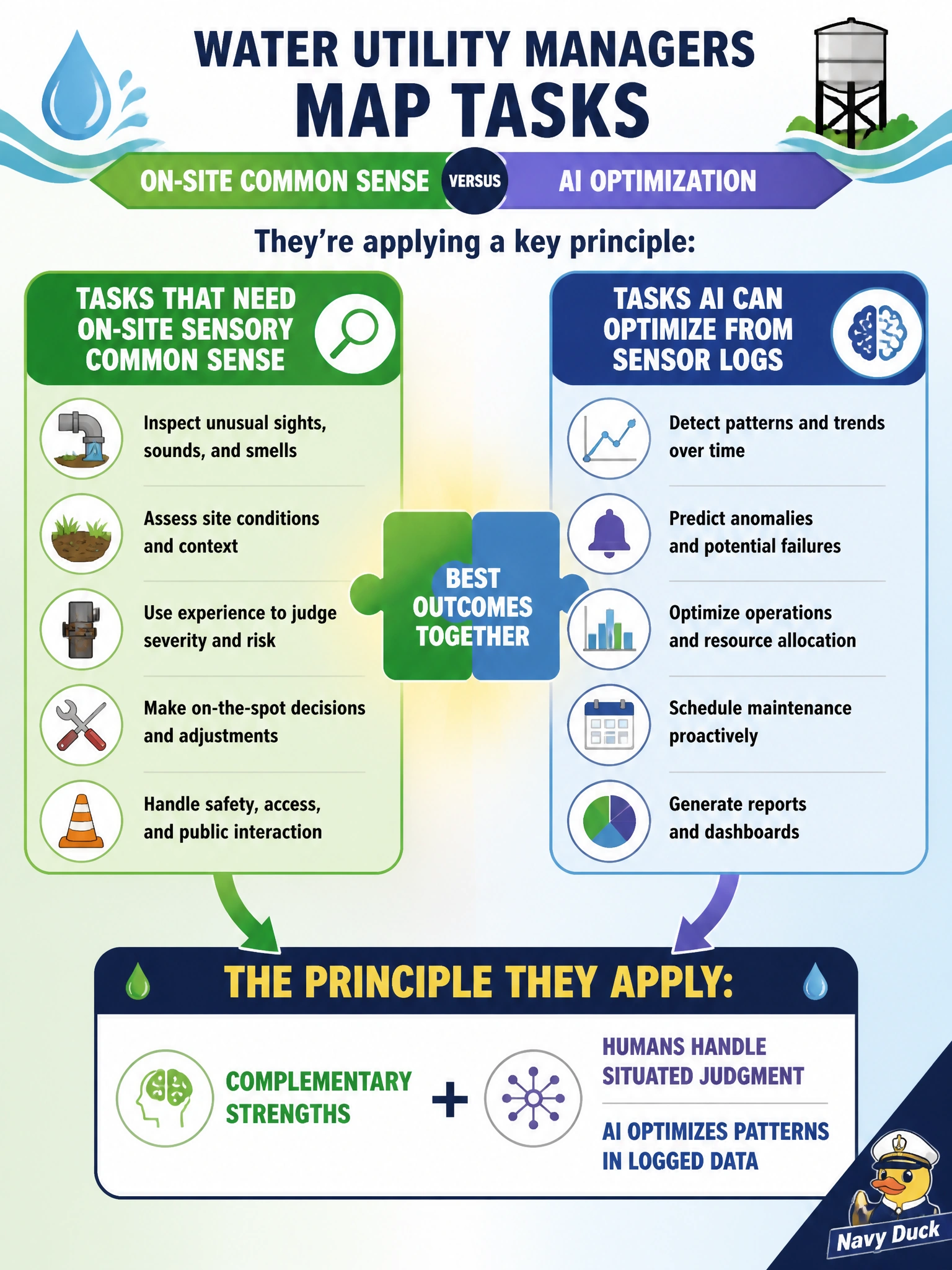
Water utility managers map tasks that need on-site sensory common sense versus tasks AI can optimize from sensor logs. What principle are they applying?
Select an answer to reveal the explanation.
Short Explanation
Smell a chlorine leak with your nose; let the model chew through months of meter ticks. Humans and AI bring different superpowers to the plant. Map the work so each strength gets the right job.
Full Explanation
Water utility managers who separate on-site sensory common sense from sensor-log optimization are applying complementary strengths: humans handle situated judgment; AI optimizes patterns in logged data. Field crews notice odors, vibration, unusual turbidity, unsafe access conditions, and neighbor reports that no SCADA point fully captures. Models and optimizers, by contrast, can mine months of flow, pressure, and consumption logs to propose pump schedules, anomaly scores, or maintenance rankings at a scale humans cannot manually compute. Mapping tasks to those strengths is the principle: do not force one modality to do the other’s job. Having humans confirm situated judgment while AI surfaces patterns in logged data describes human-in-the-loop verification as a confirmation workflow; even though situated judgment stays with humans, the principle being tested is mapping tasks to complementary strengths, not adding a confirmation step for surfaced patterns. Having humans teach situated judgment while AI absorbs patterns in logged data describes progressive automation as a teaching-to-absorbing handoff; managers mapping stable situated judgment to humans and logged-pattern optimization to AI are not describing humans training AI to take over. Having humans rotate situated judgment and AI rotate patterns in logged data describes dynamic task allocation as rotating assignments; that rotation-based switching is different from the fixed complementary-strengths split between situated judgment and logged-pattern optimization. Exam caveat: complementary strengths is not ‘humans good, AI bad’ or the reverse; it is task allocation. On the exam, watch for options that add humans confirm with AI surfaces patterns, humans teach with AI absorbs patterns, or humans rotate and AI rotates – those confirmation, teaching-absorption, or rotation qualifiers point to verification, progressive, or dynamic allocation rather than complementary strengths. Operational check: maintain joint runbooks that specify which alarms auto-prioritize work orders versus which require on-site confirmation, train crews to treat model scores as decision support, capture field observations that sensors miss so models can improve, and never close a public-safety-related alarm solely on a dashboard green status without human verification when sensory anomalies are reported.
Prefer to study offline? Printable PDF study book + test engine ($7.50, unofficial). These questions stay free here.