
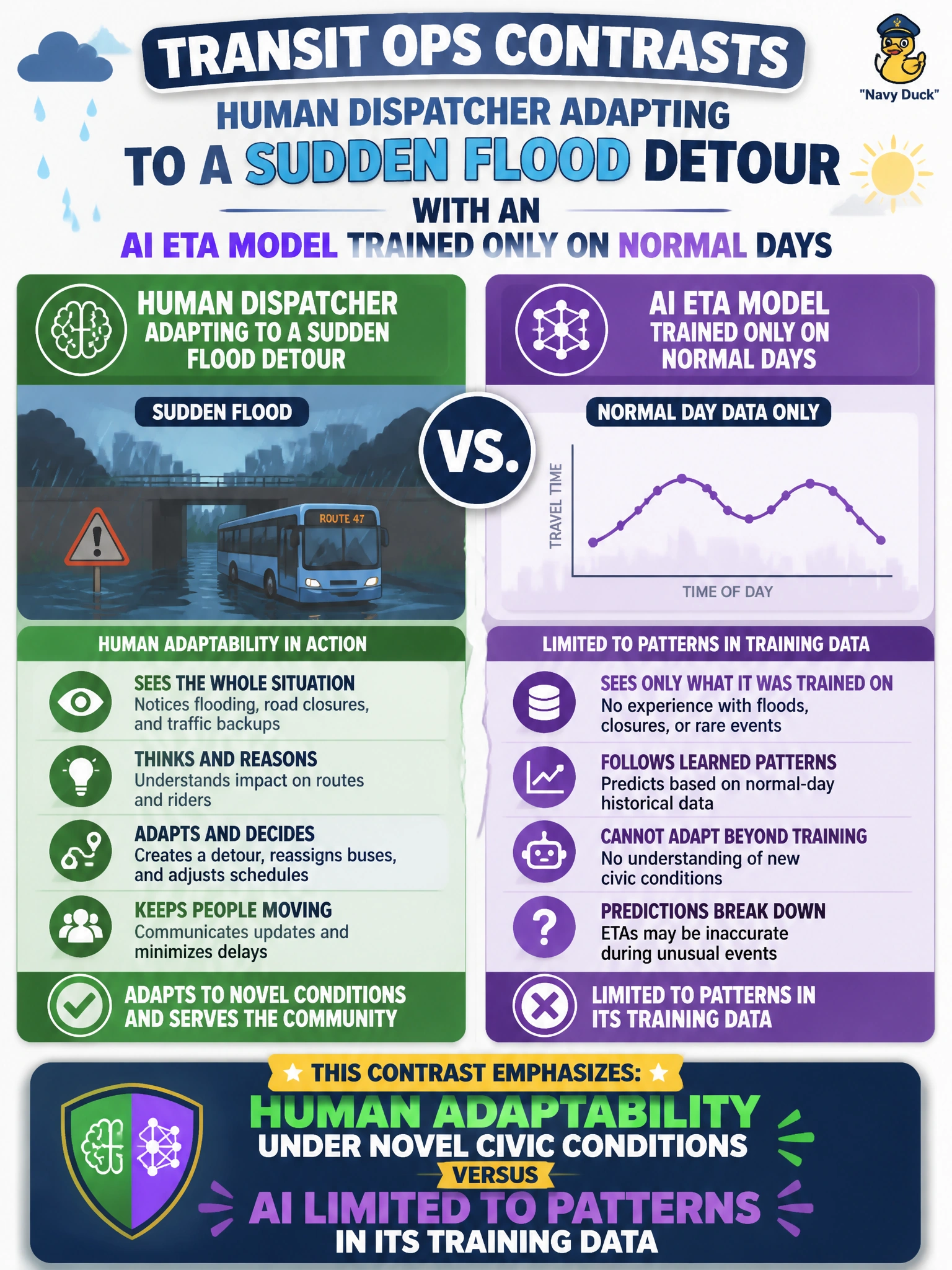
Transit ops contrasts a human dispatcher adapting to a sudden flood detour with an AI ETA model trained only on normal days. What does this contrast emphasize?
Select an answer to reveal the explanation.
Short Explanation
When the river jumps the curb, the dispatcher improvises a new route the training set never saw. The ETA model only knows sunny, ordinary days. Humans bend; models freeze when the world leaves the textbook.
Full Explanation
Transit operations use this contrast to emphasize human adaptability under novel civic conditions versus AI limited to patterns in its training data. A flood that forces unplanned detours, temporary stops, and ad-hoc transfers is exactly the kind of distribution shift ETA models trained on normal days do not encode. Human dispatchers integrate radio reports, street flooding maps, mutual-aid decisions, and rider safety concerns in real time—capabilities that go beyond interpolating historical on-time performance. The AI ETA model remains valuable on routine days when delays resemble past congestion patterns, but the flood scenario highlights the boundary: models generalize from seen patterns; humans improvise when the city’s operating picture leaves the training distribution.
Framing this as human heuristic problem solving in edge cases versus AI overfitting to historical transit schedules misuses overfitting: the model doing well on normal days but failing in the flood is not memorizing noise, it is failing to generalize beyond its training distribution to a novel civic condition. Describing this as human cognitive flexibility during emergencies versus AI susceptibility to catastrophic forgetting misapplies that term: catastrophic forgetting is losing old tasks while learning new ones, whereas this model was never trained on flood detours at all, so there is nothing forgotten, only an unseen distribution it cannot handle. Casting this as human manual intervention during infrastructure failures versus AI vulnerability to target label leakage misattributes the failure: target label leakage is when training features improperly include information about the outcome that would not be available at prediction time, whereas this ETA failure comes from never having seen flood-detour conditions, not from leaked labels inflating training performance.
Exam caveat: ‘limited to training patterns’ does not mean models are useless after any anomaly; it means performance degrades under novel conditions unless retrained, fine-tuned, or overridden by human procedures. Distinguish routine prediction from emergency command.
Operational check: define trigger conditions (flood stage, major incidents) that suspend reliance on routine ETA displays, empower dispatchers to override model outputs, log override reasons for later model improvement, and schedule post-event data capture so future training includes rare but critical disruption patterns.
Prefer to study offline? Printable PDF study book + test engine ($7.50, unofficial). These questions stay free here.