
Permitting staff notice that AI cannot invent a new variance rationale the way an experienced planner can. What limitation of current AI does this illustrate?
Select an answer to reveal the explanation.
Short Explanation
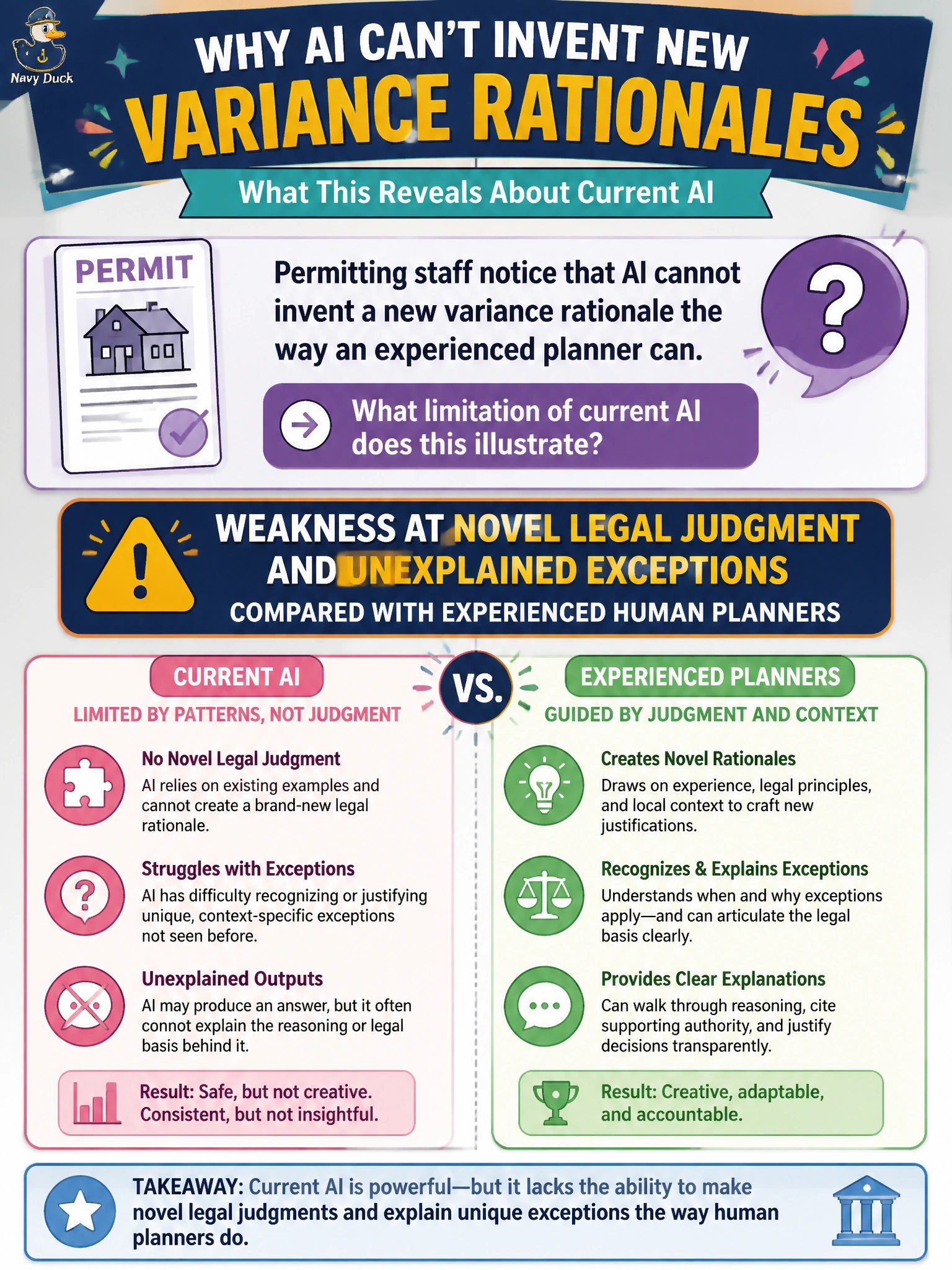
A seasoned planner can invent a careful path through a weird lot line the code barely imagined. Today’s AI mostly remixes what it has already seen—it is not a creative zoning attorney. That gap in novel judgment is exactly the limitation staff should name.
Full Explanation
Permitting and zoning variance work exposes a core limitation of current AI: weakness at novel legal judgment and unexplained exceptions compared with experienced human planners. Variances often turn on unique lot geometry, historical nonconformities, neighborhood character findings, and equitable application of standards that were never fully enumerated as training examples. An experienced planner can craft a carefully reasoned rationale that fits local code, case law norms, and council expectations for a fact pattern the department has rarely seen. Contemporary AI systems excel at retrieving and remixing prior approved language, checklists, and common findings, but they struggle when the lawful path requires original legal judgment rather than pattern completion. That is the limitation staff correctly notice when the tool cannot invent a sound new variance rationale.
Tendency toward deterministic rule matching for variance cases compared with experienced human planners describes rigidly applying existing rules as written, not the illustrated weakness in inventing a novel, legally sound rationale for an unprecedented exception. Struggle with zero-shot inference on unstructured zoning data compared with experienced human planners is a first-encounter data-interpretation gap, not the illustrated failure to generate original legal reasoning for a unique variance. Overreliance on extractive summarization for legal documentation compared with experienced human planners is a drafting-style limitation about copying source text, not the illustrated inability to invent a sound new variance rationale.
Exam caveat: the point is comparative weakness on novel exceptions, not a claim that AI is useless in permitting. AI may still help assemble packet checklists, similar precedents, and draft boilerplate—while humans own novel legal judgment.
Operational check: restrict AI outputs in variance workflows to draft assistance labeled non-final, require planner authorship of findings of fact and conclusions of law for atypical cases, peer-review AI-suggested rationales against code sections, and escalate unique edge cases to senior planners or counsel before public hearing.
Prefer to study offline? Printable PDF study book + test engine ($7.50, unofficial). These questions stay free here.