
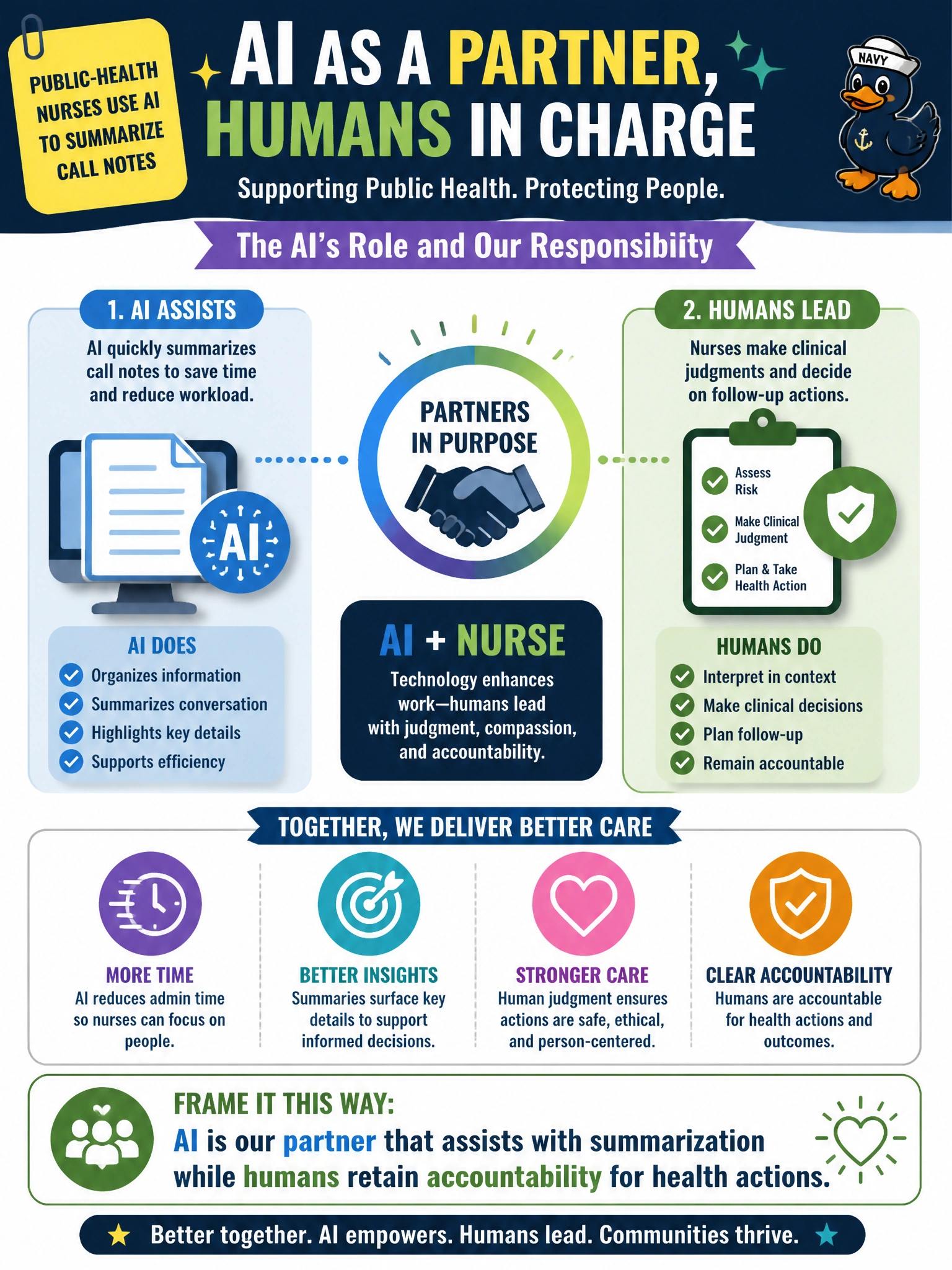
Public-health nurses use AI to summarize call notes but keep clinical follow-up decisions themselves. How should leadership frame the AI’s role?
Select an answer to reveal the explanation.
Short Explanation
You're getting a partner that boils down messy call notes so you'll act faster, not a delegate that executes them for you. It's not a surrogate performing in your place or an orchestrator directing the work — you'll still handle those health actions yourself.
Full Explanation
In public-health call centers and nurse advice lines, leadership should frame AI as a partner that assists with summarization while humans retain accountability for health actions. Summarization compresses long call notes, medication lists, and prior contacts into a readable brief so nurses can spend more time on clinical reasoning and outreach. Partnership language matters: it clarifies that the tool supports documentation workflow without transferring clinical decision authority. Follow-up decisions—whether to schedule a visit, escalate to a physician, notify partners, or close the case—remain with licensed professionals because those acts create duty of care, documentation obligations, and liability for the health department. Framing the tool as a delegate that executes the summarization while humans retain accountability for health actions still hands off execution to the AI, which conflicts with assistive partnership where nurses must affirm or edit drafts before they enter the official record. Treating the AI as a surrogate that performs the summarization while humans retain accountability for health actions still frames the AI as a substitute standing in for nurses, which overstates reliability and misses the need for nurses to check for hallucinations and retain judgment for health actions. Describing it as an orchestrator that directs the summarization while humans retain accountability for health actions still implies the AI controls and directs the workflow, which contradicts partnership where humans stay in the loop for clinical follow-up decisions. Exam caveat: ‘partner’ is not marketing fluff on the exam; it specifically means assistive capability plus retained human accountability. Do not confuse note summarization with autonomous diagnosis or prescribing. Operational check: configure summarization tools so nurses must affirm or edit summaries before they enter the official record, prohibit auto-generation of signed clinical orders from the summarizer, retain audit logs of source notes versus AI output, and train staff to spot hallucinations in medication names, dates, and symptom timelines before acting.
Prefer to study offline? Printable PDF study book + test engine ($7.50, unofficial). These questions stay free here.