
You're configuring two Data Domain replication pairs: one over low-latency metro fiber with a near-zero RPO, and one over a congested branch link with an hours-long RPO. Which policy best matches each link and recovery goal?
Select an answer to reveal the explanation.
Short Explanation
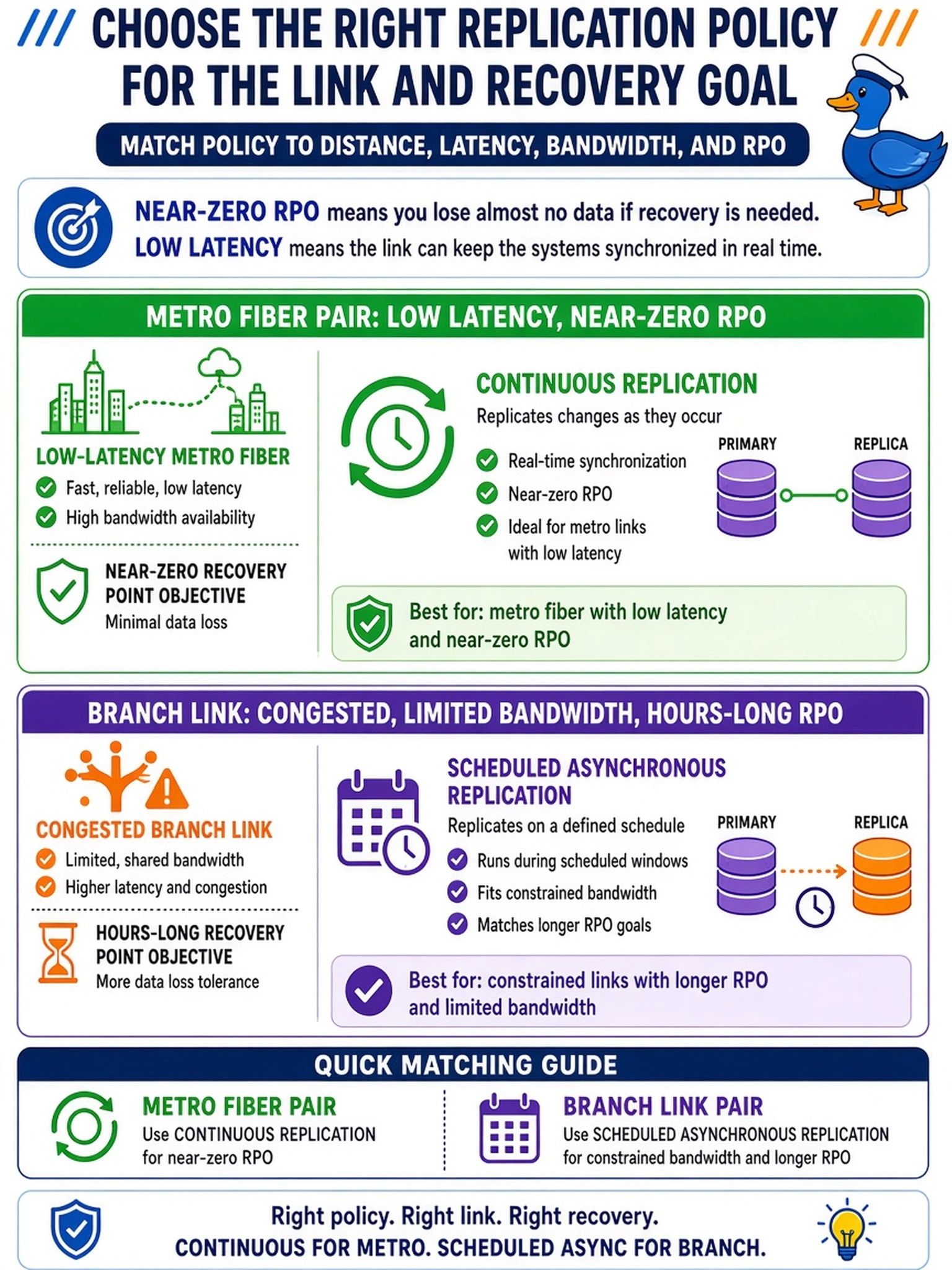
Think of replication like mail: the metro link can hand-deliver as soon as changes happen, but the branch road is jammed and can only take scheduled trucks. If you force continuous replication onto that congested link, you'll choke it and miss the recovery window anyway. Match the policy to the pipe and the RPO, not to the desire for the lowest number.
Full Explanation
Continuous replication keeps the destination close to the source by transferring changes as soon as they are ready, which suits a metro fiber path with sufficient bandwidth, low latency, and a near-zero recovery point objective. Scheduled asynchronous replication batches transfers at defined intervals, reducing sustained bandwidth pressure and fitting a congested branch link where an hours-long recovery point is acceptable. Applying continuous replication to both pairs ignores the branch link's real capacity and can saturate it, delaying or disrupting data movement. Applying scheduled replication to both pairs wastes the metro link's capability and increases recovery point exposure beyond the required target. Reversing the policies makes the branch worse because continuous replication on a constrained path is the wrong mechanism, while the metro pair loses the low-latency advantage needed for its stricter recovery goal. Exam caveat: choose the replication mode from the link's measured bandwidth and the recovery point objective, not from the assumption that continuous replication is always better. Operational check: validate each pair's throughput and schedule against the RPO by monitoring transfer duration, queue depth, and last-sync timestamps during a peak backup window.