
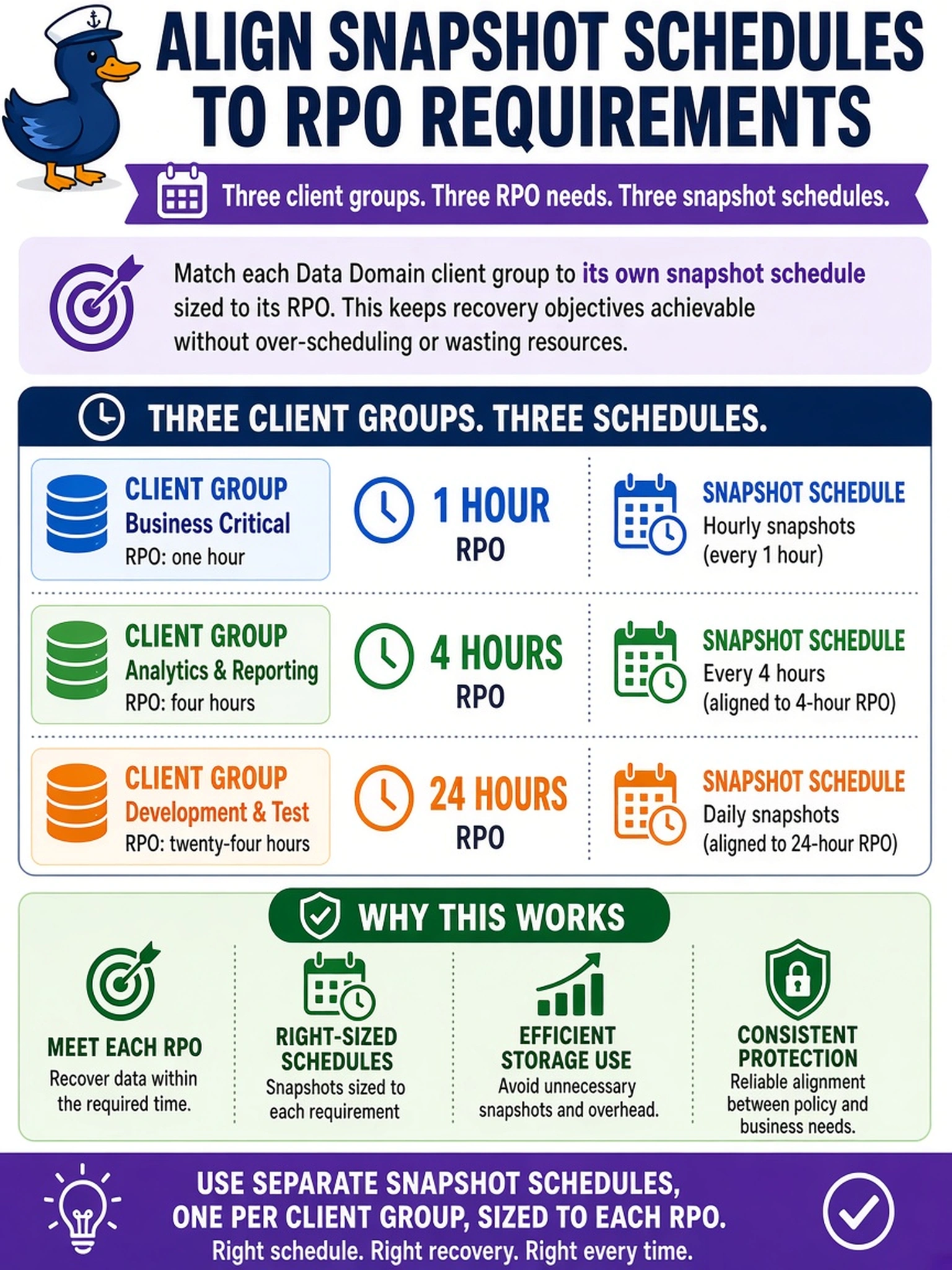
An application team defines three Data Domain client groups with RPOs of one hour, four hours, and twenty-four hours. During post-deployment policy work, you need to align snapshot schedules to those requirements. What should you configure?
Select an answer to reveal the explanation.
Short Explanation
Think of RPOs like different bus timetables: one group needs a bus every hour, another every four hours. You don't run every bus at the same interval just because it's easier. Set a schedule per group so each recovery point gets its own rhythm.
Full Explanation
Recovery point objective defines the maximum acceptable age of the most recent recoverable copy. On a Data Domain appliance, a snapshot schedule determines how often point-in-time copies are created, so the schedule must match each client group's RPO. When groups require one, four, and twenty-four hours, assigning a schedule per group lets the most critical group recover with at most one hour of loss while less critical groups use longer intervals. A single schedule set to the shortest RPO technically satisfies the tightest requirement, but it imposes unnecessary snapshot frequency, capacity overhead, and management burden on groups that do not need that cadence. A single schedule set to the longest RPO is unacceptable because it cannot meet shorter recovery points and would leave critical data with more loss than the business allows. Using separate schedules but forcing all groups to the same interval defeats the purpose of per-group policy design: it still overprotects lower-criticality groups and can make capacity and retention calculations harder. Exam caveat: Do not treat RPO as a single appliance-wide setting; translate each business requirement into the schedule applied to the relevant client group. Operational check: Confirm each client group's assigned snapshot schedule interval and verify the next scheduled snapshot time before declaring the policy compliant.