
During a quarterly review, a fourth backup application asks to join a running Data Domain appliance. Which action sequence should the engineer follow before enabling the new client?
Select an answer to reveal the explanation.
Short Explanation
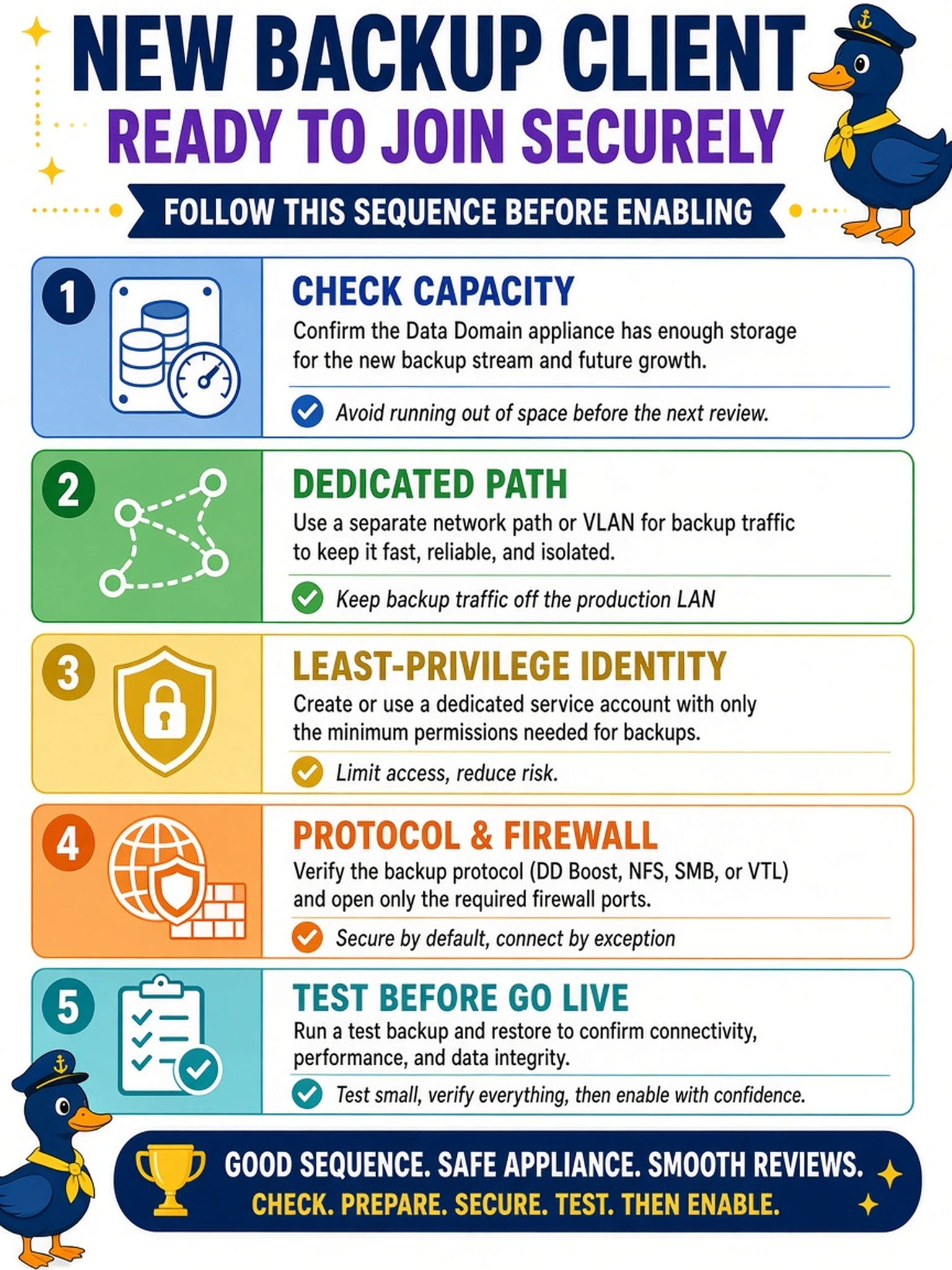
Think of adding a fourth backup app like adding another car to a busy highway: you don't just wave it in. You check the road's capacity, give it its own lane and key, open only the gates it needs, then test. Skipping that because the appliance is already running is how small problems become big outages.
Full Explanation
Onboarding another backup consumer to a running Data Domain system is not a shortcut moment; it is a repeatable change-control task. Capacity headroom must be checked because a new workload can exhaust usable space, replication bandwidth, or retention targets before the first full backup. The engineer should create a dedicated path or tenant-scoped storage location, assign a least-privilege identity, verify the correct protocol such as DD Boost, NDMP, CIFS, or NFS, and confirm firewall and network reachability before running a controlled test. Enabling a client immediately because the appliance is already stable ignores capacity, path isolation, and security changes that can affect existing tenants. Copying an existing application's share and permissions may seem efficient, but different applications often require different MTrees, retention, tenancy boundaries, or protocol behavior. Creating a broad administrative account for rapid onboarding violates least privilege and can expose unrelated MTrees or tenant data if credentials are compromised. Exam caveat: the exam expects a disciplined onboarding sequence rather than operational convenience. Operational check: before enabling the fourth application, confirm capacity, provision a dedicated path, assign scoped credentials, validate protocol/firewall access, then perform a test backup or connectivity check.