
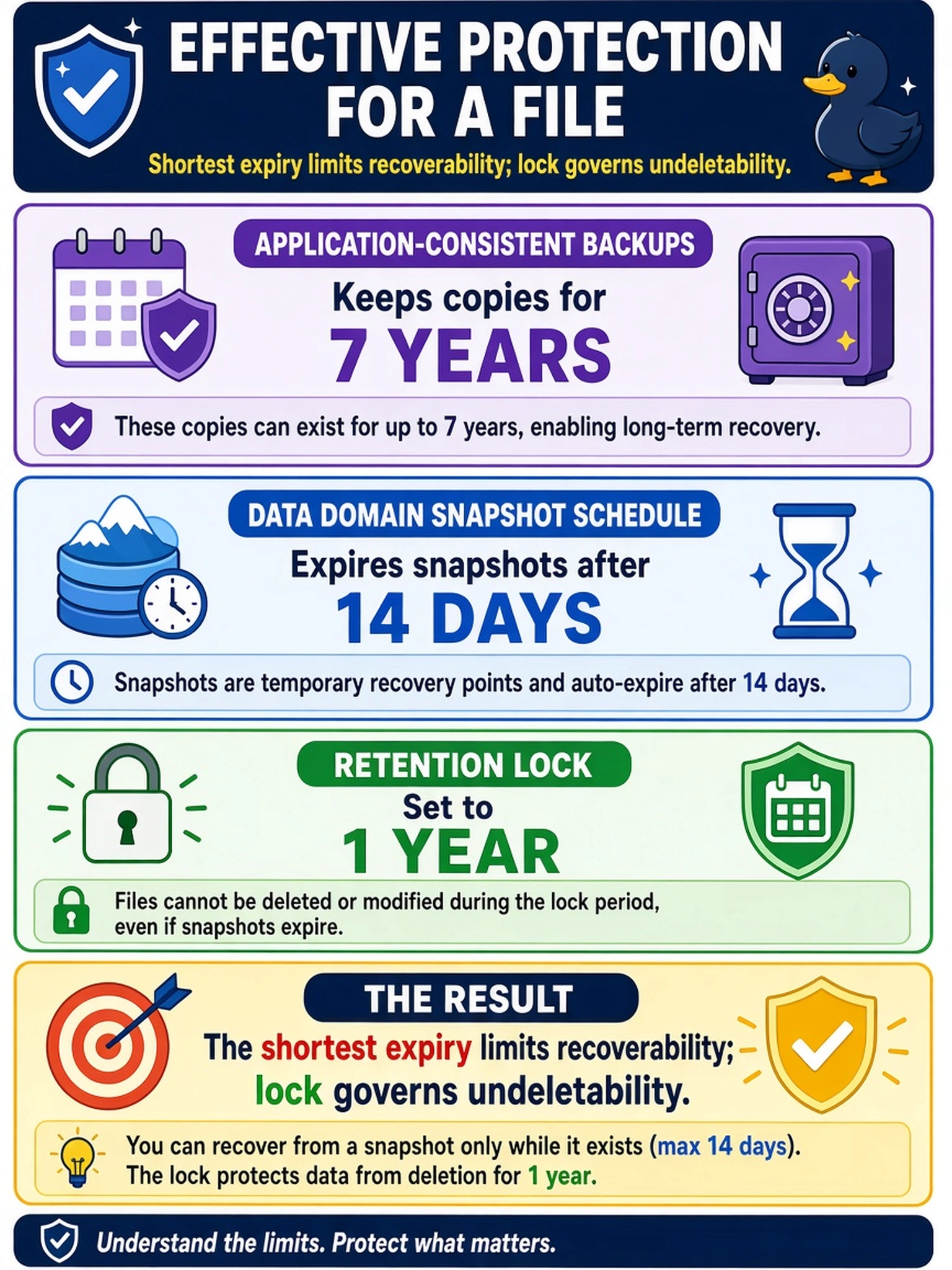
During a post-deployment review, a backup application keeps application-consistent copies for 7 years, a Data Domain snapshot schedule expires snapshots after 14 days, and retention lock is set to 1 year. Which statement best describes the effective protection for a file?
Select an answer to reveal the explanation.
Short Explanation
Think of protection like a chain: the shortest link decides whether you can still get the data back. Your application can promise seven years, but if an appliance snapshot expires in fourteen days, that promise is hollow; retention lock only decides whether someone can delete what still exists. Align the layers deliberately instead of trusting the biggest number.
Full Explanation
Effective protection is determined by the most restrictive layer in the protection chain. The backup application may schedule long-term retention, but if a Data Domain snapshot or protected object expires earlier, the restore point may no longer be available to the application. Retention lock provides a separate guarantee: while active, it prevents deletion of data within its configured lock period, but it does not extend the expiry date of snapshots or copies that have already become unavailable. Therefore, alignment is required among application retention, appliance expiry, and lock settings. A longer application retention period does not make a copy recoverable once the underlying Data Domain copy has expired. A lock period does not make data undeletable beyond that period, nor does it compensate for shorter snapshot expiry. Snapshot expiry is not cosmetic; if recovery depends on that snapshot, its expiration directly reduces the window in which the file can be restored. Exam caveat: treat retention and immutability as distinct controls, and choose the shortest recoverability constraint when determining true protection. Operational check: list the application retention value, the Data Domain expiry or snapshot schedule, and the retention lock duration, then compare them against the required recovery window and adjust the shortest layer.