
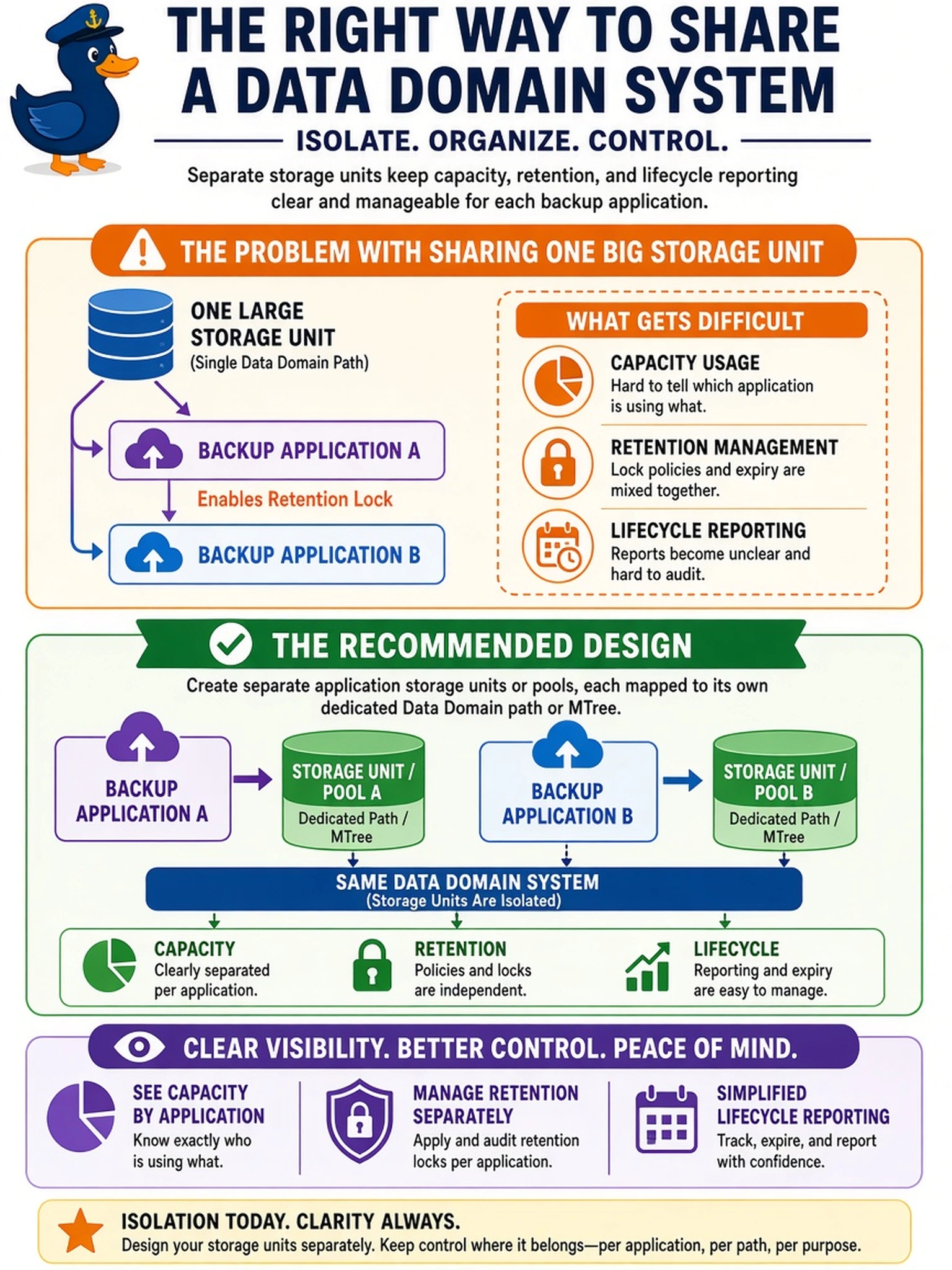
During post-deployment, two backup applications share one Data Domain system. The administrator creates one large storage unit pointing to a single Data Domain path, then maps both applications to it. After one application enables retention lock, capacity usage and lifecycle reporting become difficult to separate. Which storage-unit design should be used?
Select an answer to reveal the explanation.
Short Explanation
Think of storage units like separate mailboxes for each application; if you shove both into one box, you cannot tell whose mail, retention, or cleanup is whose. You should give each application its own Data Domain path or MTree, then point its application storage unit at that dedicated path. That keeps capacity, lifecycle, and retention controls from bleeding into one another.
Full Explanation
Data Domain MTrees and other dedicated storage paths act as logical boundaries for backup workloads. When backup software storage units or pools are mapped one-to-one to separate appliance paths, each application can have its own capacity accounting, retention behavior, lifecycle cleanup, retention-lock state, and troubleshooting context. That separation matters when multiple consumers share one appliance because maintenance, upgrades, and policy changes should affect only the intended workload. A shared storage unit with subdirectories may organize files, but it does not provide the same clean storage-unit boundary for application-level capacity, lifecycle, and policy enforcement. Relying on application tags, client names, or Boost tags does not create separate lifecycle or capacity management at the appliance path level, so cleanup and retention decisions remain ambiguous. Replication contexts are useful for replication grouping and failover relationships, but they do not replace a dedicated local storage-unit mapping for each application. Exam caveat: choose the answer that gives each backup application a dedicated Data Domain path or MTree rather than a shared path with logical tags. Operational check: after configuration, confirm each application storage unit resolves to its own Data Domain path and that reporting shows distinct capacity and lifecycle usage per application.