
The DBA team wants Oracle RMAN backups landing on the new Data Domain with the full deduplication benefit. They have mounted an NFS export from the appliance on the database hosts and propose writing RMAN backup sets to that filesystem as plain files. What should the deployment do instead for proper database-level connectivity?
Select an answer to reveal the explanation.
Short Explanation
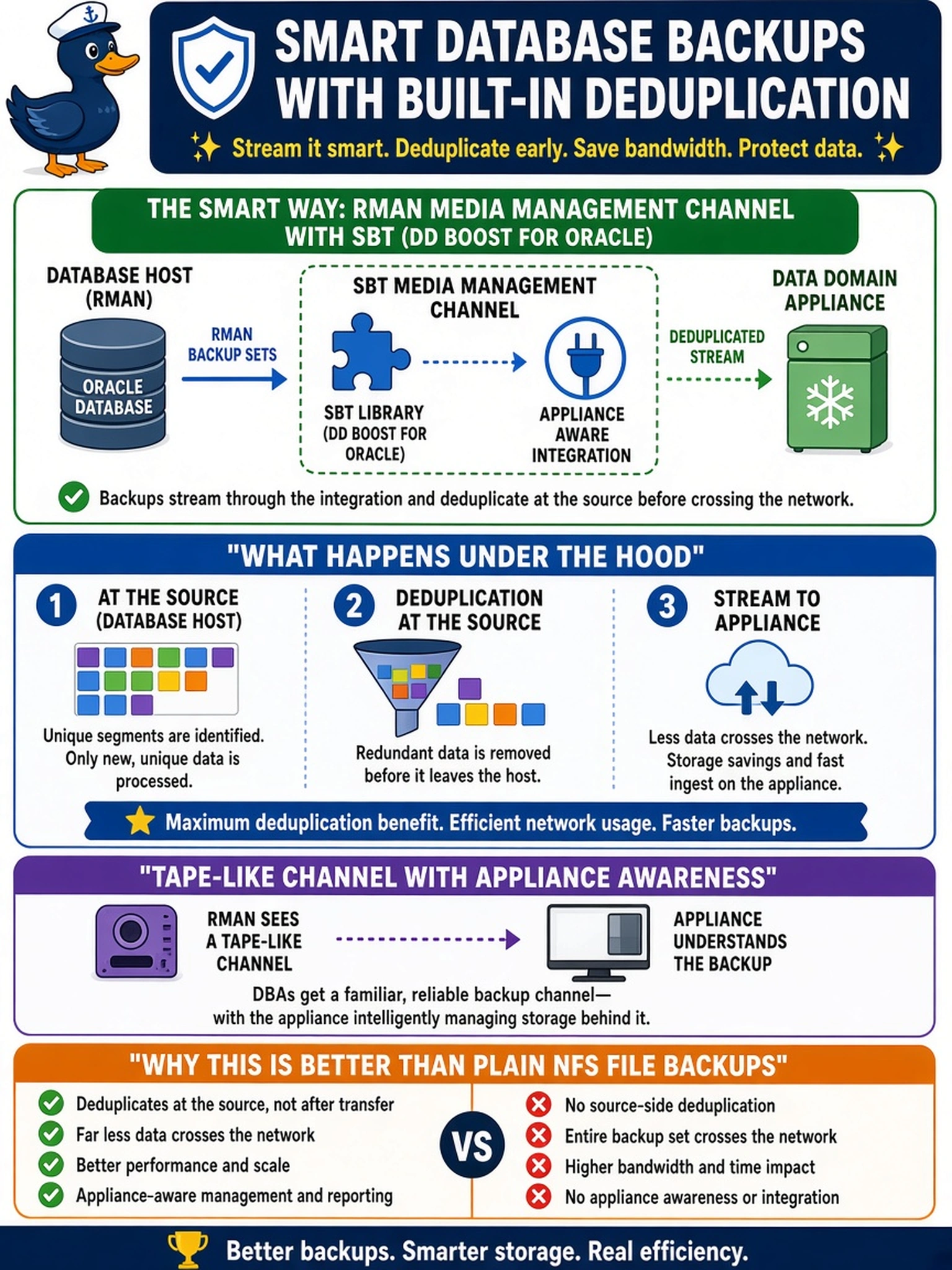
RMAN already has a tape-shaped hole cut for exactly this job, and it's called the SBT channel. Drop the Boost library into it and your database streams backups through an integration that dedupes at the source, while RMAN never notices the target isn't tape. An NFS mount works as plain files, sure, but you've traded away the best part of the appliance for a shorter wizard.
Full Explanation
The correct database path is media management: Oracle RMAN talks to an SBT library, and the vendor's Boost-provided library plugs into it so channel allocate statements direct backups through the integration. The library performs source-side fingerprinting and deduplication, transmitting only unique segments to the appliance's storage unit while RMAN keeps its normal catalog, incremental, and restore semantics. Setup means the Boost license, a library install or symlink on the database host, and a dedicated least-privilege user plus storage unit on the appliance. The NFS-mount plan does function as file storage, since ingest deduplication on the appliance still squeezes the result, but it moves every byte across the wire, forfeits media-management integration, and leaves restore planning on a filesystem mount; calling it complete misjudges what the scenario asks for. VTL-backed SBT channels are a legacy emulation path rather than the only supported integration, and they add tape bookkeeping without source-side deduplication. The built-in-awareness claim is wrong as a rule: RMAN speaks the SBT API and relies on vendor-supplied libraries, so no version auto-discovers an appliance. Exam caveat: validate the restore and crosscheck paths through the SBT channel, not just successful backups. Operational check: run an RMAN backup and a restore test through the SBT channel and compare bytes sent by the host against bytes ingested by the appliance.