
Four consumers request the same new Data Domain: NetBackup media servers, a backup server that only writes to mounted shares, a NetApp filer estate, and an archive platform that speaks only S3. A junior engineer asks which single protocol the appliance should therefore be deployed with. What is the right answer?
Select an answer to reveal the explanation.
Short Explanation
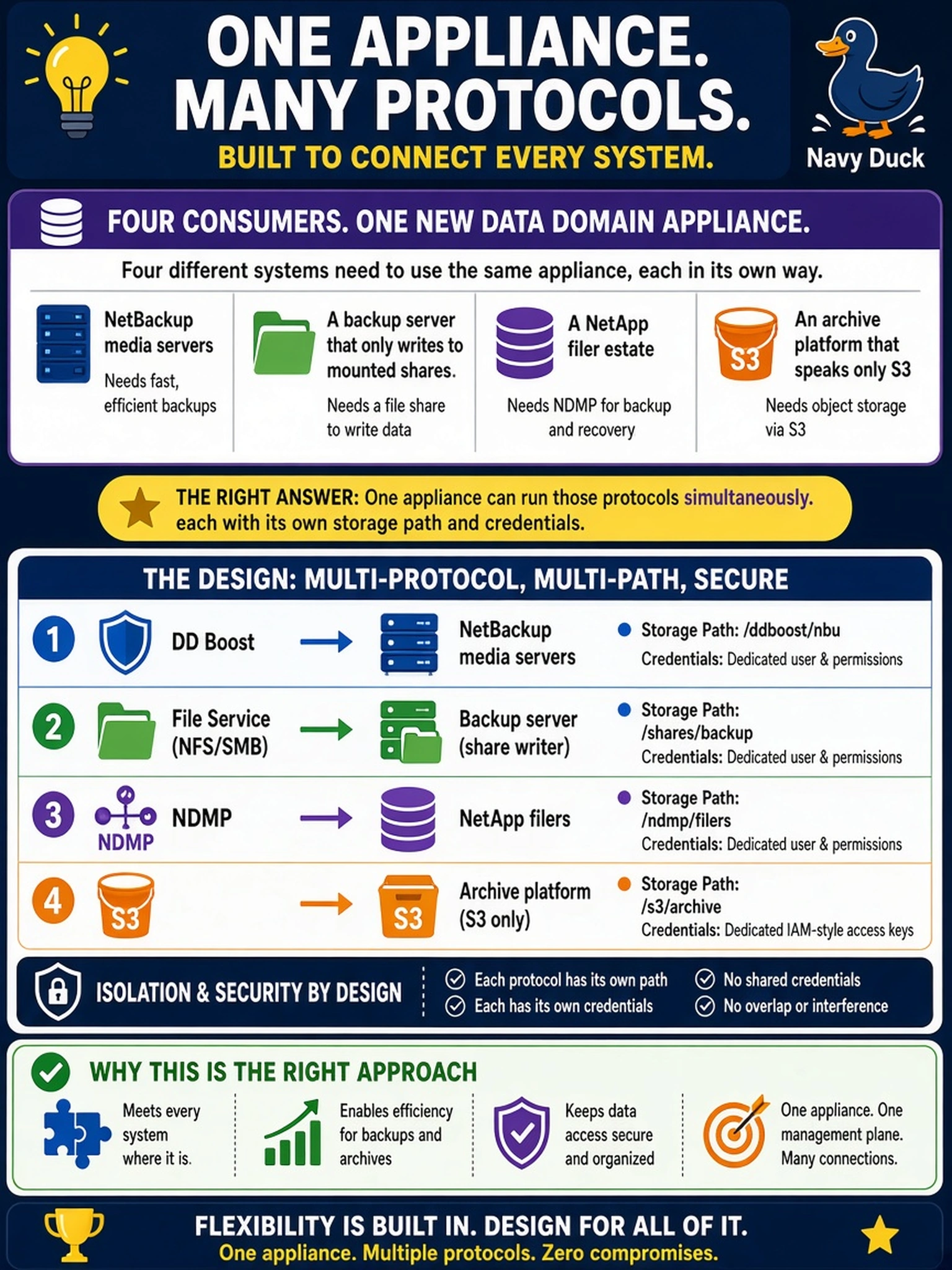
Here's a fact that surprises a lot of people: your Data Domain isn't a one-protocol dance floor. Boost, CIFS or NFS, NDMP, and S3 can all run side by side on your box, each in its own lane with its own MTree and users. Forcing everyone onto one 'simple' protocol just taxes the very workloads that already had an optimized path to begin with.
Full Explanation
The appliance operating system runs its data services concurrently, so protocol choice is made per consumer from what each application can do: an OST or Boost integration for NetBackup's media agents, a CIFS or NFS export for the plug-in-less backup server, NDMP paths for the filers, and the object store endpoint for the archive platform. Each consumer then gets a dedicated MTree and its own access identity, which keeps permissions, retention, and replication scoped, while all paths share one capacity pool and the filesystem's deduplication reaches across storage paths, so nothing is lost by separating them. Routing every workload through the biggest application's media servers adds double-hop data movement and strips the native integrations away from the smaller consumers. The NFS-everywhere plan buys simplicity with fragility, inventing conversion gateways that must translate S3 request semantics into file operations that do not exist. The one-mode-per-system premise is simply false; mixed-protocol service on a single system is normal, documented operation rather than a compromise. Exam caveat: never serve the same storage path over two file protocols at once, even though different paths may use different protocols on the same box. Operational check: enable each service, complete one test write from each of the four consumer types, and confirm each lands in its own MTree.