
A small virtualization shop runs a backup server that can only write its backup files to mounted shares; the product offers no plug-in or appliance integration of any kind. The new Data Domain must serve as the target anyway. What has to exist on the appliance side for this backup connectivity?
Select an answer to reveal the explanation.
Short Explanation
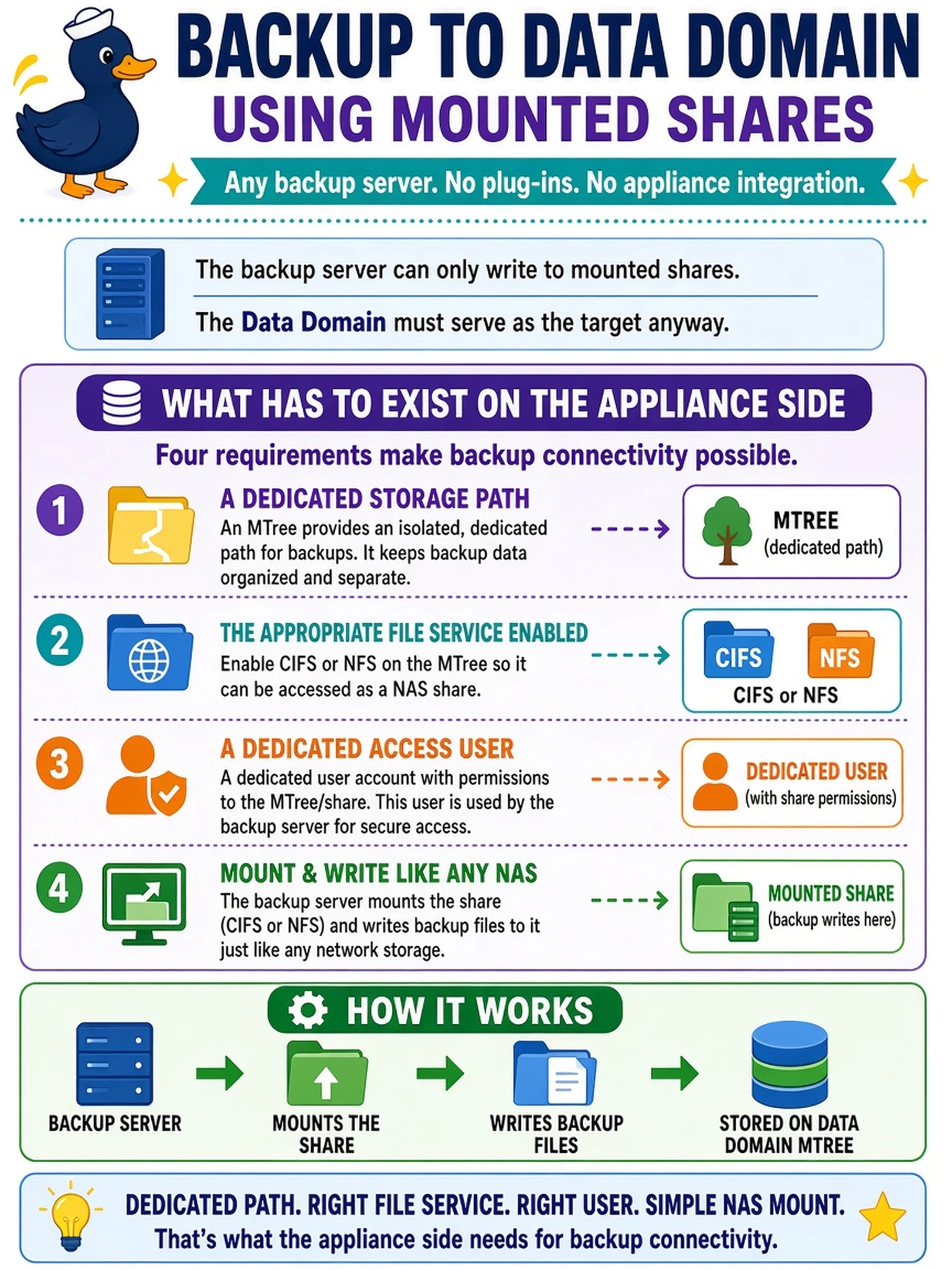
No plug-in? No problem, because every Data Domain is also a very smart file share. Create a dedicated MTree, enable CIFS or NFS, hand the backup server its own user account, and mount it like any NAS. You are not losing the dedupe on the box, you are only losing the source-side dedupe a Boost plug-in would have done for you.
Full Explanation
Target-side deduplication happens when data is ingested into the filesystem, independent of the protocol that delivered it, so a backup application with no integration support can still benefit from the appliance through a plain file share. The connectivity design is concrete: create a dedicated MTree for this consumer, enable the CIFS or NFS service, create a least-privilege user scoped to that path, and have the backup server mount it, with client-side persistence configured so the mount survives reboots. The honest trade-off is that all data crosses the network in full and single-session file protocol limits apply, but the appliance still stores only unique segments. The claim that file mode stores every byte verbatim fails by mechanism, since ingest deduplication is protocol-agnostic; what file mode forfeits is only the source-side elimination that Boost-class integrations provide. The optimized-endpoint requirement reverses the situation: integration endpoints exist for applications that support them, and an application without plug-in support simply cannot use that path. Virtual tape presents SCSI tape devices, not a filesystem, so a product designed to write files has no way to address drives as disks. Exam caveat: restrict which clients may mount the share rather than opening the path to the subnet. Operational check: mount the share, run a test backup, and confirm the MTree's deduped logical-versus-physical usage before accepting.