
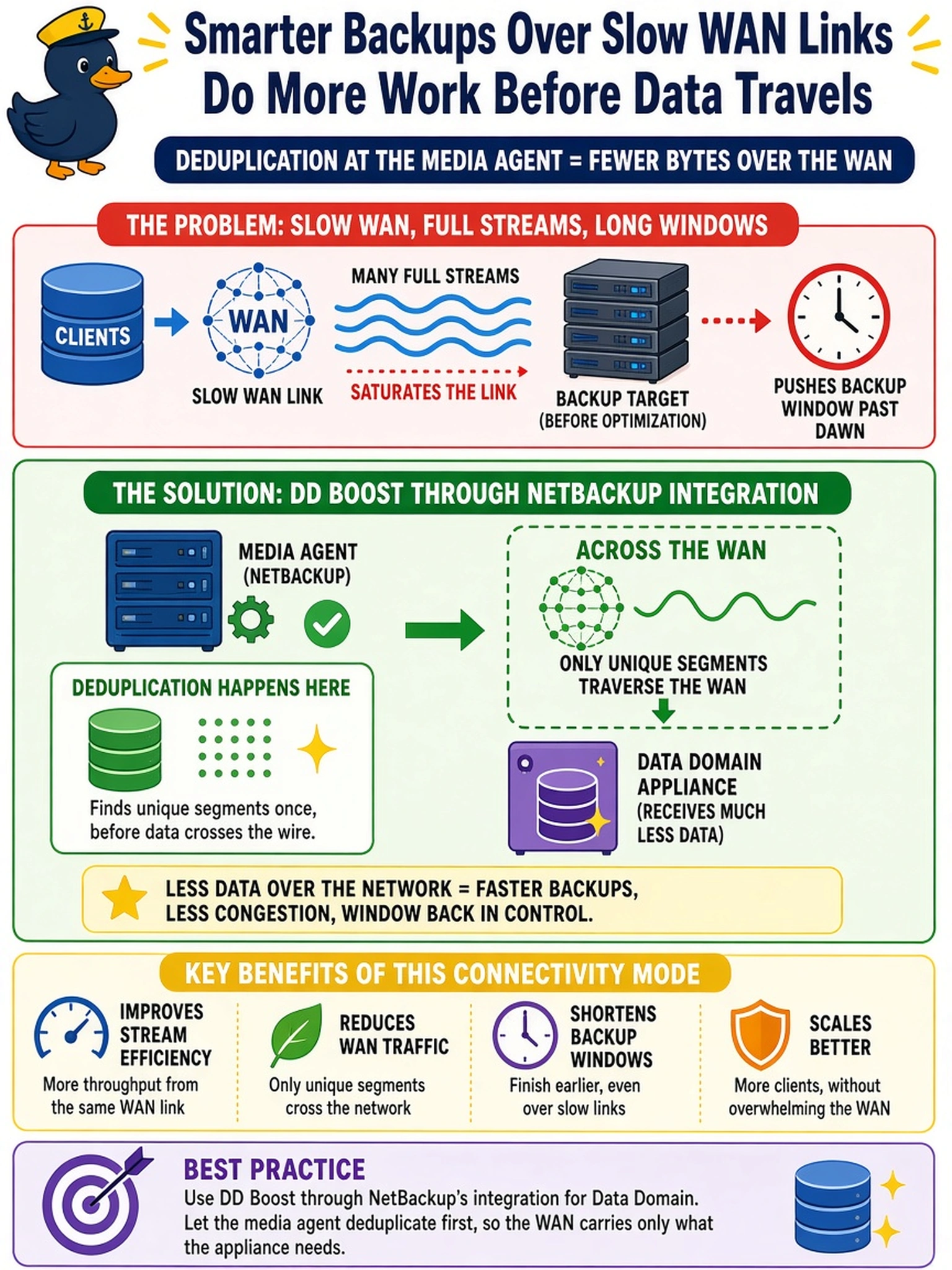
A NetBackup environment backs up clients located across slow WAN links, and backup streams routinely saturate those links, pushing the window well past dawn. The architect is wiring in a Data Domain and wants the connectivity mode that most improves stream efficiency across the network before the appliance ever sees a byte. Which choice fits?
Select an answer to reveal the explanation.
Short Explanation
When the WAN is the bottleneck, the winning move is to stop sending data the appliance would throw away anyway. DD Boost hands that job to the backup software's own plugin, deduplicating at the source so only the unique bits cross the wire. Mounting a plain share and hoping is not a strategy; the integration exists precisely for your scenario.
Full Explanation
The defining feature of DD Boost is source-side processing: the integration library loaded by the backup application's media agent fingerprints the stream and performs variable-length deduplication before transmission, so only unique segments reach the appliance, frequently cutting WAN bytes by orders of magnitude while multiple parallel streams lift throughput. Deployment requires the matching integration or plug-in on the media agent, a Boost license, and a storage-unit plus least-privilege user configured on the appliance, but the payoff lands exactly where this scenario hurts, on the wire. A generic CIFS or NFS target still transfers every byte of every stream in full, since target-side deduplication happens after arrival and compression cannot substitute for eliminating duplicate segments; NDMP, meanwhile, is a filer-backup protocol and does not optimize ordinary client streams at all. Virtual tape presents emulated drives that absorb complete written images with no source-side deduplication, making it the worst match for a bandwidth-starved WAN even though it suits tape-only applications elsewhere. Exam caveat: confirm supported application and plug-in versions at both ends before committing the design. Operational check: after configuration, run a test backup and compare bytes received at the appliance against bytes sent by the media agent to confirm the WAN reduction.