
A backup product offers two ways to target a new Data Domain: a generic SMB share mount, or the vendor's dedicated dedupe-appliance integration for Data Domain. The administrator prefers the share route because its wizard is simpler and needs no extra software. Why should the integration win this argument?
Select an answer to reveal the explanation.
Short Explanation
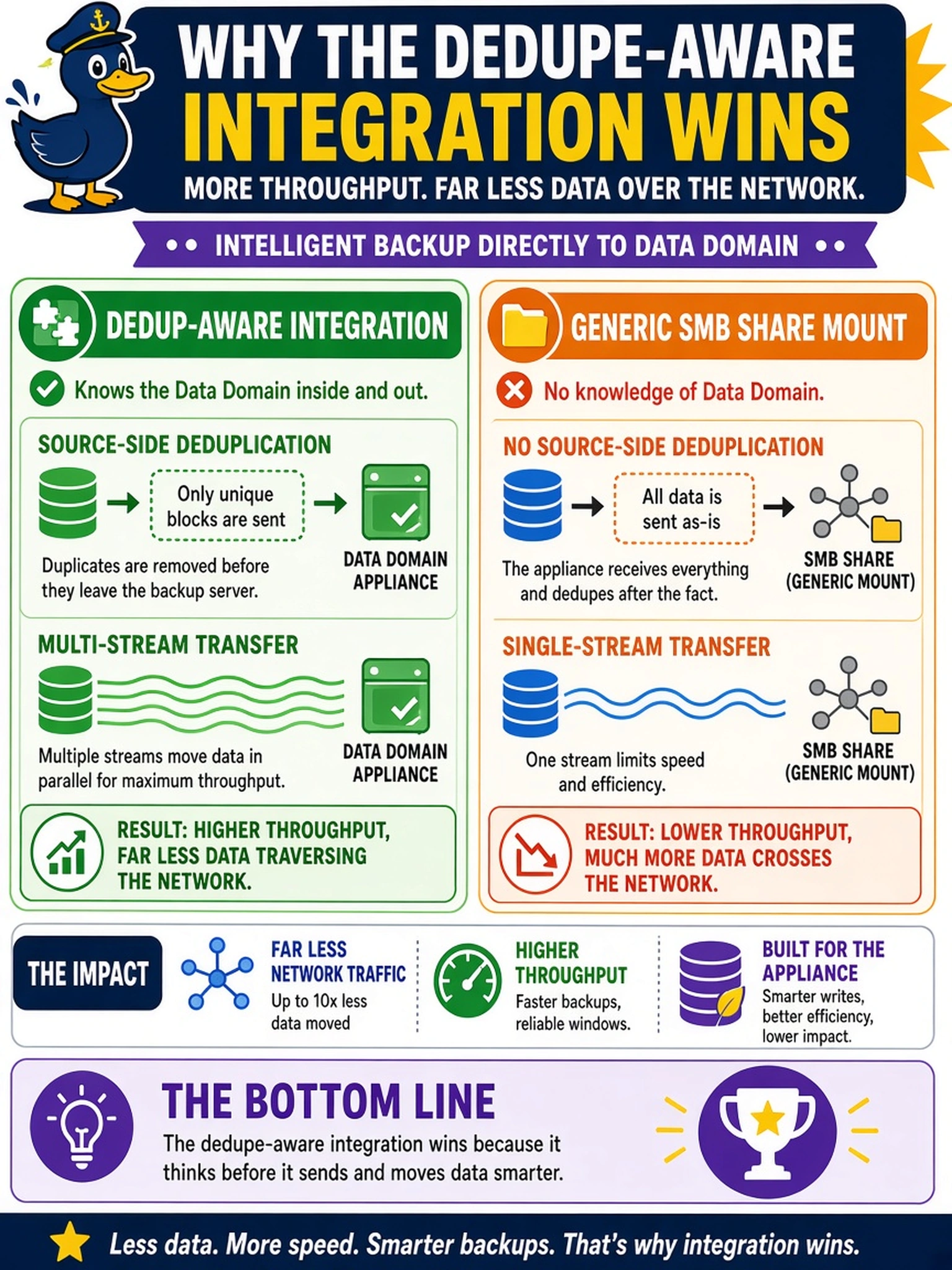
When your application offers a handshake, don't wave at it from across the room. The dedupe-appliance integration speaks the appliance's language, deduping at the source, fanning into parallel streams, and reporting real status, while a share mount is just a pipe. The simpler wizard is the trap here; you will pay for the missing efficiency in longer windows, not shorter ones.
Full Explanation
Deduplication-aware integrations, of which DD Boost and the OpenStorage dialogue are the Data Domain examples, change where the work happens: the media agent fingerprints segments and sends only unique data, opens multiple parallel streams for throughput, and exchanges application-aware status so failures surface with meaning. A generic CIFS mount moves every byte over the wire and depends on target-side ingest for deduplication, which works but leaves network efficiency and per-session throughput limits untouched. The dismissal of share targets as archive-only fails the facts, since file-share targets are fully supported for backup repositories and are commonly deployed where no plug-in exists; what they lack is optimization, not legitimacy. Encryption is a protocol capability rather than a mode gate, as modern SMB deployments can encrypt sessions and TLS covers other paths, so claiming only integration mode can secure transfers mislocates the feature. Retention and immutability are likewise configured on the appliance against the storage path, compliance and retention-lock features applying regardless of which protocol wrote the data. Exam caveat: integrations require supported application versions and licensing, so verify the compatibility matrix before choosing the integration path. Operational check: run an equivalent test backup both ways and compare bytes-on-wire and ingest duration against the window requirement.