
The customer eventually plans to run fourteen DD systems and asks whether all the per-system GUI work so far was wrong. What is the correct answer?
Select an answer to reveal the explanation.
Short Explanation
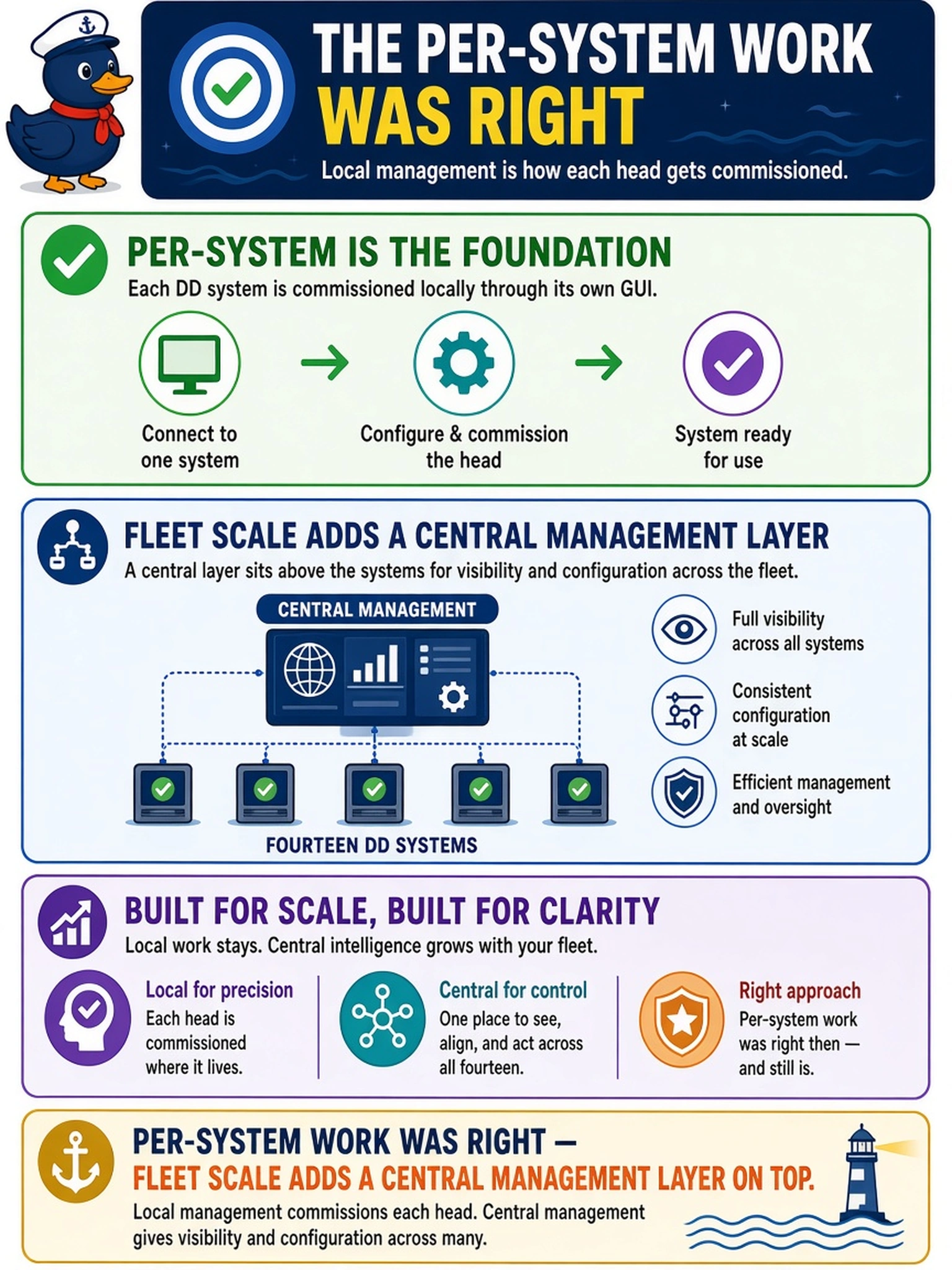
Fourteen systems doesn't make your single-system work retroactively wrong — someone had to commission each box, and that someone was you, at the local GUI. What fleet scale adds is a manager layer on top, because nobody should capacity-plan fourteen logins. The tool grows up; the foundation you laid stays.
Full Explanation
Single-system commissioning stays correct at any eventual fleet size: local management — GUI or CLI aimed at one head — is how a system is brought up, and its addresses, users, and certificates are precisely what a fleet manager later inventories. The scale change is additive: with many systems in view, a central management platform is layered on for fleet-wide visibility, capacity rollups, and configuration tasks that span boxes, while the per-system access knowledge remains the foundation each registration depends on. Redoing the work through per-system CLI scripting fails the scale logic: retyping the same work box by box automates one layer below where a management platform operates, and buys no cross-system view. A support limit of exactly one system for the local GUI is an invented ceiling — fourteen heads do not break local access; they merely make per-box-only operation tedious and error-prone. Refusing the manager layer as pure added risk fails the other direction: without cross-system visibility, capacity, upgrades, and compliance drift independently on every box. Exam caveat: scale changes the tooling layer, not the correctness of the single-system access task. Operational check: give the central manager its own address and access plan in the design, then inventory each head's management entry points as registration inputs.