
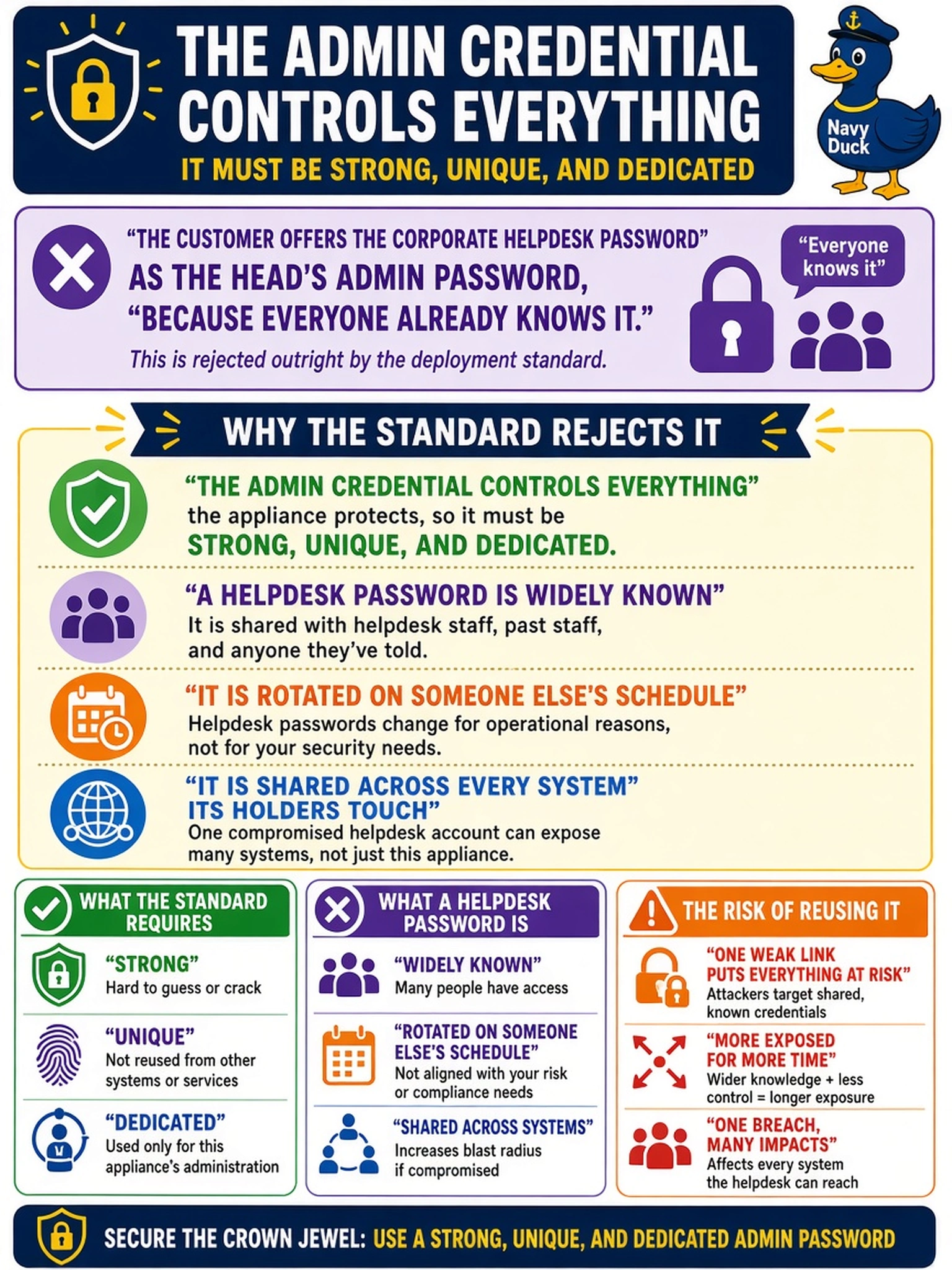
The customer offers the corporate helpdesk password as the head's admin password, 'because everyone already knows it.' Why does the deployment standard reject this outright?
Select an answer to reveal the explanation.
Short Explanation
The admin password is the master key to the most locked room in the data center — and 'everyone already knows it' is a reason not to use it. A shared helpdesk password is widely known and weakly rotated, and it erases who did what; when something breaks, you won't know which 'everyone' to blame. Give your appliance its own strong credential, vault it, and share nothing.
Full Explanation
The admin credential is the single strongest door on the appliance — control over configuration, access, and the protected data itself — so deployment standards require it to be strong, unique to the system, and dedicated to the role. A helpdesk password fails on three independent axes: it is widely known by design, its rotation cadence belongs to another process entirely, and sharing one credential across systems and people destroys attribution of privileged actions. Platform password policy exists precisely to push credentials away from this class of exposure. Special-character incompatibility fails as the wrong reason: the defect is exposure and sharing, not which characters tripped a rule — a weak password that passes complexity is still weak. Claiming the password stops mattering after named accounts exist fails on the window and the fallback: the admin credential remains a valid door, often the recovery door, so its strength matters permanently. Segmentation excusing a weak credential fails by layering: network isolation reduces the attack surface but is not authentication strength, and hardening privileged credentials assumes adversaries can already reach the segment. Exam caveat: privileged access on backup infrastructure is audited as a data-protection control, not just an IT hygiene item. Operational check: set a dedicated strong admin password, store it in the customer's credential vault, and remove the shared password from every document that named it.