
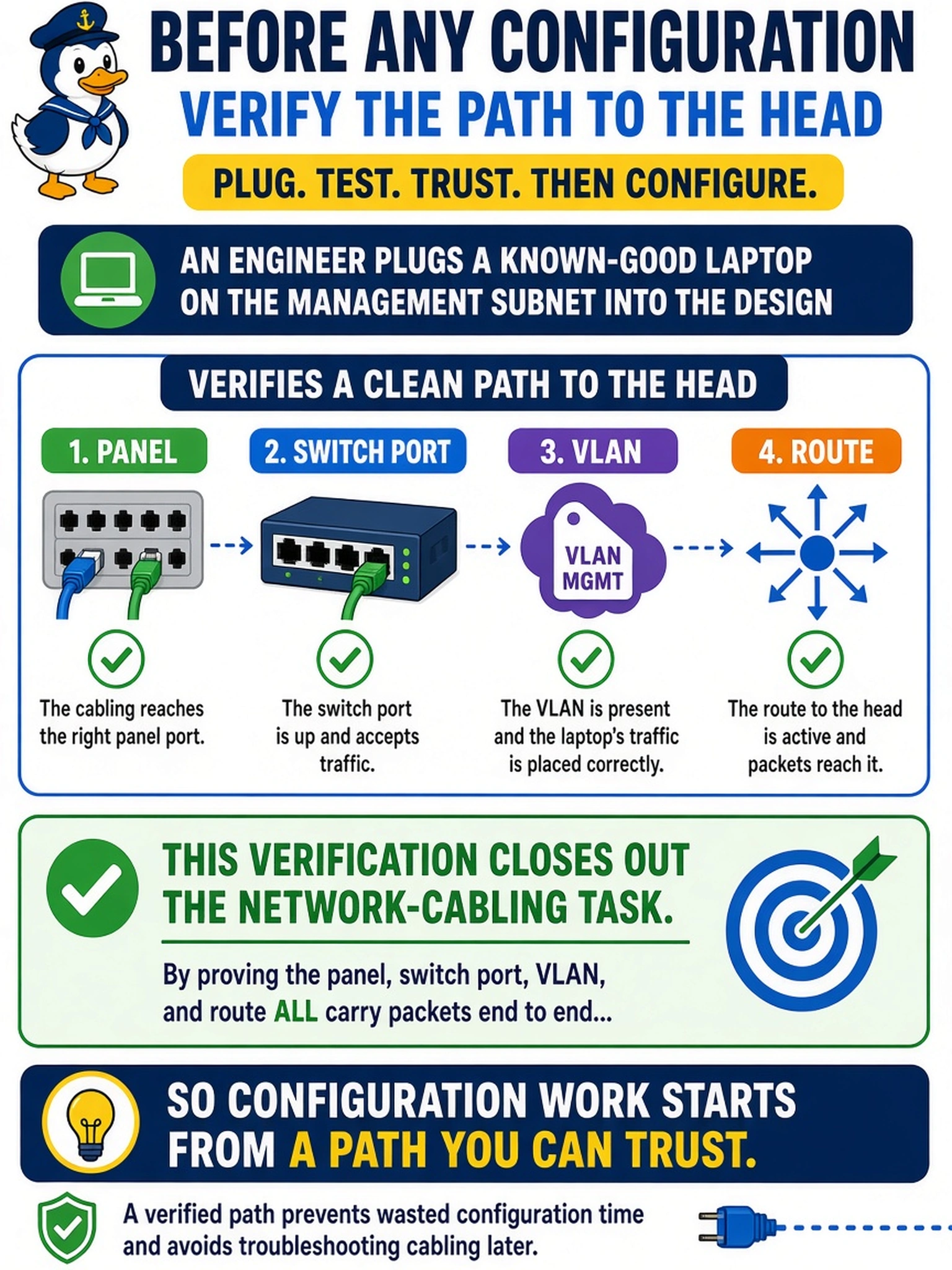
Before any configuration, an engineer plugs a known-good laptop on the management subnet into the design and verifies a clean path to the head. Which task does this verification close out, and why at this point?
Select an answer to reveal the explanation.
Short Explanation
Prove the road before you drive on it. A laptop on the management subnet that reaches the head tells you the patch panel, switch port, VLAN, and addressing all work — so when something misbehaves later, you know where not to look. That one test closes the cabling task; skipping it just moves the discovery to a worse time.
Full Explanation
End-to-end verification is the acceptance test that closes the cabling task. Physically connecting cables only claims the task; proving that a known-good host on the management subnet exchanges traffic cleanly with the head validates the whole chain — patch cord, panel, switch port, VLAN membership, routing, and the head's physical interface — before a single configuration minute is invested. Starting from a verified path means later symptoms point at configuration rather than wiring, which makes every subsequent debug shorter and more reliable. Closing the rack-installation task with this test fails because mounting is verified by rails, load rating, clearances, and bonding — reachability is evidence about cabling, not about brackets. Reducing the test to warming ARP caches undersells it: it detects or eliminates whole classes of fault — wrong VLAN, dead port, duplicate or mistyped address — which is exactly why the schedule gates on it. A licensing gate on network response is invented: addressing and link behavior on a fresh system are independent of license state. Exam caveat: the verifying host should be one you control, so a fault can never be blamed on the test client. Operational check: run ping and traceroute from the admin address to the head's intended interface, confirm lossless symmetric paths, and only then open the configuration wizard.