
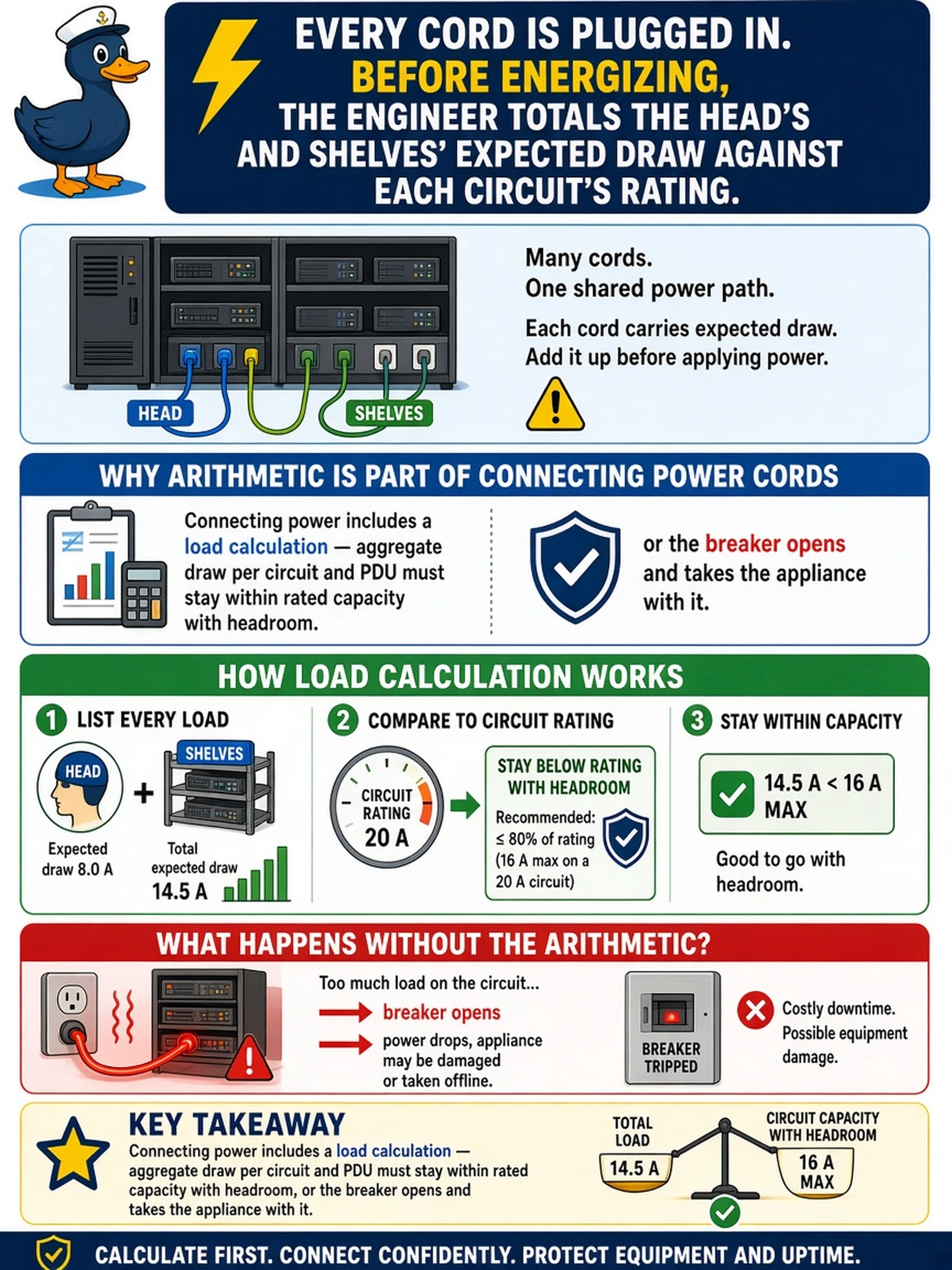
Every cord in the stack is plugged in, and before energizing, the engineer totals the head's and shelves' expected draw against each circuit's rating. Why is this arithmetic part of connecting power cords?
Select an answer to reveal the explanation.
Short Explanation
Plugging in the cord isn't the job — the cord is a promise against the breaker's rating. Overload a circuit and the breaker does its job at the worst possible moment: halfway through a restore at closing time. Total the load per circuit before you energize; physics doesn't negotiate.
Full Explanation
Connecting power is a load calculation as much as a physical act. Circuits and PDUs carry rated capacities, and breakers are sized to open on sustained overload. A Data Domain head with expansion shelves draws real, variable power — significantly above idle during deduplication, replication, and backup ingest peaks — so summing expected load across everything served by each circuit and comparing it against breaker and PDU ratings with headroom is what prevents the classic failure: a healthy-looking appliance tripping its own branch circuit during its busiest hour. Refusing boot on cord-gauge mismatch invents a check the platform does not perform — the appliance cannot measure the upstream circuit before it is energized, which is precisely why the human calculation is the safeguard. Shrinkage of draw over early operation fails by physics: storage workloads grow toward peak, so initial low load is the least reliable basis for sizing. PDU meter calibration fails by task substitution: meter accuracy is a factory and facility property, and no number of cords plugged in simultaneously calibrates anything. Exam caveat: redundant PSU legs split across two circuits mean the arithmetic must be done per circuit, counting what actually lands on each. Operational check: for every circuit serving the stack, sum expected load against rating with growth headroom, verify breaker sizes match, and record the table in the as-built.