
The customer 'turns on jumbo frames' on the one switch port facing the replication link and declares it done, yet replication throughput never changes. What understanding is missing here?
Select an answer to reveal the explanation.
Short Explanation
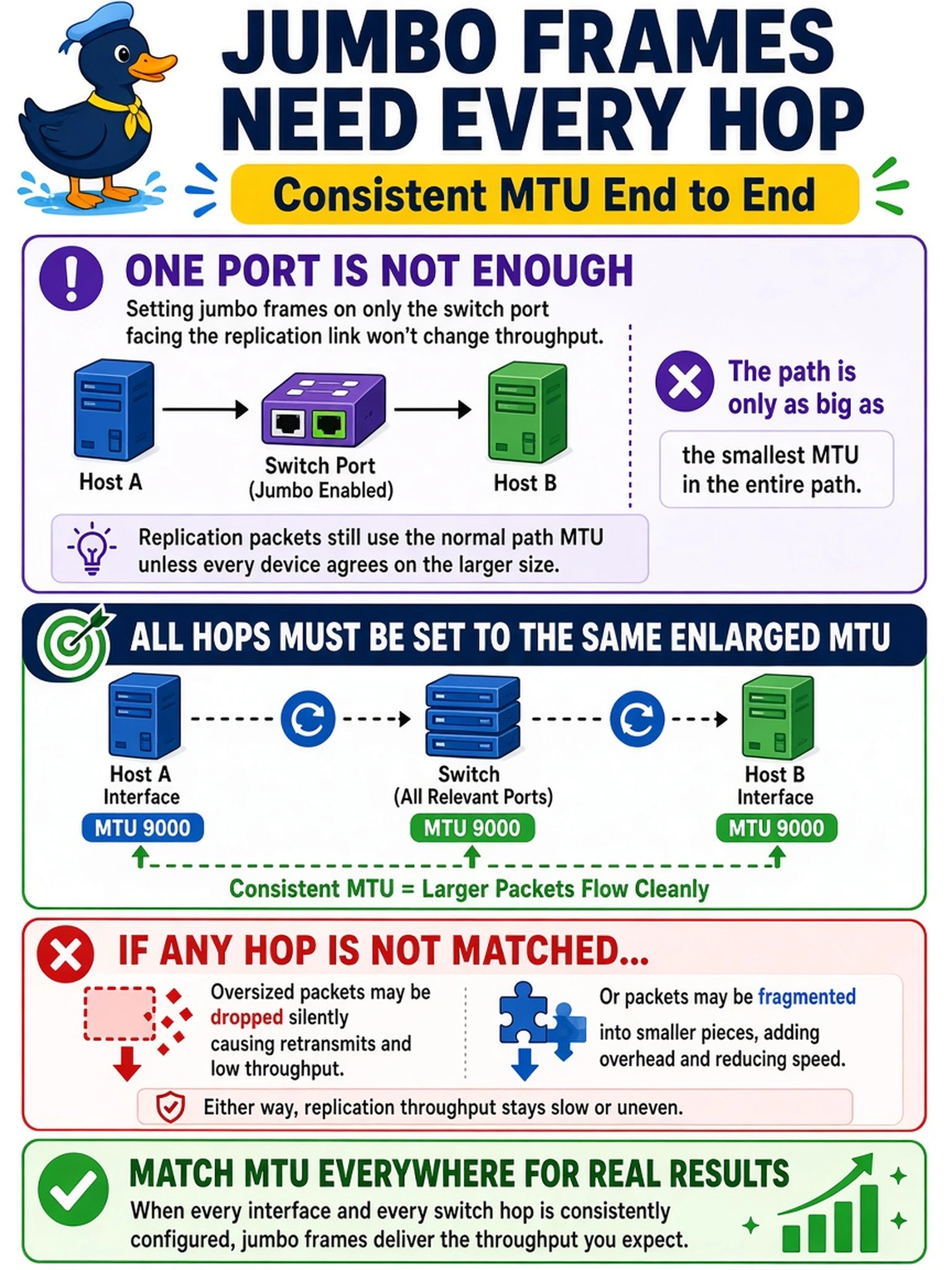
Jumbo frames are a group decision, not a switch-port checkbox. One small hop anywhere along the path and your big packets get dropped or fragmented, leaving throughput exactly where it started. Walk the whole path — both ends and every switch between — and make them all agree on the size you intended.
Full Explanation
MTU is a per-hop property. A frame carrying an oversized payload must be accepted by every interface on its path — the sending host, every intermediate switch port, and the receiving host — and a single hop left at the standard size drops the oversized frames, or where permitted pays fragmentation's cost, so a replication flow configured for jumbo at one point sees no change at all. That is precisely why throughput stayed flat after one port was changed: the enlargement must be configured consistently across the complete end-to-end path before any benefit exists. Requiring 9216 on everything fails by concept: jumbo sizes vary — 9000 is widely used — and switches honor configured values rather than one magic number, so the rule is consistency, not a particular figure. Automatic MTU detection on the appliance is invented: interface MTU is a configured setting at each end with no mechanism that advertises and forces it from the switch, which is exactly why path-wide configuration is the discipline. A special-optic requirement for jumbo fails technically: jumbo is ordinary Ethernet framing with a larger payload limit, and the media or optic class does not constrain it. Exam caveat: the path includes every intermediate switch, not just the two access ports people remember. Operational check: set the same MTU on both DD OS replication interfaces and every port between them, then prove the path carries a large sized ping end to end.