
Six identical blue cables leave the head's rear and disappear into the same top-of-rack switch. Which labeling practice prevents a mis-patch during future work?
Select an answer to reveal the explanation.
Short Explanation
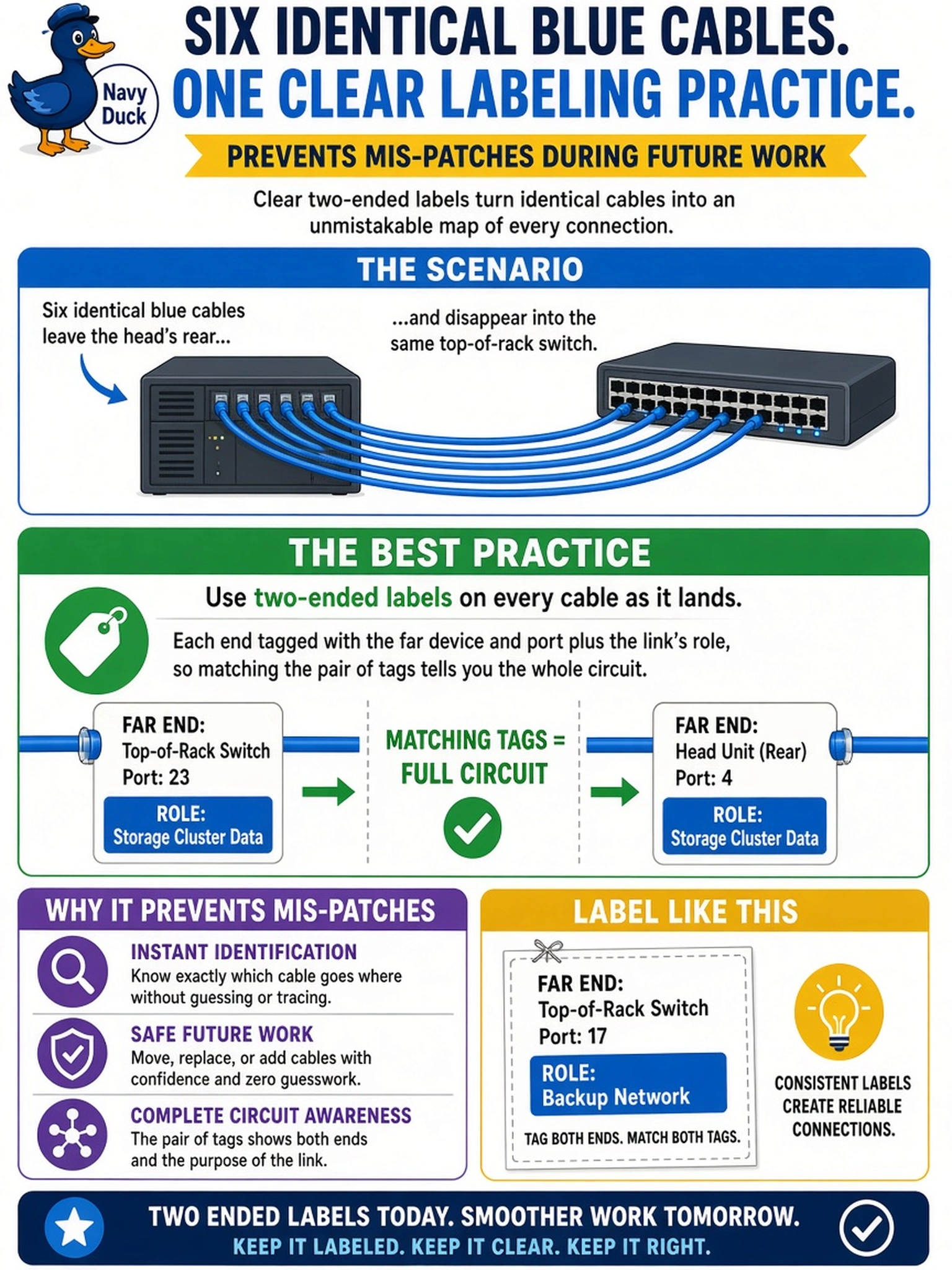
Six identical blue twins wearing no name tags — you know this story. One wrong cable pulled in the dark and you're auditing your labeling policy at two in the morning. Both ends, every cable, naming the far end: do it as each cable lands, not later as a rescue project.
Full Explanation
Traceability is created at cable time, while the truth is known. A label on both ends of every cable, each naming the far device, the far port, and the link's role, gives the circuit two-ended identity: matching the pair of tags states the whole path, so any technician — including a future you with no memory of install day — can identify a cable without tracing it by hand, and a planned change names its target before anyone touches anything. A single mid-bundle label fails because the unknown in any trace is the far end: a tag buried mid-run resolves neither side and is usually under the dressing when it is needed. Color-by-role without written records fails on human memory: schemes erode as roles multiply, staff change, or a role is repurposed months later — documentation must outlive recall. A desk spreadsheet with no physical tags fails at the moment of truth: it records what should be true but cannot point at one cable among six identical blues, which is exactly when labels bridge document and reality. Exam caveat: labeling belongs to the cabling task, applied as each cable lands rather than retrofitted. Operational check: every cable's two tags agree with each other and with the as-built records before sign-off.