
The network team offers one access-VLAN switch port today, while the design calls for tagged VLAN separation later for tenants. What should the deployment do about the switch side while cabling?
Select an answer to reveal the explanation.
Short Explanation
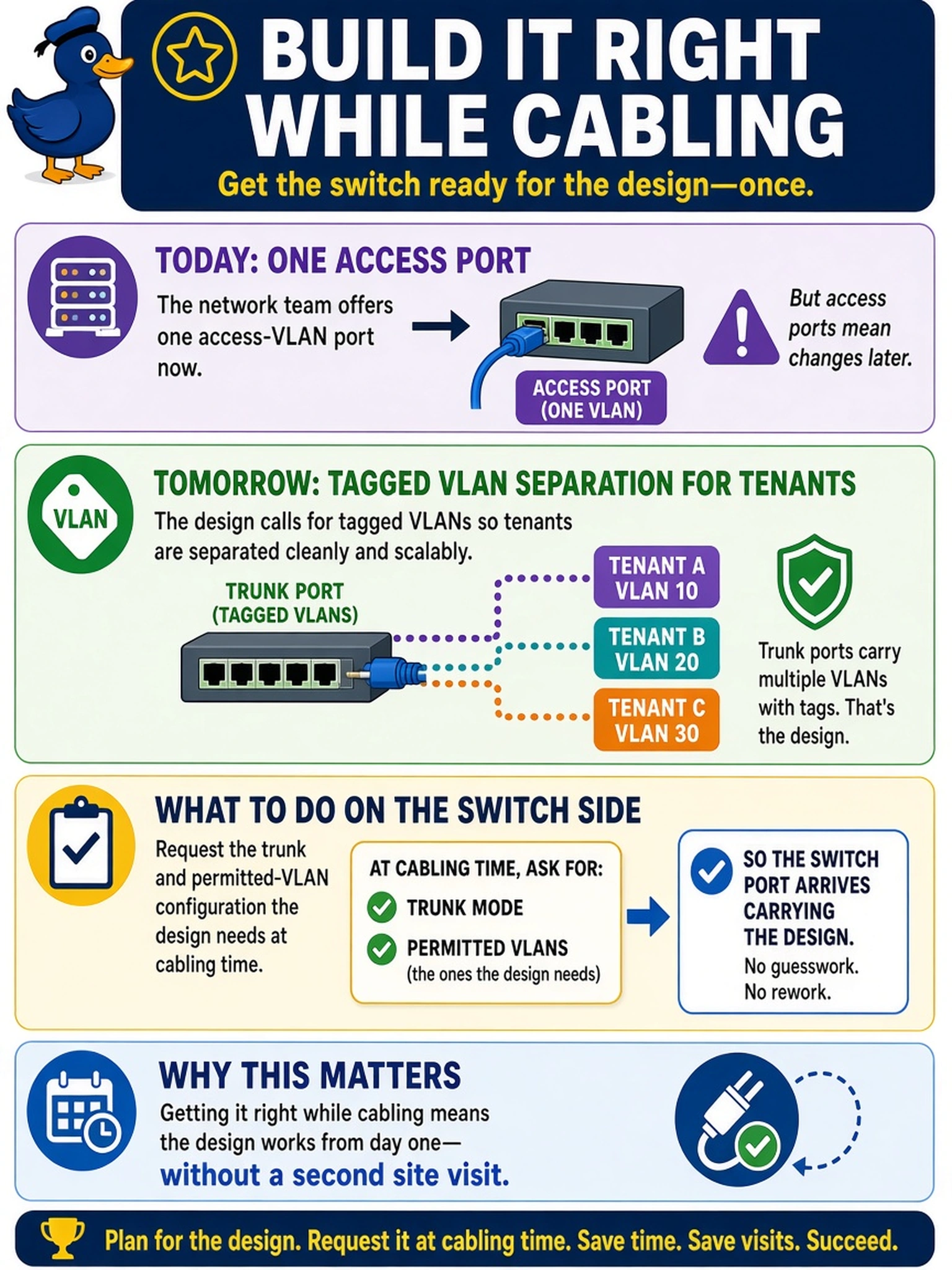
Cabling closes a plan, so a port that can't do the design's job is a plan already broken. An access port today with tagging planned for tomorrow means the tenant traffic has nowhere to land — and the return truck roll will land on you to explain. Ask the network team for the trunk and VLANs now, before the cable clicks in.
Full Explanation
Tagged tenant separation is a two-sided configuration: the DD OS interface can carry tags only as far as the switch port will carry them, and the port must be a trunk with the design's VLANs permitted for the appliance's tagged traffic to reach anything. Requesting that switch-side capability as part of the cabling task means the physical port arrives ready for the design instead of forcing a second visit under production pressure — the cable and the switch-port plan are one deliverable. Reconfiguring the appliance for untagged-only operation fails by quietly abandoning the requirement: tenant isolation was the goal, and deferring it to a separate set of cables reintroduces exactly the port-multiplication the tagging design existed to avoid. Calling a trunk a marketing term fails technically: a trunk is a precisely defined single link carrying multiple VLANs distinguished by 802.1Q tags, and an access port by definition drops or ignores the distinction the tenants depend on. Waiting for a runtime failure to justify the change fails operationally: it converts a planned network coordination into an outage-driven visit where the appliance absorbs blame for a switch-side gap. Exam caveat: switch-side prerequisites belong on the deployment checklist next to ports and addresses. Operational check: before configuring the appliance, confirm the port operates as a trunk with the required VLANs permitted and proves it with tagged traffic end to end.