
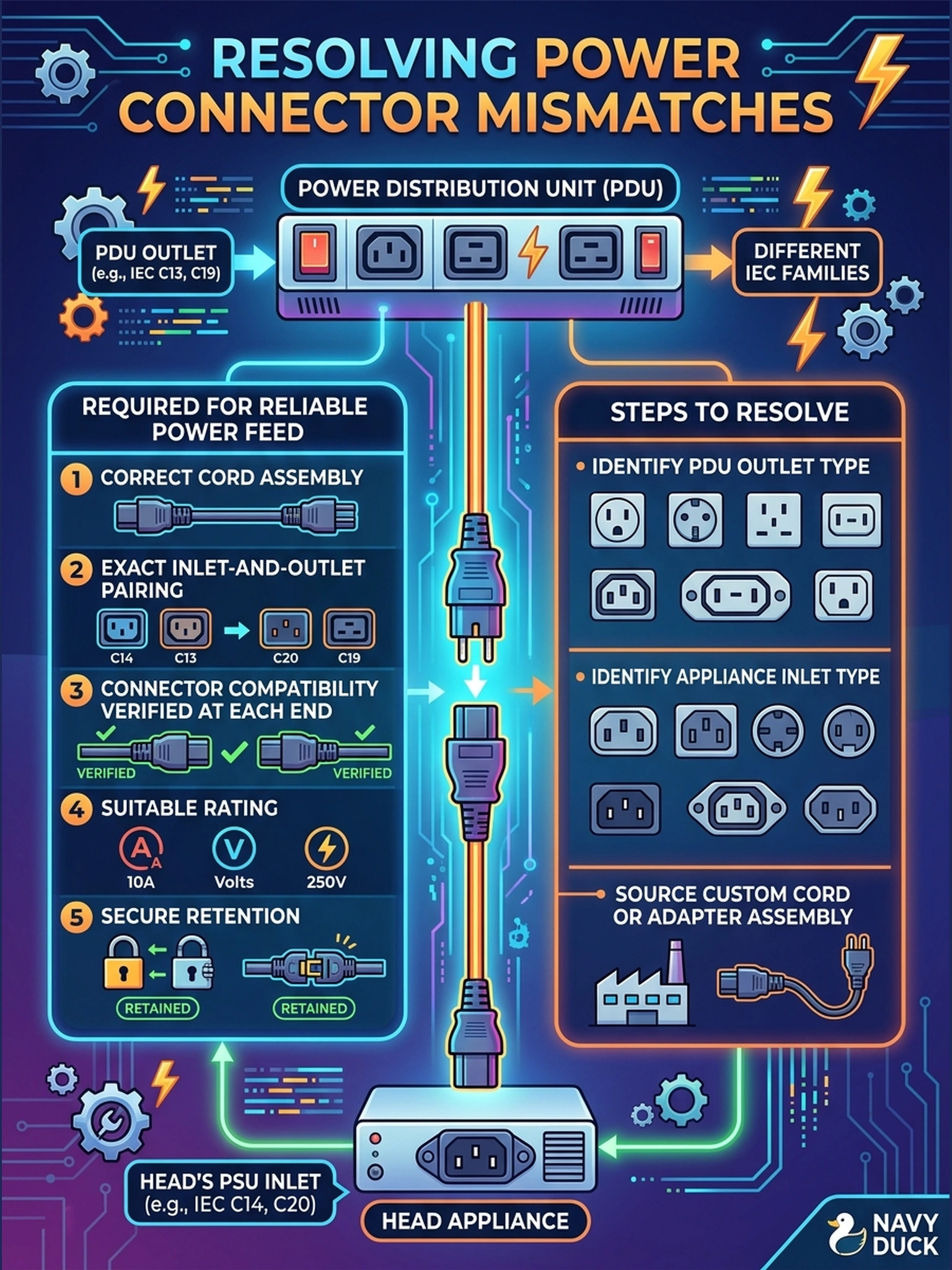
The head's PSU inlets and the customer's PDU outlets belong to different IEC connector families, and the cords in the appliance box may not fit either end. What must be resolved before a power feed can be relied on?
Select an answer to reveal the explanation.
Short Explanation
Here's a trap that bites installers at six in the evening: the cord in the box is the right kind but the wrong end. C13-to-C14 and C19-to-C20 are not cousins you can persuade into each other's sockets. Match both ends, verify the rating, and then you've got a feed you can trust.
Full Explanation
Rack power presents distinct connector families — common examples pair C13 outlets with C14 inlets and C19 outlets with C20 inlets — with different current ratings and keying, and the IEC standard deliberately makes these families non-interchangeable rather than universal. The head's PSU inlets and the customer's PDU outlets must therefore be surveyed at both ends, and the correct factory cord assembly for that exact pairing selected: right connector family on each side, current rating matched to the supply's draw, and retention that survives rack service. Universal interchangeability fails by inverting the standard: the families exist precisely so a higher-draw inlet cannot accept a lower-rated plug, and the keying is the safety feature, not an obstacle. Forcing a mismatch home and strapping it down fails dangerously — deformed contacts produce resistance, heat, and arcing risk, and dressing tension belongs on the cable jacket rather than on a jammed interface. Locally fabricated mains cords fail as permanent equipment power practice: appliance feeds are served by factory-rated assemblies built and certified as complete units. Exam caveat: cord kits are planned against a site PDU survey before install day arrives. Operational check: verify connector family and rating at both ends of every cord before plugging, and record the cord types on the as-built.