
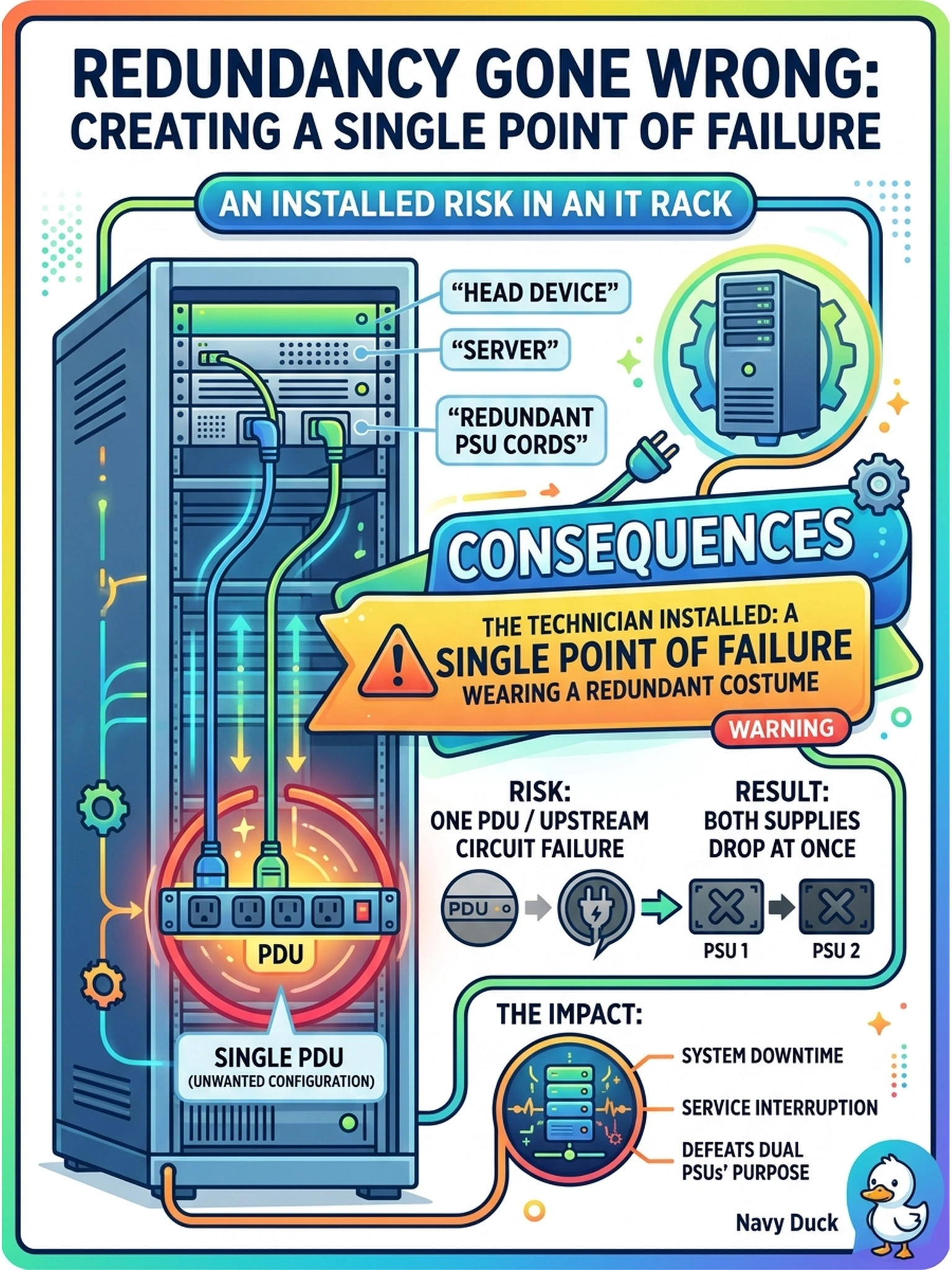
Both of the head's redundant PSU cords are plugged into the same PDU because it was closest. What has the technician actually installed?
Select an answer to reveal the explanation.
Short Explanation
Two power supplies plugged into one PDU is really one power supply with extra weight. The whole point of A/B feeds is that a PDU or a circuit can fail and you never notice. Rack distance is a cable-planning problem, not something to solve by spending your redundancy budget on an extension cord.
Full Explanation
Redundant power supplies deliver value only when their feeds are independent: supply A on PDU A fed by circuit X, supply B on PDU B fed by circuit Y. The failure domain being defended against includes the PDU itself and its upstream breaker, not merely the supply, because everything above an inlet is shared risk. Landing both cords on one PDU collapses two feeds into a single domain: a PDU trip, a maintenance window on that unit, or an upstream circuit fault removes both supplies simultaneously — precisely the scenario the dual hardware exists to survive. Internal load sharing bridging a lost PDU fails by concept: each supply draws only through its own inlet, and there is no path for one live supply to carry the other when their shared feed dies. Superior monitoring through one management point fails because observability is not redundancy — a dashboard that faithfully reports the death of the only remaining feed is not protection. Fixing it later fails on risk timing: redundancy matters most during cutovers and early operations, and a system carried unprotected through that window has already been exposed regardless of the eventual end state. Exam caveat: A/B means separate PDUs on separate circuits from day one. Operational check: trace both cords to different PDUs and note each PDU's upstream circuit on the as-built.