
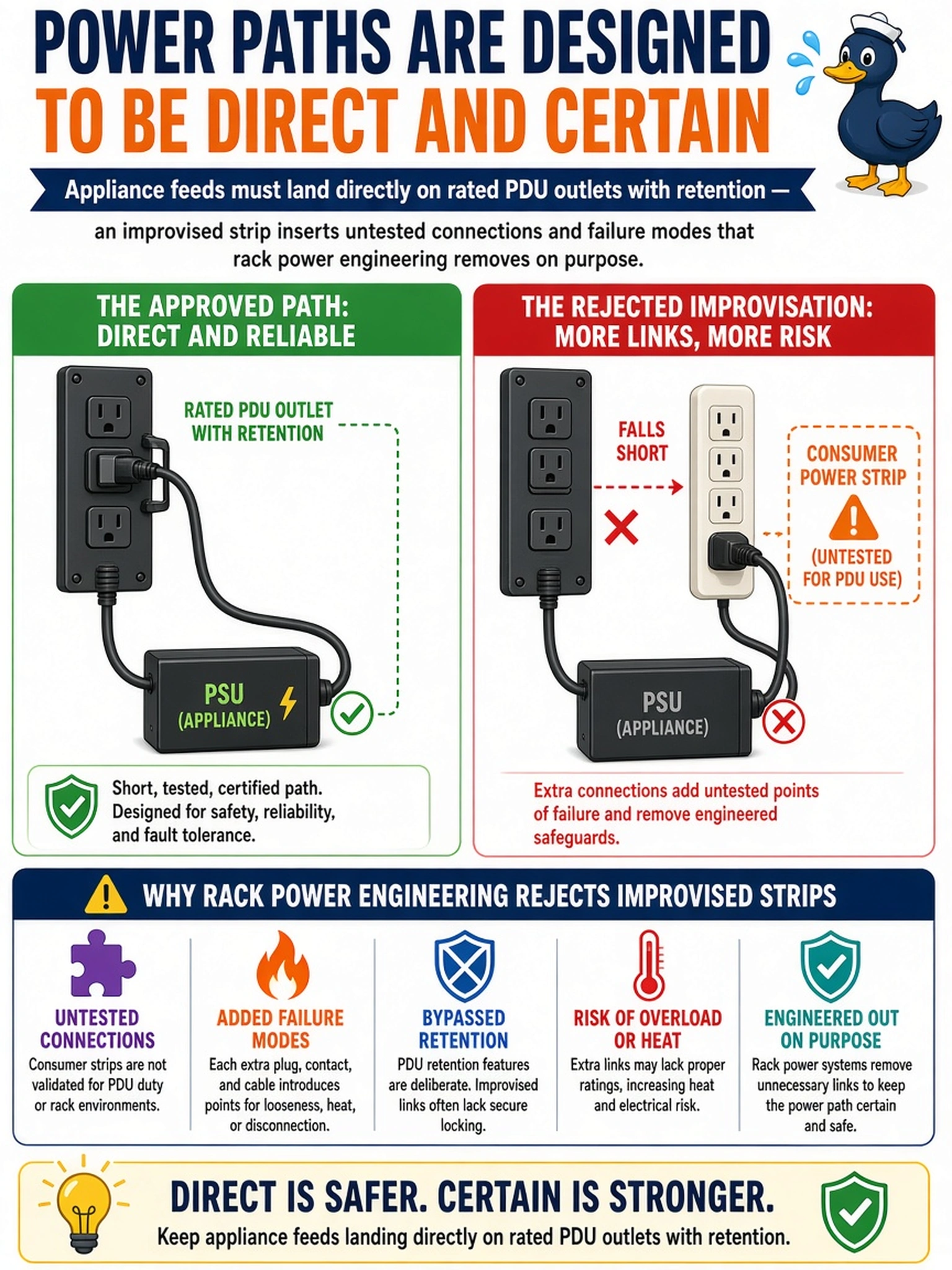
The second PSU's cord falls a few inches short, and the tech is about to plug a consumer power strip into a PDU outlet to bridge the gap. Why is that practice rejected?
Select an answer to reveal the explanation.
Short Explanation
Think of a consumer strip in a rack like the extension cord behind your television: it works right up until the moment it doesn't. The whole point of a PDU is an engineered, rated path from outlet to inlet — an improvised strip pokes an untested hole in that story your shop gets to explain at three in the morning. Get the right cord instead of a bridge.
Full Explanation
Rack power is engineered end to end: a rated PDU outlet, a connector with retention, a verified circuit, and a cord of proper capacity. A consumer strip inserted between PDU and appliance inserts a tap that sits outside that engineering — outside the connector-retention scheme, outside the load and vibration profile the design was checked against, and into the class of improvised connections that fail without warning. The correct answer to a short cord is a cord of correct length. A pass-through strip without surge suppression fails for the same core reason: removing one feature does not give the assembly the ratings, retention, and certification an appliance feed requires, and brand alignment changes nothing about what the device is certified to be. Dressing long slack across cooling vents fails by trading one hazard for another — oversized cord belongs in a service loop clear of the vents, never shadowing the airflow the enclosures need. Splitting the two supplies across PDU and strip fails because the strip still hangs off one engineered outlet and adds its own untested joint to that side, so the failure domain is unchanged. Exam caveat: the power task requires direct, rated, retained connections. Operational check: both supplies land directly on separate PDUs with correctly rated cords and no intermediate taps anywhere in the path.