
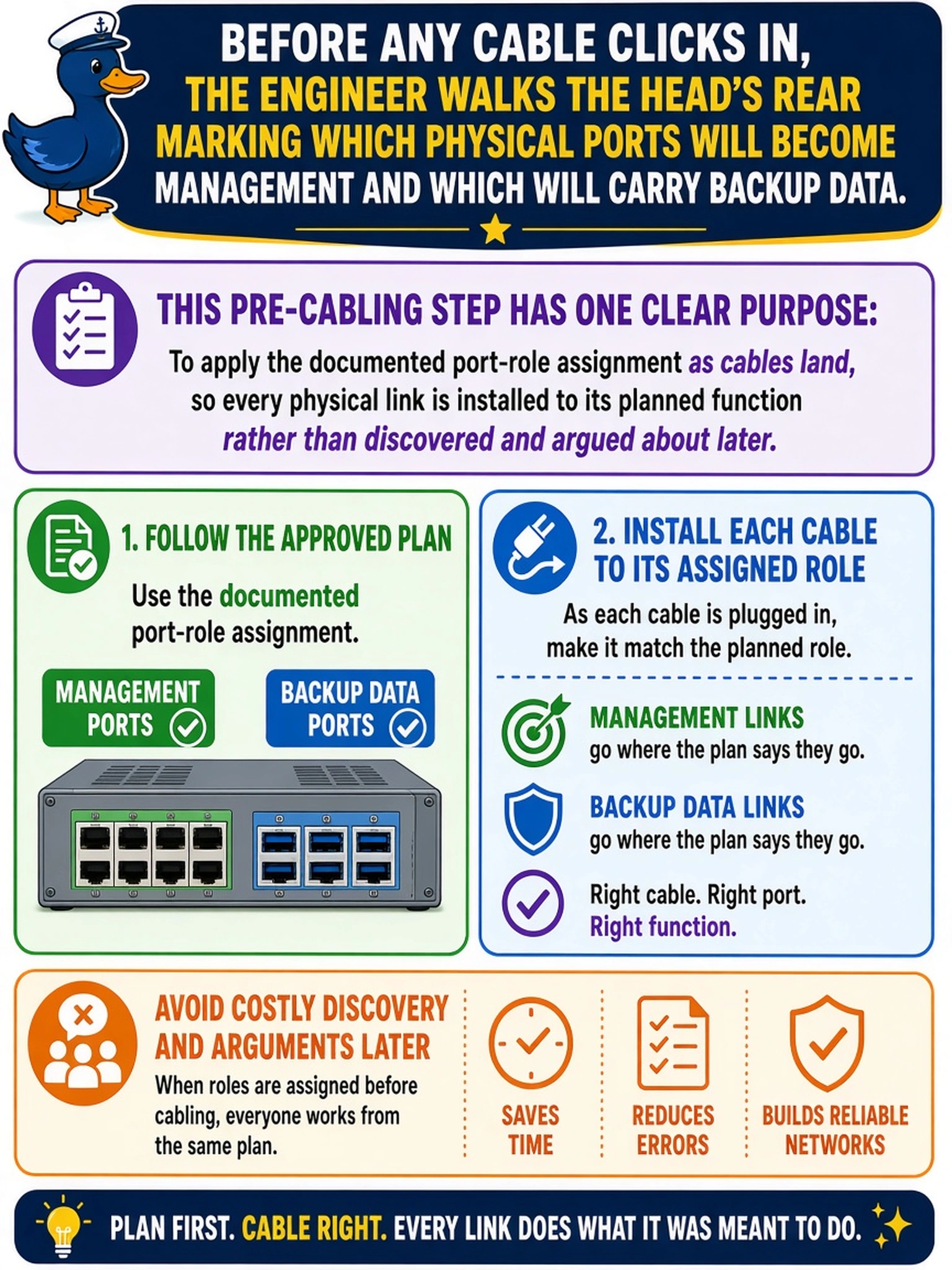
Before any cable clicks in, the engineer walks the head's rear marking which physical ports will become management and which will carry backup data, per the approved design. What is the purpose of this pre-cabling step?
Select an answer to reveal the explanation.
Short Explanation
Ports don't come labeled 'management' and 'backup data' — your design does that. Mark the plan onto the hardware as you cable, and every link goes to the right place the first time; skip it and you'll be guessing in six months when something moves. Plan first, mark first, click second.
Full Explanation
DD OS interfaces take on configured roles — management versus data for the various protocols — and the approved design states which physical ports carry which role. Marking the plan onto the hardware before the first cable lands means each link is installed to its planned function, so configuration, labels, and physical layout agree from the first click, and the as-built record is written while the truth is known rather than reconstructed under pressure. Cable length following role fails by concept: either role might be a short patch or a structured run — length is a property of the physical layout, not of the logical function a port will serve. A cold-spare majority rule is invented: the design allocates ports as the design requires, and no convention demands that unused ports outnumber active ones. VLANs having to exist before a DD port links fails mechanically: VLAN configuration lives on the switch and tag handling in DD OS configuration, and a physical port establishes link without any VLAN decision being made first. Exam caveat: the as-built mapping of physical port to role is created at cabling time, as part of the networking task. Operational check: every cable lands on its marked port, and the as-built plus the switch-port map record each port's role and far end.