
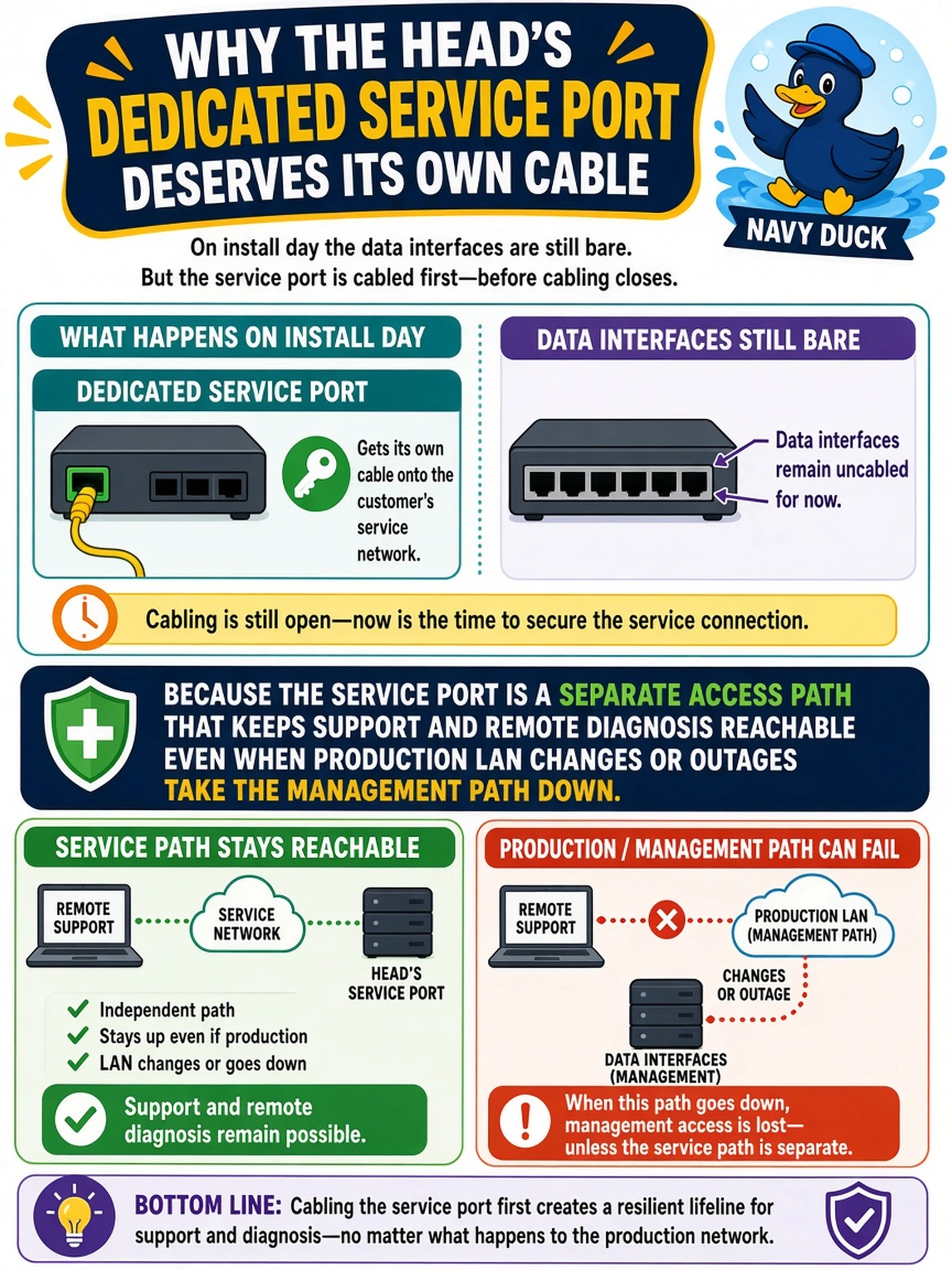
On install day the head's dedicated service port gets its own cable onto the customer's service network while the data interfaces are still bare. Why does this deserve a cable of its own before cabling closes?
Select an answer to reveal the explanation.
Short Explanation
The service port is your lifeline phone that still works after the storm. If support can only reach the box through the same LAN you're debugging, an outage and a diagnosis go dark together. Cable that port to its own network on install day, not on the day everything goes wrong.
Full Explanation
The head's dedicated service port exists to provide an independent access path, used by vendor support and remote diagnostics, that does not depend on the health or configuration of the production management and data networks. Cabling it onto the customer's service network during installation means a later management-LAN change, misconfiguration, or outage cannot remove the route support uses to reach the system — the path earns its value precisely when the primary network is the thing that is broken, which is when nobody wants to discover the port was never landed. Replacing the management interface fails by concept: management remains the administration path and the service port keeps its own distinct purpose; nothing about day-two operation migrates those roles. The configuration wizard depending on the service port is invented — initial configuration runs over management, and a service cable's absence resets nothing. Aggregating shelf management fails because enclosure health rides the SAS interconnects, never the head's Ethernet. Exam caveat: the cabling task includes the service port per the design even when it appears unnecessary today. Operational check: confirm the port is linked on the service network, reachable from a support host, and its role recorded in the as-built.