
The chain was healthy on temporary bench power, but dies when the rack's PDUs are transferred to house circuits during a breaker test. Which part of the power-cord task was clearly incomplete?
Select an answer to reveal the explanation.
Short Explanation
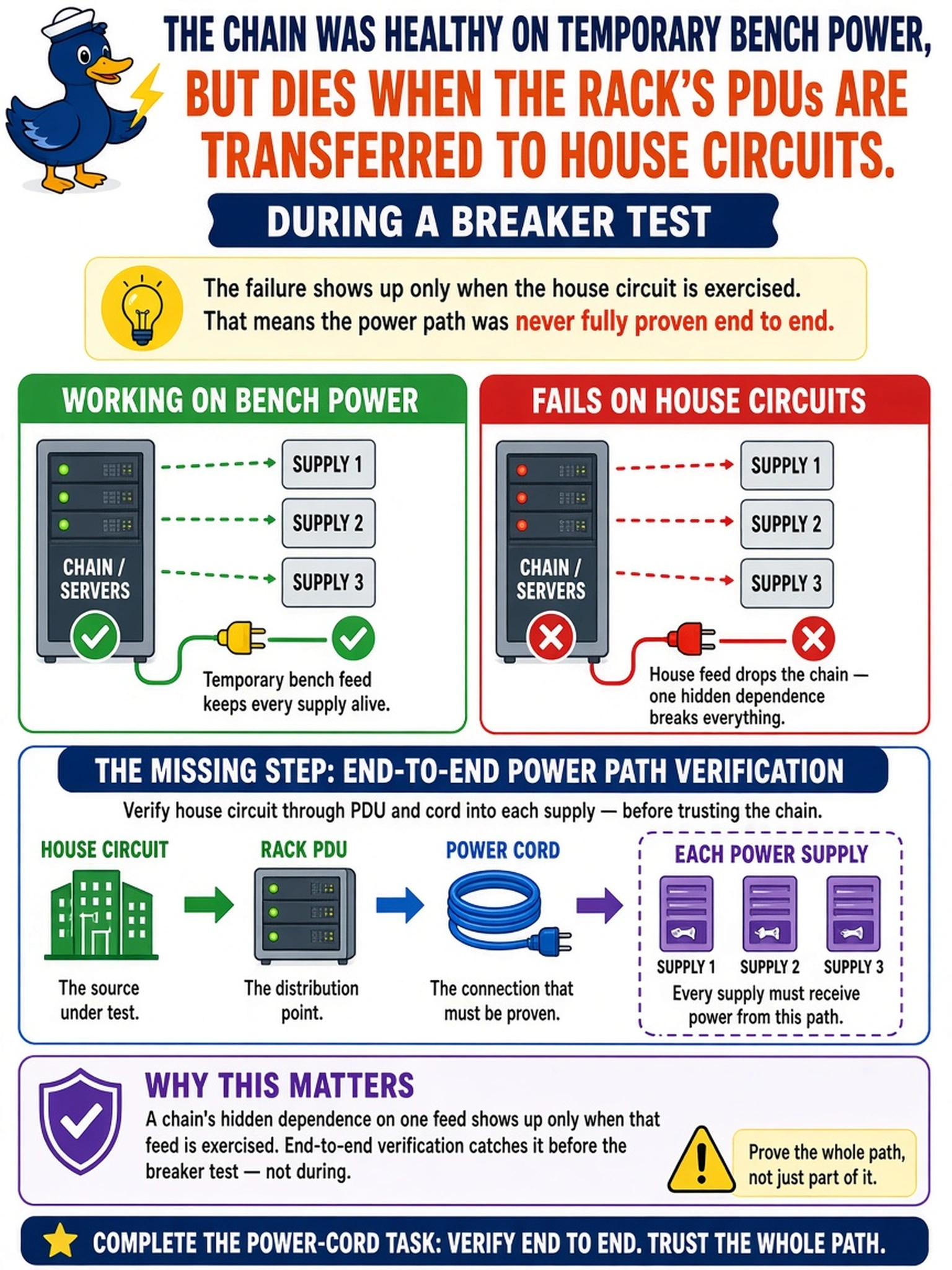
Local connections and end-to-end power are two different tests. Everything clicked together, but nobody followed the circuit from the panel through the PDU to each shelf — so nobody knew which leg the chain was secretly leaning on until a breaker popped. Verify the whole path while you still have the rack open.
Full Explanation
Completing the power-cord task means proving the entire path — house circuit, PDU, cord, and each power supply — on both A and B sides, because the chain's real dependencies only announce themselves when every leg is exercised. A chain that enumerates on bench power proves its interconnects; a chain that dies when the PDUs transfer to house circuits proves an unverified dependency, such as a shelf fed only from a circuit inside the switched group, or a feed assumed live that was never actually energized. Signal quality depending on which compliant circuit feeds the shelves fails by concept: power supplies regulate their inputs and the interconnects are indifferent to the upstream source, so a source-dependent failure points at lost power, not degraded signaling. Blaming the power-on sequence fails by category error: sequence governs enumeration behavior at startup, while a failure during a power transfer is a path-verification gap. A magic two-transfer acceptance rule is invented — the transfer was the correct test; its failure simply exposed verification work that had never been done. Exam caveat: cabling acceptance includes exercising every feed end to end, coordinated with the site's breaker and PDU plan. Operational check: with the chain live, confirm each shelf's feeds on independent PDUs and record each PDU's upstream circuit id on the as-built.