
Before the head unit is ever powered, both PSUs of every expansion shelf are cabled, with each shelf's two feeds landing on different PDUs. Why is this a precondition of head bring-up rather than later cleanup?
Select an answer to reveal the explanation.
Short Explanation
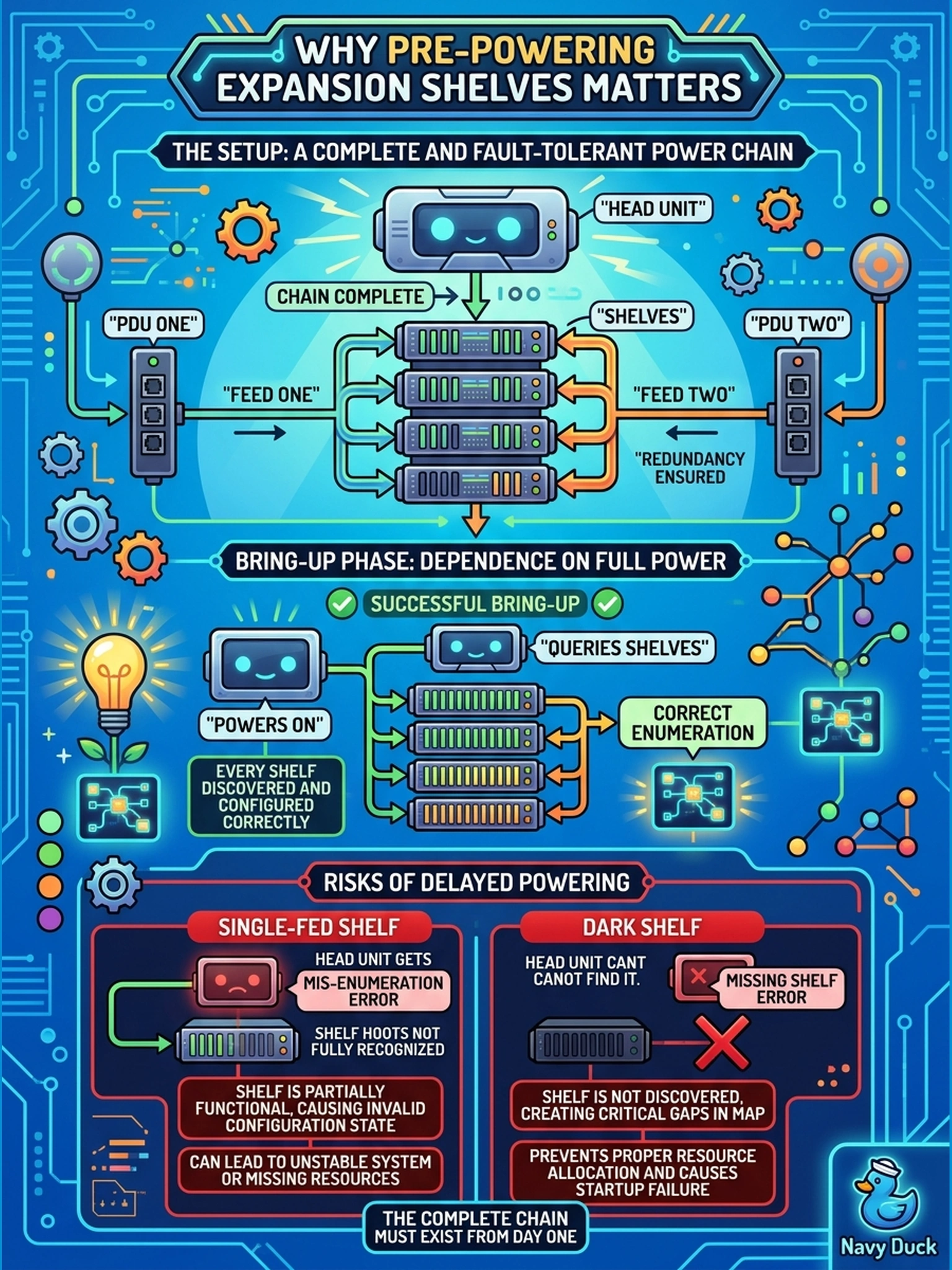
Think of the chain like a string of holiday lights — the head wakes up expecting every bulb to be ready. A shelf that's dark or running on one feed during bring-up makes the enumeration you're about to trust a coin flip. Feed both supplies on every shelf, on different PDUs, before the head wakes up.
Full Explanation
The head enumerates its storage chain at boot, so every shelf must be powered and settled — both PSUs cabled, with feeds split across separate PDUs — before the head wakes and takes inventory of the enclosure chain. A shelf that is dark or single-fed at that moment either mis-enumerates during bring-up or joins the configuration carrying a redundancy gap that stays invisible until the first PDU event removes its only live feed. The task order exists because the head's view of the chain is a snapshot of shelf readiness taken once. Shelf inrush current tripping the head's feed fails as invented reasoning: distribution is sized per the design, and sequencing exists to establish enumeration order and complete paths, not to dodge startup draw. Gating enumeration on a license-record serial scan fails by concept: chain presence is an electrical and physical fact, and license state has no bearing on whether an enclosure answers discovery. Limited-cycle power cords fail as nonsense — they are standard rated assemblies intended for repeated service. Exam caveat: the pre-power checklist puts both shelf feeds live and separated on different PDUs before the head powers on. Operational check: verify each shelf's two PSUs are in live outlets on opposite PDUs, with normal PSU status, before touching the head's power.