
A junior tech hunts for the separate management cable that is supposed to connect a new expansion shelf, and the engineer says there isn't one. Why?
Select an answer to reveal the explanation.
Short Explanation
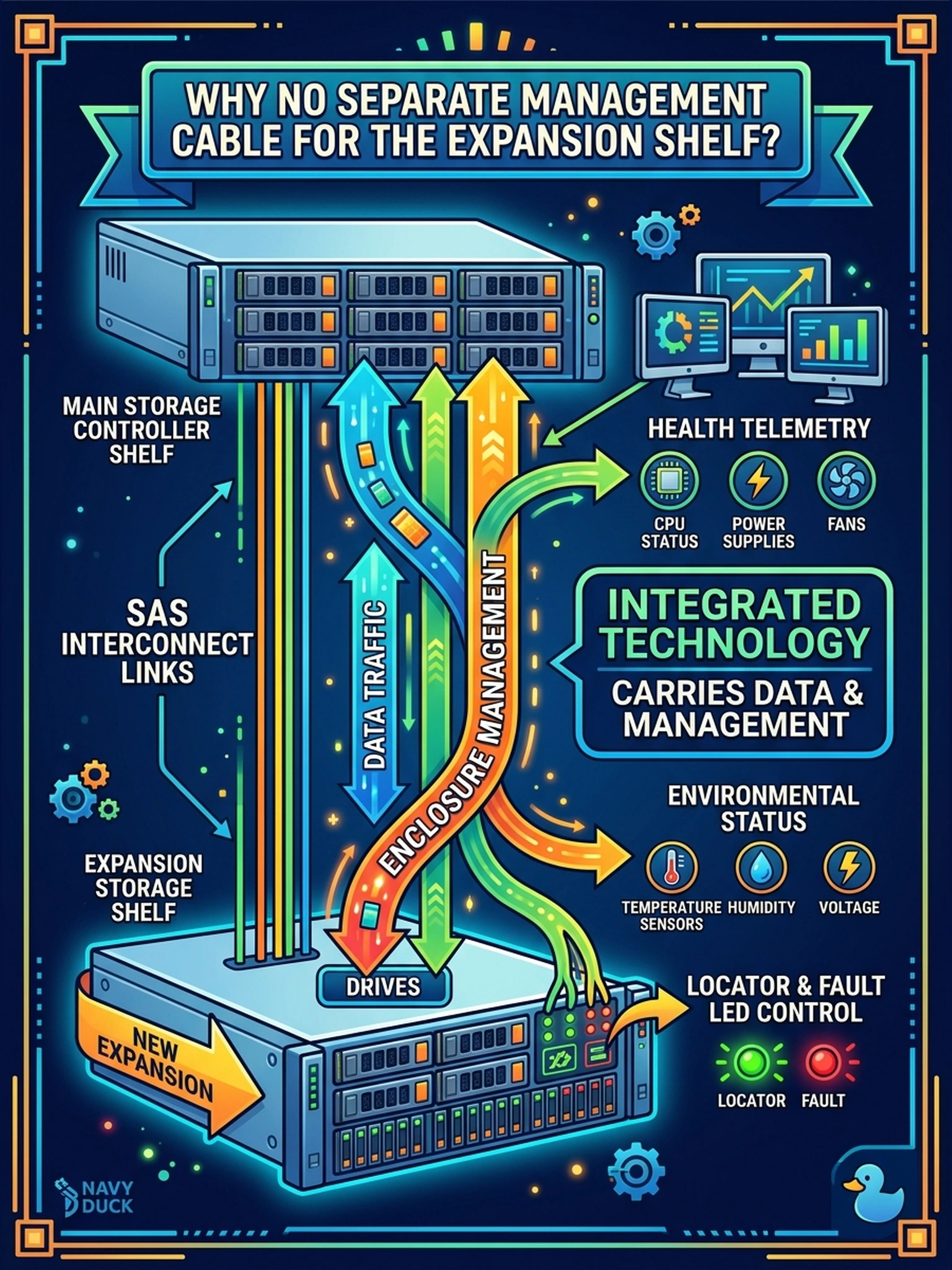
Here's a trap that burns a wasted hour at plenty of rack installs: there is no separate 'shelf network cable.' The enclosure's brain talks over the same SAS links that move your data — one cable does both jobs. Save your tracing effort and put that spare cable where you actually need one.
Full Explanation
Enclosure management for SAS-attached shelves is carried by the SAS protocol itself. Enclosure services (SES-type functions) embed health telemetry — temperature, fan, and power-supply status, plus locator and fault LED control — in the same interconnect links that carry I/O, so the shelf's I/O modules report over the data path and no separate management wire exists to run. This is why the back of a shelf offers interconnect ports and power connections and nothing else to plug in. Waiting for external monitoring registration fails by concept: the head sees enclosure health across the chain with no customer network involved at all. A per-shelf Ethernet service port on the customer's service network fails because shelves do not have such ports — the dedicated service port is a head-unit feature. Claiming shelves have no management functions contradicts their visible behavior: locator and fault LEDs and environmental reporting all exist, and they answer over the SAS links rather than any panel control on the head. Exam caveat: a 'missing' shelf management cable is always a misread of the design, never a missing part. Operational check: confirm the shelf reports healthy through enclosure status from the head, then issue a locator LED command and watch the correct bay light through the chain.