
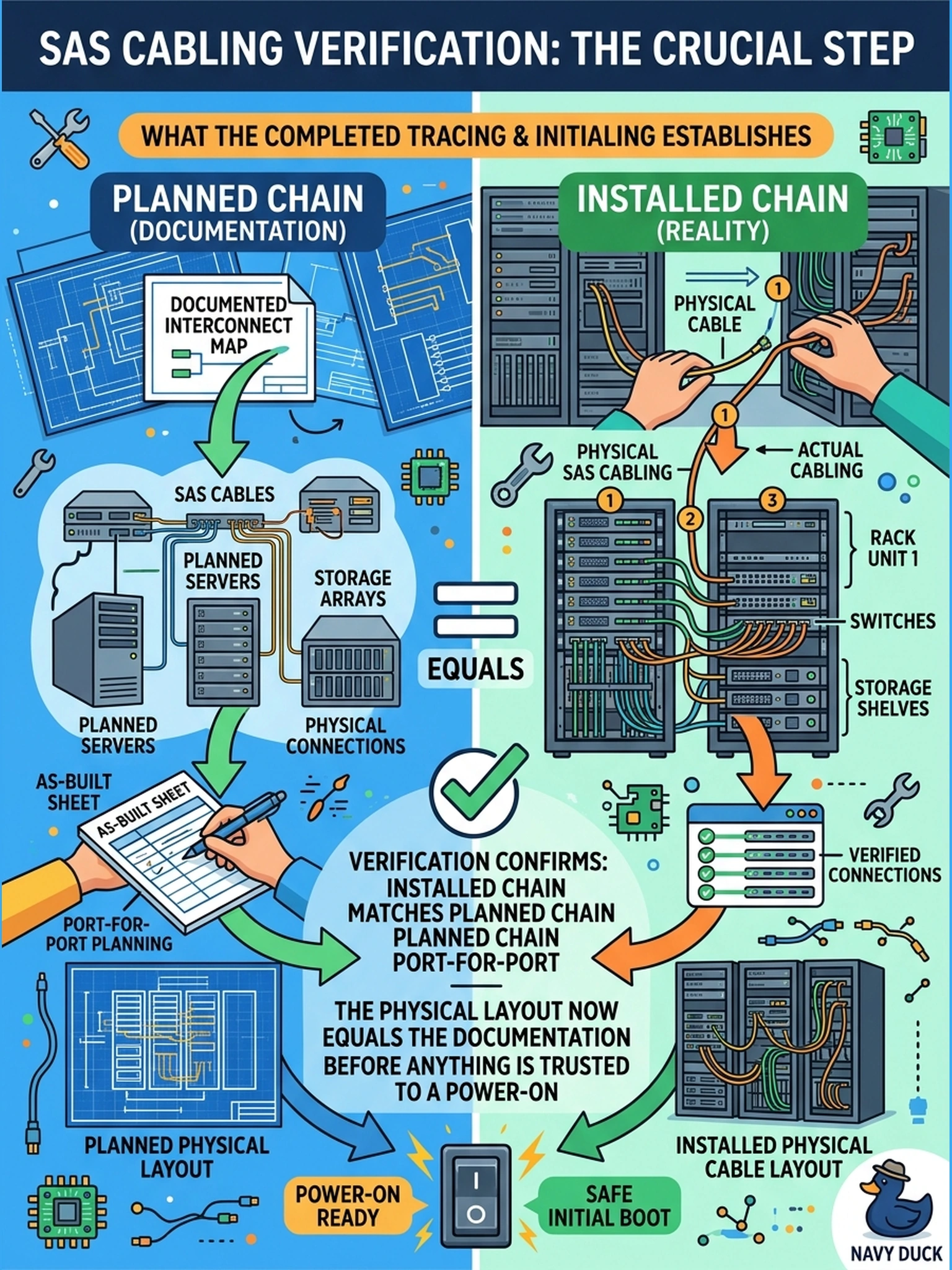
An installer finishes the SAS cabling, traces every physical cable against the documented interconnect map, and initials the as-built sheet. What does that verification step actually establish?
Select an answer to reveal the explanation.
Short Explanation
A chain that works by accident is a chain nobody can service later. Tracing every cable against the map proves the install matches the plan, and the signed as-built becomes what the next tech — maybe you in a year — will depend on. Sign it only when the cable matches the drawing.
Full Explanation
The documented SAS map defines which head port feeds which shelf module's in-port or out-port across the chain. Tracing each physical cable against that map, then initialing the as-built, establishes that the installed chain equals the planned chain port-for-port. This matters because a chain can work by coincidence: a link landed in the wrong port may enumerate today while quietly violating the assumptions that future expansion, failover expectations, and support diagnostics will rest on. The installer's initials failing to retire the map is the key distinction — the signed as-built is documentation continuing to exist, corrected to reality, not a replacement for it; the next technician needs the drawing, not the memory. Procurement auditing fails as the purpose: the trace verifies endpoints and topology, while lengths were settled when the cable kit was ordered. Firmware comparison fails by concept: baselines are checked through inventory tooling once the chain is powered, and the unpowered trace of copper never tested firmware at all. Exam caveat: the cabling task is not complete until physical layout is verified against documentation with deviations recorded. Operational check: each cable's two ends match the map; any field deviation is drawn onto the as-built before sign-off.