
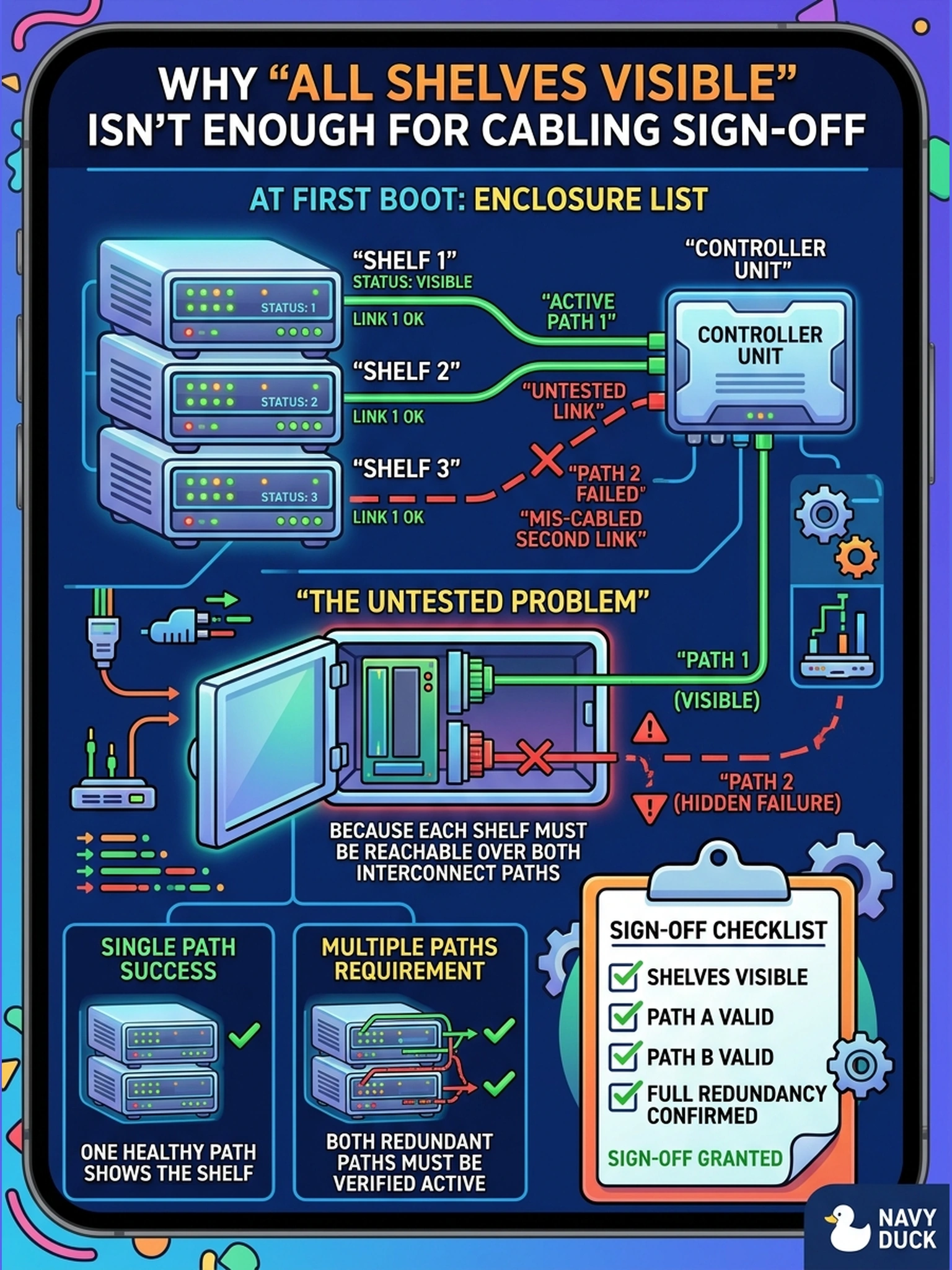
At first boot every expansion shelf appears in the enclosure list, and the engineer is about to sign off the cabling. Why is 'all shelves visible' not yet enough?
Select an answer to reveal the explanation.
Short Explanation
Seeing a shelf and trusting a shelf are two different things. The enclosure list proves one working path; the redundancy lives in that second link nobody tested yet. Check both paths on every shelf report healthy before you sign off — that's the price of the word redundant.
Full Explanation
Enumeration proves the chain completed over at least one path; redundancy is a statement about the second path. With dual I/O modules and separate interconnect links, a shelf that is visible over one healthy link tells you nothing about a second interconnect that was never seated, was landed in the wrong port, or is quietly degraded — and that hidden link is exactly the one that matters the first time the working path fails. The bring-up check is per shelf: enclosure or interconnect status is read on both modules of each shelf and both report healthy, not merely that shelves appear in a list. A stale-view-after-rescan explanation has no mechanism here: enumeration happens live at discovery, so a visible shelf is genuinely visible on that path. File system creation is irrelevant to shelf presence — enumeration occurs at the enclosure level long before any storage layout. Reporting only the nearest shelf contradicts chain behavior: once the chain completes, every shelf on it responds, so mid-chain shelves appear as a matter of course. Exam caveat: the acceptance statement is both paths on each shelf healthy — presence alone is half the proof. Operational check: query enclosure status on each shelf's I/O modules, record both path states, and re-verify after the first reboot.