
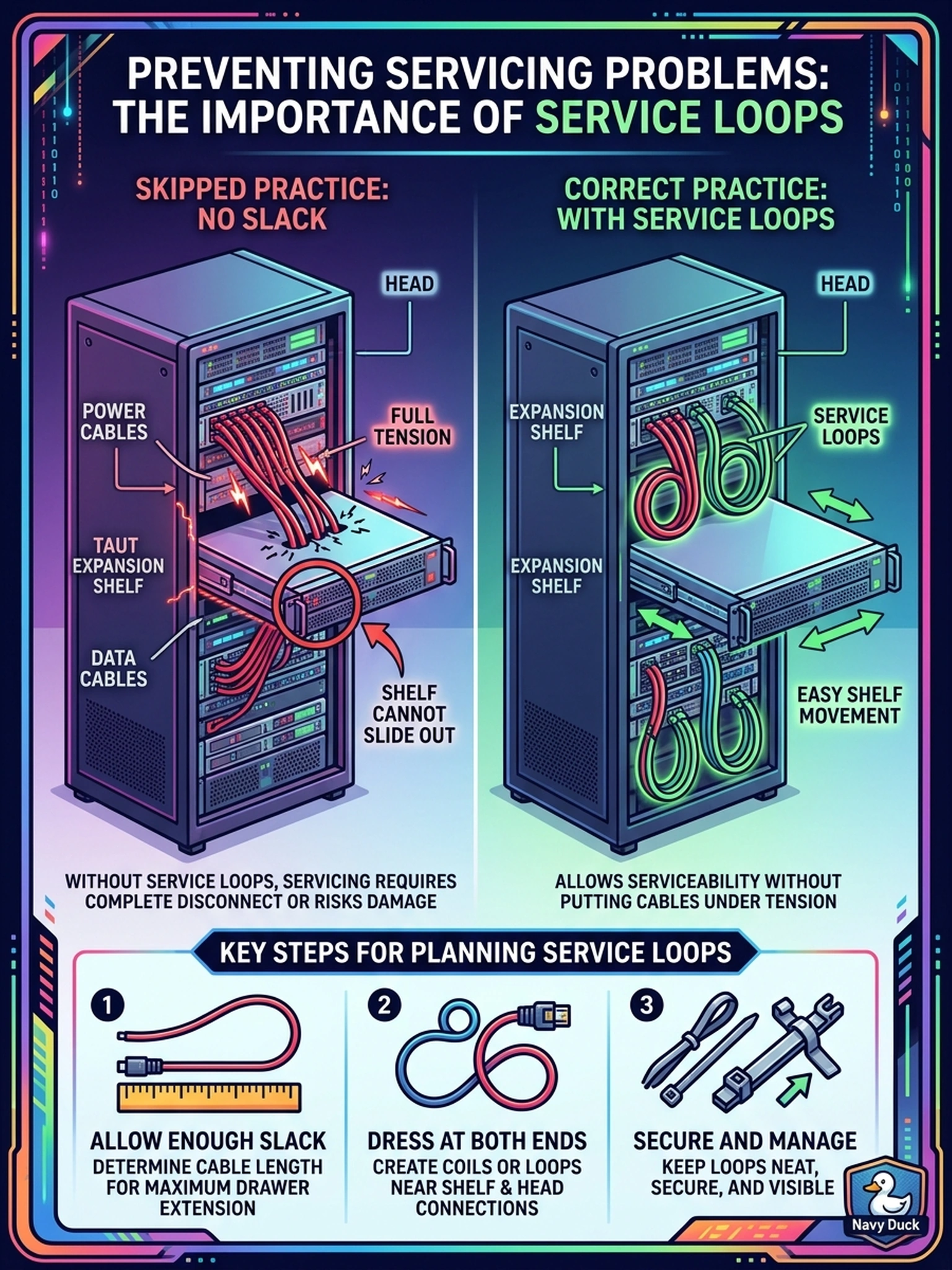
A drive in an expansion shelf needs replacement, but every cable between the shelf and the head was pulled to full length, so the shelf cannot slide out. Which cabling practice was skipped?
Select an answer to reveal the explanation.
Short Explanation
Here's the deal about service loops: that slack you think you wasted on install day is what saves you during a drive swap at two in the morning. If a shelf can't slide out without dragging the chain taut, the loops were never planned. Coil the slack properly at each end — your future self will thank you when the drive fails.
Full Explanation
A service loop is planned slack — a dressed, secured coil at the ends of a cable so the attached equipment can be moved for service without loading or disconnecting the link. When loops are skipped and every cable is installed at full tension, pulling a shelf for a drive swap pulls on the whole chain, so the correct practice dresses the spare length into secured loops at both the head end and the shelf end while preserving bend radius. Missing labels fail by concept: labeling provides traceability, a separate practice that neither creates slack nor permits movement. A longer cable assembly dressed taut across the rear of the rack fails too — unmanaged slack under tension is a snag and strain hazard and can shadow airflow; a service loop is specifically secured, accessible slack, not simply extra wire. Relying on dual-path cabling fails because redundancy is about failover paths, not physical freedom: a shelf with two taut links still cannot be pulled. Exam caveat: serviceability is part of the acceptance criteria for the cabling task — the chain is complete when it works and remains workable. Operational check: before sign-off, gently slide each shelf forward on its rails; loops should pay out from the dressing instead of tightening at the connectors.