
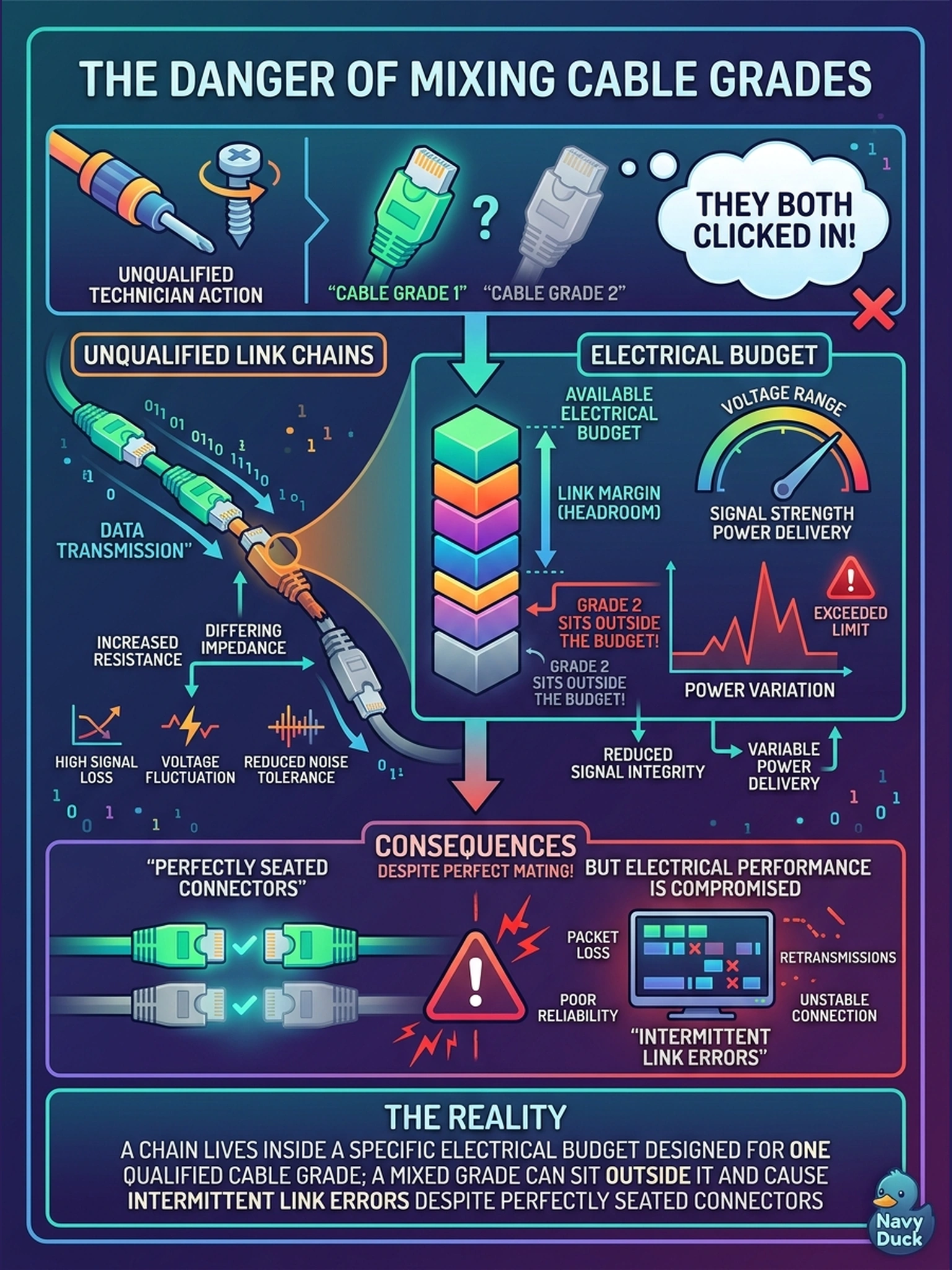
Inside one shelf chain, the tech mixes two different grades of interconnect cable because 'they both clicked in.' Why can this be a problem even though the connectors mate?
Select an answer to reveal the explanation.
Short Explanation
Both cables clicked, so both are fine — said no dependable storage link, ever. Clicking a connector in is a free sample; the chain's signal budget is the real test. Cable the chain to the grade the docs name, because a flaky link later costs you far more than a missing cable does.
Full Explanation
A chain lives within an electrical budget — driver strength, cable loss, connector loss, and receiver margin — qualified against the interconnect specification the platform was tested with. Mixing two grades inside one chain keeps every link clickable, but the chain's total loss and signal quality can drift past the point where there is margin, and the result is classic intermittents: link renegotiation, sporadic checksum errors, a shelf that drops under load and reappears at idle. Those symptoms cost far more, found in a backup window, than the correct cable would have cost at install. The chain-serial-identity story is invented — chains address by topology and ports, not by cable identity. The complete-refusal theory is false by concept: dissimilar connectors that mate at all are exactly the trap being warned about, and a bad seating would not be a mixed-grade issue. The firmware-downshift behavior is invented. Exam caveat: a scenario that says 'both fit' is cueing that mechanical compatibility is not electrical qualification. Operational check: audit every chain against the parts list — one approved cable grade per chain, correct lengths, latches fully seated at both ends.