
On power-on day the tech energizes the head first while the shelves stay dark for a few extra minutes, and the boot reports missing disks. What went wrong with the power sequence?
Select an answer to reveal the explanation.
Short Explanation
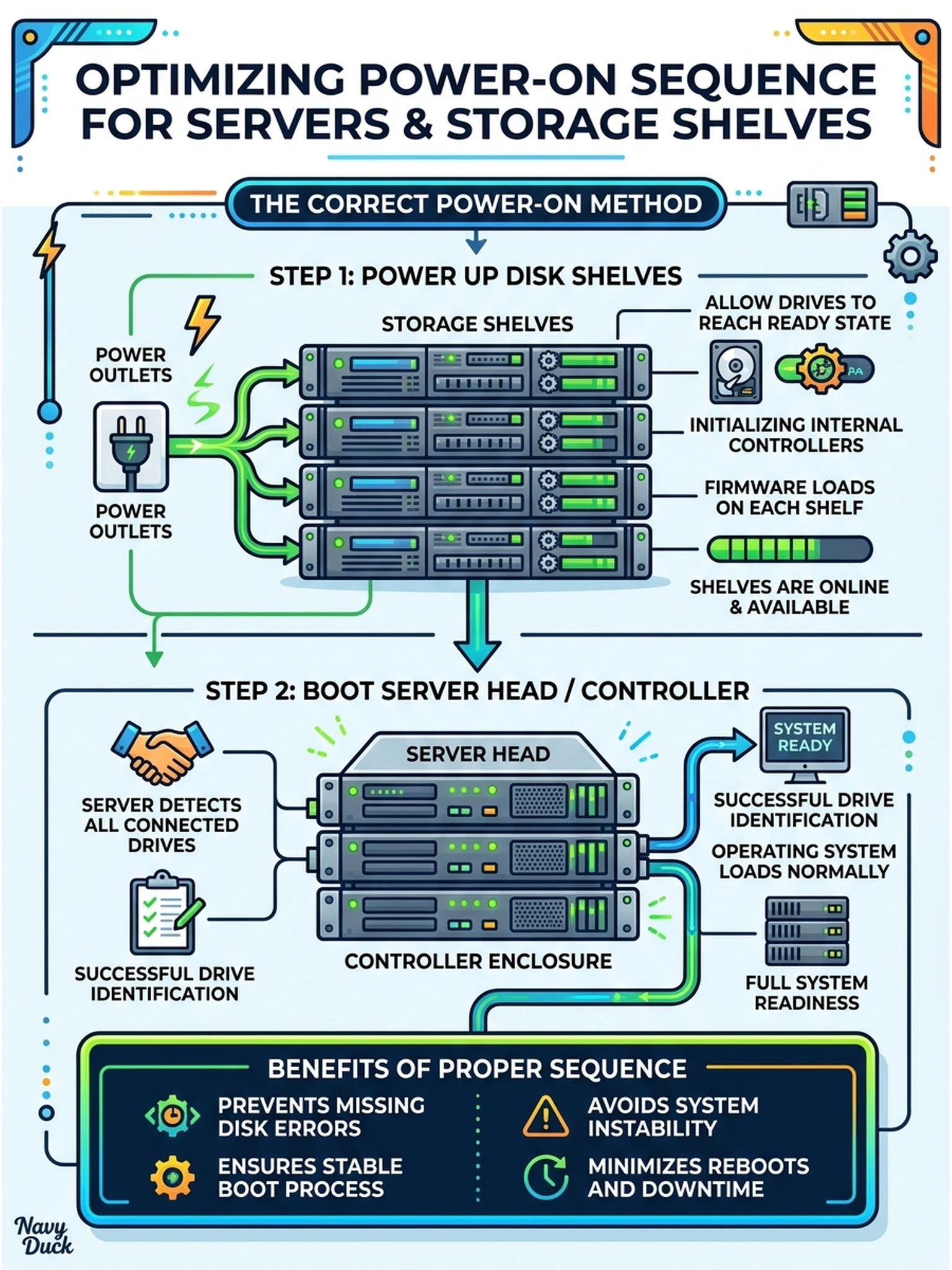
The head can't talk to shelves that are still asleep. Power the shelves first, let them spin up and go steady, then wake the head — and suddenly every disk on your system shows up for work. Missing disks on day one are usually an alarm-clock problem, not a hardware problem.
Full Explanation
Storage stacks have a readiness dependency: expansion shelves need to energize, spin drives, and bring their interconnect ports up before the head's boot enumerates enclosures. Power-on order follows the dependency — shelves first, wait the documented interval for ready state, then the head. A head booted while shelves are dark has no enclosures to discover and reports missing drives; the fix is an orderly shutdown of the head, energizing the shelves, and a clean reboot, not a disk diagnosis. 'The scan fixes itself' fails by concept: an installation procedure cannot accept a system that booted with enclosures absent, and unverified capacity is never a pass condition. The front-button versus console distinction is invented — enumeration depends on shelf readiness, not on the trigger method. Separate PDUs address availability design, not enumeration timing. Exam caveat: the same rule appears inverted for shutdown questions — power down the head before the shelves. Operational check: at the next start, energize the shelves, wait for documented ready indicators, boot the head, and confirm every enclosure and drive is present on the first look at the view.