
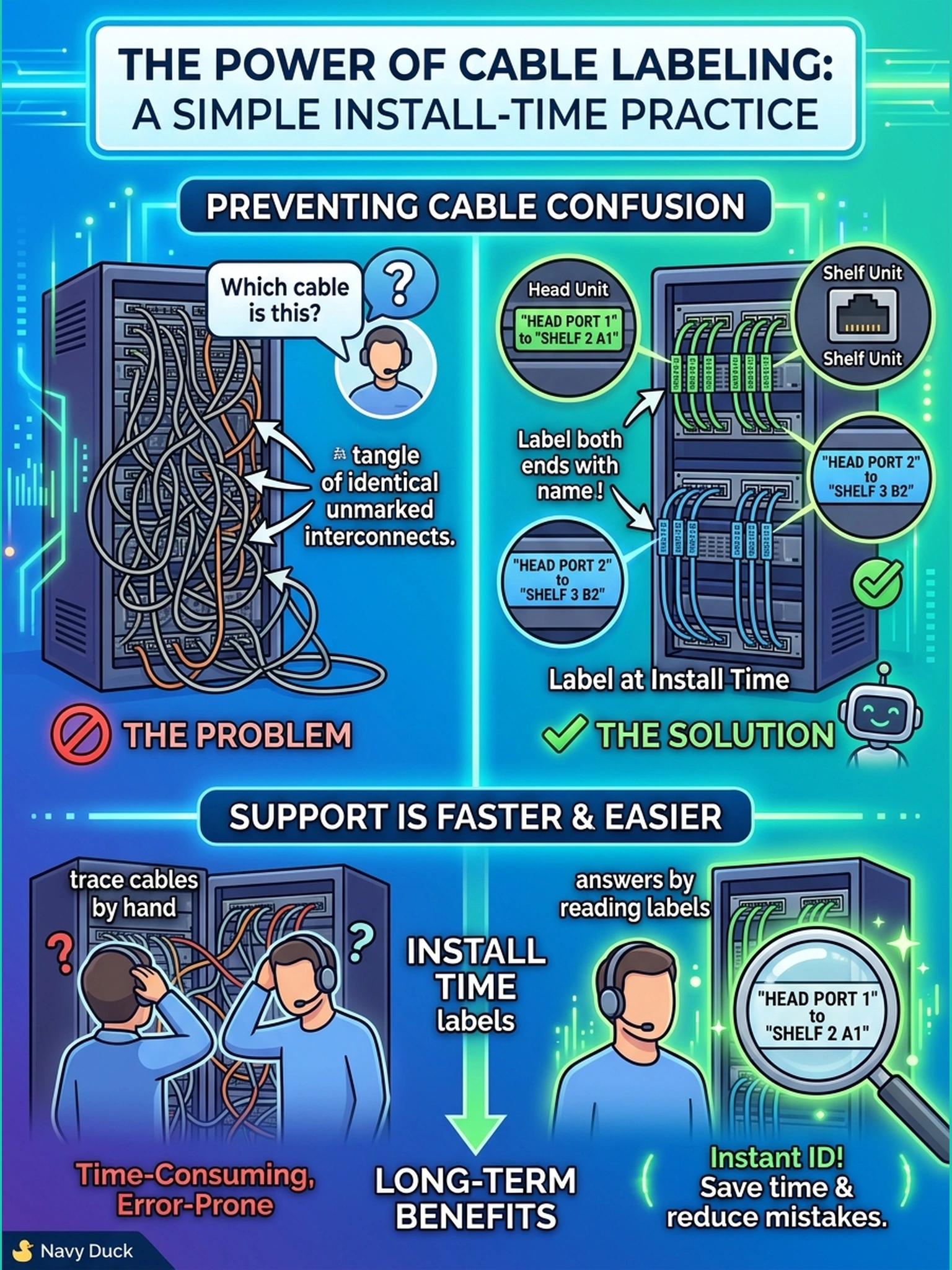
Six weeks after install, support asks which cable runs from the head's port to shelf 2 port A1, and the rack holds a tangle of identical unmarked interconnects. Which install-time practice would have prevented this?
Select an answer to reveal the explanation.
Short Explanation
Future you has no idea which cable is which — trust me on that. Labels on both ends of every interconnect, naming both ports, are the cheapest troubleshooting tool you'll ever buy. Do it while the answer is still obvious, because 'which cable is that?' stops being a mystery forever.
Full Explanation
Cable identity is information, and it is cheapest to capture at the moment it exists. At install, the installer knows exactly what every run connects because they just made the connection; a label on each end naming both endpoints converts that knowledge into a permanent readable fact. Six weeks later, the support question gets answered from the front of the rack rather than by two people and a walkie-talkie tracing a dressed bundle while a customer waits. The photo-archive approach fails by concept: photos record layout, not identity, and dressing changes, re-runs, and staleness erode them. Unique-length coding fails by concept: it encodes identity in a property that is unreadable at a glance, wastes the kit, and collapses as soon as anything is recabled. Serialized-cable querying is invented — enclosure software does not report patch-cord serials against links. Exam caveat: the standard answer for cable identity is both ends labeled with both endpoints, done at install time, because retrofit labels onto dressed runs means unplugging live circuits to do it. Operational check: at handover, read one cable end to end — both labels must name each other without any tracing required.