
During cable dressing an interconnect gets routed around a sharp rack-post corner and cinched tight with a zip tie pressed against the connector boot. Which cabling principle is at risk here?
Select an answer to reveal the explanation.
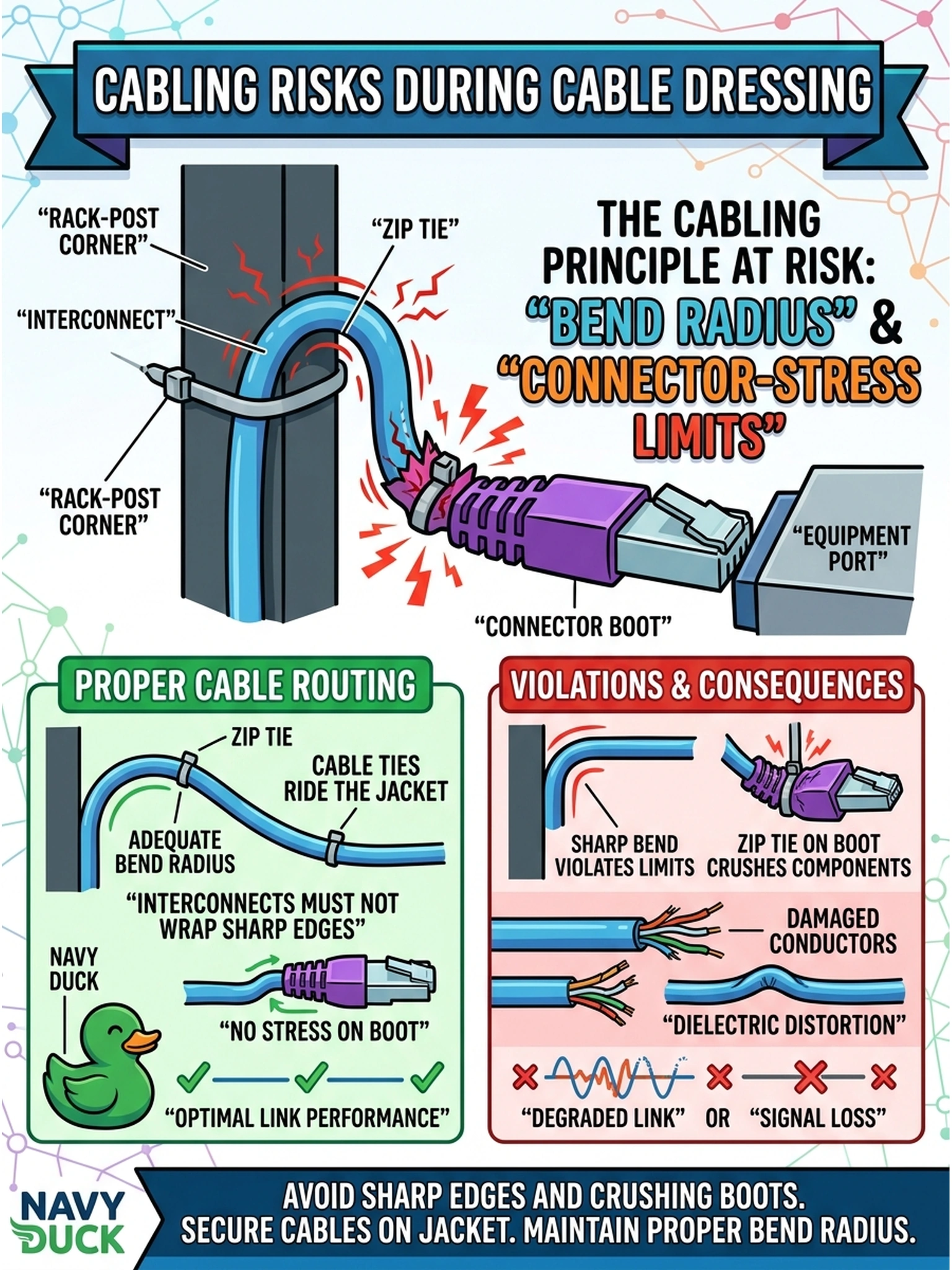
Short Explanation
Cables are like straws: kink one and you don't just bend the shape, you choke the flow. A sharp corner plus a tight tie on the boot is a recipe for intermittent errors that show up on your busiest night. Respect the bend radius, keep ties gentle and on the jacket, and let the connector sit unstressed.
Full Explanation
Interconnect cables carry published handling limits: a minimum bend radius, a maximum tie-down force, and guidance against loading the connector boot. Bending a cable around a sharp post corner does two things at once — the jacket compresses on the inside of the bend while the conductors or fibers stretch on the outside, shifting the electrical geometry the cable was designed around — while a tight tie on the boot presses axially on the connector body, which can walk it out of its socket or stress the latch. Both defects produce intermittent errors: renegotiated links, sporadic checksum failures, and a shelf that drops under load and returns at idle. Correct dressing routes cables along managers, keeps bends to a hand-fitting curve, and places ties on the jacket away from boots with light tension. Color-coding and label visibility are genuine installation standards but are not the principle being violated; the signal-direction reversal around a post is invented — direction follows ports and topology, not geometry. Exam caveat: bend radius appears in dressing questions and in troubleshooting ones; tight around sharp edges is always the wrong answer. Operational check: trace each dressed run by hand — no sharp-corner contact, no zip-tie deformation of the jacket, boots free of load.