
The kit includes both short and long interconnect cables, and the tech grabs a long one for every link between adjacent units. What is the correct thinking on cable-length selection?
Select an answer to reveal the explanation.
Short Explanation
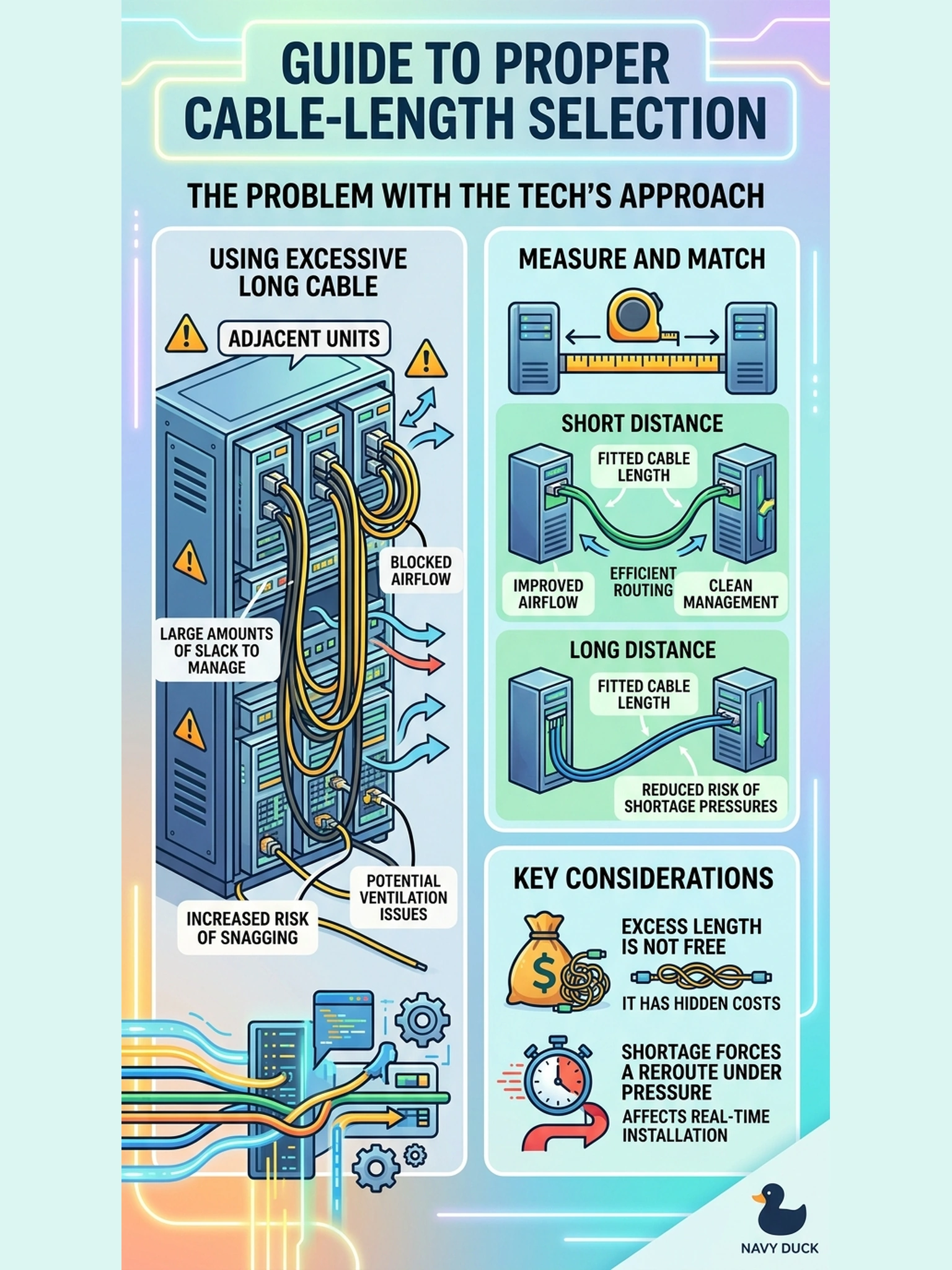
Extra cable isn't free — it's a coiled python you babysit for the life of the rack. Measure each run and pick the shortest length that still leaves a service loop, then dress the slack where it belongs. Taut is wrong, but so is too much slack in front of your drives.
Full Explanation
Cable length is a measured decision: route the run as it will be dressed, measure, and select the shortest standard length that still leaves service slack at both ends. Excess is not harmless — surplus cable must be coiled somewhere, and coils in the wrong place obstruct airflow, hide labels, snag on adjacent units, or make a service extension a puzzle of bundles. Every extra meter installed is slack to manage forever. The opposite error — pulling a short run taut to make it reach — puts continuous strain on connectors, the exact failure service loops exist to prevent. 'Longest is flexible' fails by concept: repositioning shelves is not a routine service activity, so permanent slack pays a constant cost for a hypothetical event. 'Shortest under tension' fails by concept: cables are not specified to work best taut; strain is a damage mechanism. The signal-resonance story is invented — the chain does not care about length uniformity so long as each link is within spec for its run. Exam caveat: the right answer is always 'just enough slack' — never taut, never coiled chaos. Operational check: at each link confirm the dressed cable reaches both ports with a service loop, excess is dressed into managers, and nothing strains or blocks an intake.