
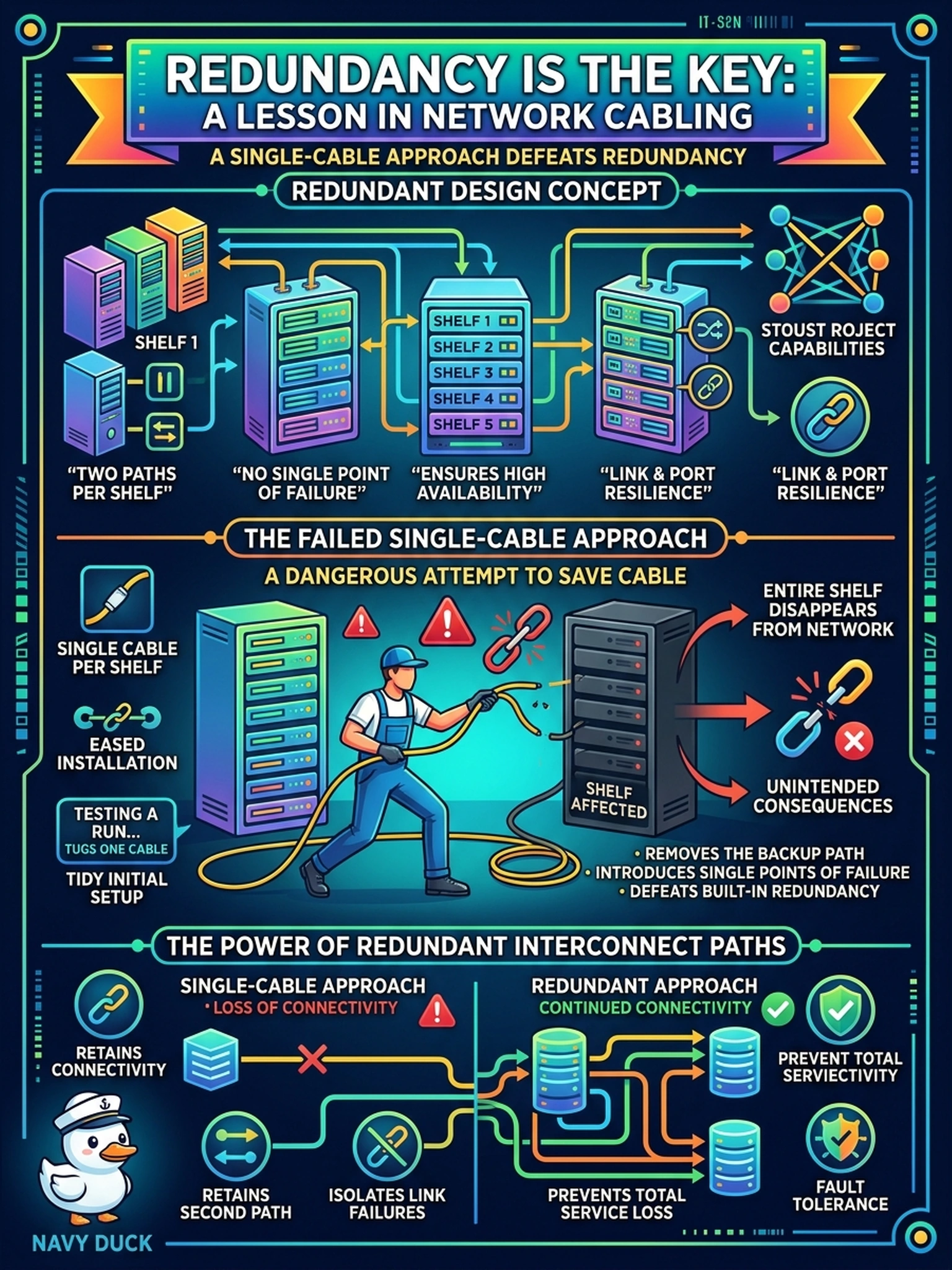
To save cable, an installer runs a single interconnect from each shelf to the head; the run looks tidy until testing tugs one cable and a shelf disappears. What did the single-cable approach defeat?
Select an answer to reveal the explanation.
Short Explanation
Single-cabling looks clean until somebody breathes on the wrong cable and a shelf goes dark. Redundant paths are the whole reason a chain survives a bad link — remove them and you've built a fragile system with pretty zip ties. Cable the second path; tidy and redundant can absolutely coexist.
Full Explanation
Expansion-shelf cabling is designed so that no single cable, port, or link failure takes a shelf offline: each shelf maintains more than one path to the head through the chain, and a single-cable run turns a redundant design into a single point of failure with nicer aesthetics. The test-floor result — a tugged cable, a vanished shelf — is the design lesson demonstrating itself: with one path, its failure is total and the shelves behind it can drop with it. The remedy is cabling the documented redundant topology in full, every shelf with its complete set of links on the specified ports, not merely handling cables more gently afterward. The thermal-current argument fails by concept: interconnects carry data, not heating load, and shelf temperature is independent of cable count. The enumeration argument fails by concept: a shelf enumerates fine on one link — which is exactly why single-cabling survives the install and fails later under fault conditions. The dressing argument fails by concept: dressing organizes cables; it does not define availability, and redundancy is a topology requirement. Exam caveat: when 'tidy' or 'saved cable' accompanies an availability symptom, suspect a sacrificed redundant path. Operational check: trace each shelf's links against the cable map, confirm both paths are present and latched, then re-run the tug test with confidence.